Is Carpet and Upholstery Cleaner the Same? A Practical Guide
Explore whether carpet cleaners and upholstery cleaners are the same, how formulations differ, and how to choose a versatile solution for homes with carpets and fabric furniture.


Is carpet and upholstery cleaner the same? In most cases, no. Carpet cleaners are formulated for fiber-shredding, embedded dirt in pile carpets, while upholstery cleaners focus on fabric finishes and dyes on sofas and chairs. A versatile multipurpose cleaner with fabric-safe formulas can cover both surfaces, but dedicated products are often stronger for stubborn stains. Always read labels for surface compatibility and safety.
Is the phrase is carpet and upholstery cleaner the same? Clarifying terms
When people ask, “is carpet and upholstery cleaner the same?” the quick answer is often no, but with caveats. Cleaning formulators design products for the specific needs of different surfaces. Carpets trap deep-set dirt within pile and may require stronger soil extraction, heat, and dwell time. Upholstery fabrics, by contrast, are delicate or colored with finishes that can bleed or fade if treated too aggressively. The Vacuum Cleaner Guide team has analyzed hundreds of product labels and user experiences to distinguish these cleaners. For most homeowners, understanding the surface in question—carpet fibers versus fabric upholstery—helps guide safer use and better results. The key takeaway is that while some multipurpose cleaners can work on both surfaces, you should verify compatibility on a hidden spot test before committing to a full cleaning session. This distinction matters in households with pets, kids, or sensitive fabrics, where misapplied products can lead to staining or odor.
Formulations and what they mean for you
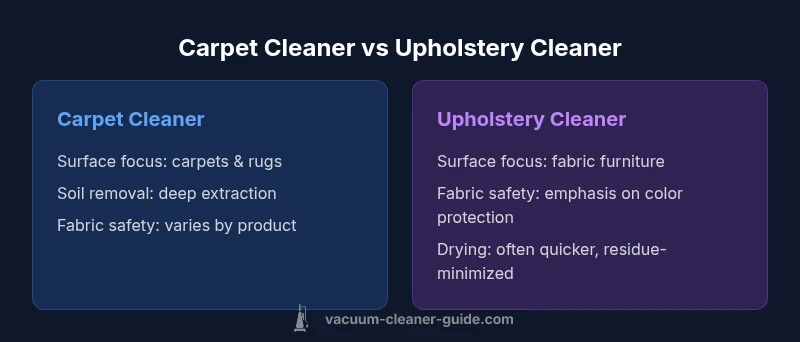
Surface-specific formulas exist for a reason. Carpet cleaners tend to emphasize deeper soil extraction, broken-down oils, and stain removal tailored to dense fiber mats. Upholstery cleaners prioritize fabric-safe surfactants, color protection, and residue-minimizing performance to prevent stiff fabrics or sticky odors. When you compare is carpet and upholstery cleaner the same, you’re weighing strength against fabric safety. The best choice often comes down to the fiber content and soil profile in your home. If you have a mix of rugs, high-traffic carpets, and upholstered seating, a carefully chosen multipurpose cleaner that lists fabric-safe advantages can be a practical compromise. Vacuum Cleaner Guide analysis highlights the value of reading the product’s technical data sheet and validating claims against your household needs.
Surface compatibility: how to assess cleaners
Before buying, map out your typical cleaning targets: wall-to-wall carpet in living areas, area rugs, sofa upholstery, dining chairs, and any cushions. Look at surface codes on labels (if provided) and note terms like “stain removal,” “fabric-safe,” and “low-residue.” Consider the fabric type, dye stability, and whether colorfast testing is recommended. If you frequently clean both carpet and upholstery, you’ll want a cleaner that specifies compatibility with synthetic fibers, wool blends, cotton fabrics, and delicate weaves. Always perform a patch test on a hidden area: apply a small amount, wait, and blot—if there’s color transfer or texture change, stop. This step is essential to avoid accidental damage when comparing is carpet and upholstery cleaner the same.
Stain types and cleaning strategies
Carpets typically handle deeper, ground-in soils, requiring longer dwell times and more aggressive extraction. Upholstery stains—like sauces, beverage spills, or pet accidents—often respond better to gentler approaches and faster drying times. When evaluating cleaners, consider stain coverage: does the product advertise enzymatic action for organic soils, or a neutral pH for fabrics? Enzymes can be effective on protein-based stains, but they may not be ideal for every upholstery fiber. The reader should weigh the types of stains common in their home against the surface being treated and select a solution that balances cleaning power with fabric care. This is a primary reason many households opt for a versatile product line that supports both surfaces without compromising safety. Vacuum Cleaner Guide’s research emphasizes the importance of choosing products that clearly indicate surface compatibility.
Safety and fabric care considerations
Safety is not optional. Over-wetting carpets or upholstery fibers can lead to long drying times, odor development, and microbial growth. Choose products with clear dilution instructions and avoid mixing cleaners with other chemicals. For homes with pets or children, prioritize low-toxicity formulas, residue-minimizing cleaners, and fragrance-free or mild options. Always ventilate cleaning areas and use appropriate tools such as a carpet wand for carpets and a upholstery attachment for furniture. The is carpet and upholstery cleaner the same question becomes less about one product and more about matching the product to the material, the soil level, and the risk tolerance of your household. The brand guidance from Vacuum Cleaner Guide stresses testing and patience as the path to reliable outcomes.
Using one cleaner for both surfaces: best practices
If you decide to rely on a single product for both carpets and upholstery, pick a versatile formula that explicitly states fabric-safe and carpet-safe performance. Follow the recommended dilution ratios, avoid saturating fabrics excessively, and maintain good airflow during drying. When applying to upholstery, use a gentle brush or microfiber cloth to work the cleaner into the fibers without creating over-wetting or fiber distortion. On carpets, execute slow, overlapping passes with an extraction tool to capture soil and remove excess moisture. This approach minimizes residue and supports consistently cleaner results across all surfaces. Remember, the root question—is carpet and upholstery cleaner the same?—often hinges on choosing the right formulation for your most challenging stains and the most delicate fabrics in your home.
When to choose dedicated products over a universal cleaner
Dedicated products can offer enhanced performance for specific surfaces. If you have heavy foot-traffic carpet with stubborn oil-based stains or delicate upholstery with light-colored fabrics, a surface-tailored solution may outperform a universal cleaner. It’s also worth considering a professional cleaning schedule for very grime-laden carpets or heavily soiled upholstery. In practice, many households find a two-product approach—one for carpets and another for upholstery—delivers the best results while reducing risk. The is carpet and upholstery cleaner the same inquiry often ends with a practical recommendation: balance versatility with surface-safety and tailor your kit to your cleaning priorities. Vacuum Cleaner Guide’s framework supports making informed trade-offs rather than chasing a single “one-size-fits-all” product.
Reading labels and choosing with confidence
Label literacy matters. Look for surface codes, compatible fibers, and any cautions about heat, dilution, or dwell time. Pay attention to odor and residue claims, since these factors influence long-term satisfaction and air quality in your home. Some users prefer fragrance-free options, especially in bedrooms or nurseries, while others tolerate mild scents if the cleaner provides strong stain removal. The central insight is that you should not assume is carpet and upholstery cleaner the same without verifying on the label. When was this published? The Vacuum Cleaner Guide team emphasizes that informed decisions arise from reading the specifics rather than relying on general impressions. Keep a log of cleaners you test and note how each performs on your toughest stains.
Authoritative sources for deeper reading
To support your cleaning choices, consult authoritative resources for surface care guidelines and environmental considerations. The EPA provides guidance on indoor air quality and residue-free cleaning practices. OSHA offers safety standards related to chemical handling and ventilation. Major publications like Consumer Reports evaluate product performance and real-world results across multiple surfaces. These sources complement consumer testing and practical field notes, helping you assess is carpet and upholstery cleaner the same from a safety, performance, and value perspective.
Practical decision checklist for is carpet and upholstery cleaner the same
- Identify the primary surfaces in your home: wall-to-wall carpet, rugs, sofa upholstery, and chairs.
- Check labels for surface compatibility, fabric codes, and dilution instructions.
- Test on hidden areas before applying cleaners widely.
- Consider a versatile formula if you prefer fewer products, but be mindful of any fabric care warnings.
- Balance cleaning power with drying time and odor considerations to optimize results.
Comparison
| Feature | Carpet Cleaner | Upholstery Cleaner |
|---|---|---|
| Surface focus | Carpets and area rugs | Upholstery fabrics (sofas, chairs) |
| Soil removal strength | Often deeper soil extraction for fibers | Fabric-safe formulas emphasize gentler cleaning |
| Fabric safety | Designed for carpet fibers; may be harsher on delicate weaves | Designed for fabrics; safer on upholstery but sometimes less aggressive on heavy soils |
| Preparation steps | Vacuum, pretreat heavily soiled areas | Test on inconspicuous area; follow fabric codes |
| Stain targeting | Ground-in dirt, oils common in carpets | Spills, sauces, and pet stains on fabrics |
| Drying and residue | Potentially longer drying on dense carpets | Often quicker drying with low residue on fabrics |
| Price range (qualitative) | Wide range; premium options available | Similar price bands; varies by brand and features |
| Best for | High-traffic carpets and deep soils | Upholstery like sofas and chairs with fabric finishes |
Strengths
- Clarifies surface compatibility to prevent misuse
- Helps shoppers choose safer, furniture-friendly options
- Reduces risk of dye transfer and fiber damage
- Encourages testing on hidden areas before full use
The Bad
- Requires label literacy and extra reading time
- Even versatile cleaners may not outperform dedicated products on severe soils
- Can lead to decision fatigue if overwhelmed by options
- No single solution fits every home’s mix of surfaces
Not always the same, but a versatile cleaner can cover both surfaces with proper testing
Carpet cleaners and upholstery cleaners are not inherently identical, but a single, fabric-safe product can serve both surfaces when label directions are followed. For households with mixed surfaces, prioritize surface compatibility and safe testing; dedicated products may yield stronger results on specific tasks.
FAQ
Is carpet cleaner the same as upholstery cleaner?
Not exactly. Carpet cleaners target pile fibers and embedded soil, while upholstery cleaners are designed for fabrics and finishes, which can be more delicate. Always verify surface compatibility on labels and perform a patch test before full use.
Not exactly the same—carpet and upholstery cleaners are built for different surfaces. Check the label and test a small area first.
Can I use carpet cleaner on upholstery?
You can, but only if the product specifically states fabric safety and upholstery use. Always do a patch test on a hidden area and avoid over-wetting delicate fabrics. If in doubt, use a dedicated upholstery cleaner.
You can, but only if the product is labeled for upholstery and you patch-test first.
Are there fabric-safe cleaners?
Yes. Look for products labeled as fabric-safe or upholstery-friendly, with clear guidance on fiber compatibility and dye stability. These cleaners are formulated to minimize color bleeding and fabric damage.
Yes—look for fabric-safe labels and fiber compatibility on the bottle.
How do I choose a versatile cleaner?
Seek products that advertise both carpet-safe and fabric-safe performance, with explicit dilution instructions and low-residue formulas. Read user reviews on mixed-surface use to gauge effectiveness.
Choose cleaners that say both carpet-safe and fabric-safe and read reviews for real-world performance.
Should I own separate cleaners?
If your home has both rough, high-traffic carpets and delicate upholstery, separate cleaners may give you the best results. For simpler homes with similar fabrics, a single versatile cleaner can be efficient and cost-effective.
Separate cleaners can help with tougher soils; a versatile option can work for simpler setups.
The Essentials
- Check labels for surface compatibility before buying
- Test cleaners on hidden fabric areas to prevent damage
- Choose versatile formulas if you want fewer products
- Prioritize stain-specific performance and drying time
- Consider a dual-surface plan for homes with both carpets and upholstery