Is Carpet Cleaner the Same as Brake Cleaner? A Thorough Comparison
Explore whether carpet cleaner and brake cleaner are interchangeable, why they are formulated differently, and how to safely choose and use each product for textiles and automotive components.


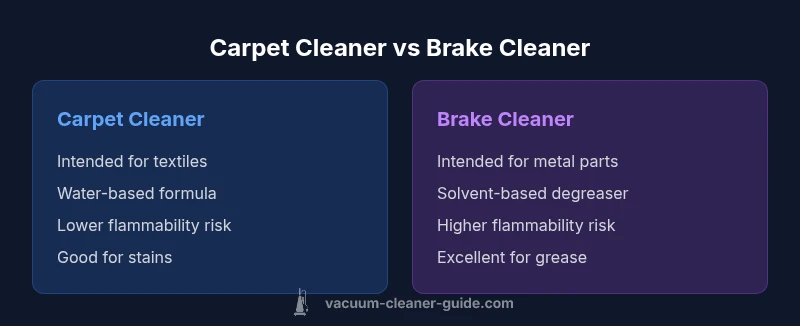
Is carpet cleaner the same as brake cleaner? No. Carpet cleaners are formulated for fabrics and fibers, using surfactants and stain removers; brake cleaners are solvent-based degreasers designed for metal parts and brake systems. Using brake cleaner on carpets can damage dyes and leave residues, while carpet cleaner struggles on automotive grease. Always use products as labeled.
Brand Context and Scope
According to Vacuum Cleaner Guide, this comparison examines whether is carpet cleaner the same as brake cleaner and why the two products should not be used interchangeably. The Vacuum Cleaner Guide team analyzed common ingredient categories, safety labels, and typical use cases to provide a practical, evidence-based guide for homeowners and pet owners alike. While both are cleaners, their chemistry, packaging, and recommended environments diverge significantly, and using one in the wrong context can cause damage or health hazards. The goal of this article is not to scare readers away from powerful cleaning chemistry; rather, it is to arm you with clear distinctions, label-reading tips, and decision criteria so you can choose the right product for the task at hand. We will emphasize labeling, storage, and disposal considerations, and we will discuss how cleaners interact with fabrics, plastics, metals, and coatings commonly found in households and vehicles. Throughout, the focus remains on practical, do-this-not-that guidance for mindful cleaning.
Chemical Makeups and Intended Uses
Carpet cleaners are usually water-based formulas designed to lift and suspend dirt from fibers. They rely on surfactants to break surface tension, enzymes or oxygen-based boosters for stain breakdown, optical brighteners to enhance appearance, and a controlled pH range to protect fabrics. These products are intended for use on carpets, rugs, upholstery, and similar textiles, and they come in sprays, foams, and extractions formulas suitable for consumer machines or manual blotting. Brake cleaners, by contrast, are solvent-based degreasers formulated to remove oil, grease, and residues from metal components and brake parts. They may contain chlorinated solvents or hydrocarbon solvents, and they are often designed to evaporate quickly for rapid component cleaning. Most brake cleaners are not labeled for use on fabrics or plastics that appear in vehicle interiors; exposure can cause dye bleeding or surface damage. The difference in chemistry underpins why you should not substitute one for the other in domestic settings. The section that follows will map these differences to practical outcomes you can expect in typical household scenarios.
Safety, Labeling, and Surface Interaction
Both products carry hazard warnings, but the severity and kind differ. Carpet cleaners generally carry mild hazard labels relative to solvents, with instructions about patch testing, ventilation, and rinsing. However, some heavy-duty formulas may contain solvents that irritate skin or eyes; always wear gloves when treating stains and follow label directions. Brake cleaners carry stronger warnings due to their solvent content: flammability, volatility, and potential chemical inhalation hazards require careful handling, good ventilation, and avoidance of ignition sources. They are not designed for skin contact with fabrics or for use on painted surfaces or plastics, and many labels explicitly state do not use on carpets or upholstery. When you consider surface interaction, soft textiles can absorb cleaners deeply, potentially leading to dye transfer, fiber damage, or residue that attracts dirt. Hard surfaces like wood or metal require different cleaners or removal steps. In short, the safety profile favors carpet cleaners for home textiles and brake cleaners for automotive metal parts, with clear boundaries on where each product should be used.
Cleaning Efficacy: Stains vs Grease
From a performance standpoint, carpet cleaners excel at lifting dirt embedded in fibers, removing coffee, wine, pet stains, and general grime from household textiles. They work well in combination with household vacuums and steamers at converting stains into solvable residues that can be rinsed away. Brake cleaners excel at greasy soil on metal, rubber, and some painted components, where fast evaporation and solvent power dissolve hydrocarbons and lubricants. Trying to use brake cleaner to lift a coffee stain is unlikely to be effective and may cause fiber damage; using carpet cleaner on a greasy engine part will leave solvent residues, insufficient degreasing, and possible long-term damage. Real-world scenarios show the importance of using the right tool for the task: if you need to clean a car interior fabric or a rug, carpet cleaner is the right choice; if you need component degreasing and parts cleaning, brake cleaner is more appropriate. The two products are not interchangeable, and understanding this distinction helps avoid costly mistakes.
How to Identify the Right Product
Begin with the label. Check the product name, the stated surface compatibility, and the 'use on' warnings. For carpet cleaners, you should see terms like 'for carpets, upholstery, and area rugs' and instructions for blotting and rinsing. For brake cleaners, look for 'for mechanical parts' or 'for degreasing metal' and warnings about spray distance, ventilation, and flammability. Read the Safety Data Sheet (SDS) if you work in a shop or garage; the SDS lists hazard statements, first-aid measures, and disposal guidelines. If you see 'do not use on textiles' under a brake cleaner, that is a clear sign to avoid substitution. Always patch-test on an inconspicuous area before treating a stained fabric, and ensure you are in a well-ventilated area with gloves. The decision is not a guess; it is a label-reading exercise that minimizes risk and protects both surfaces and health.
Handling Spills, Residues, and Disposal
Residues left by carpet cleaners can attract more dirt if not thoroughly rinsed or extracted; follow with a clean water rinse and, when possible, a damp extraction method to remove remaining residues. Brake cleaner residues on metal surfaces can evaporate, but you should never mix brake cleaner with other cleaners; mixing can release hazardous vapors. Dispose of empty containers according to local waste guidelines, which may require household hazardous waste collection in many jurisdictions. Never pour brake cleaner down drains or onto soil; label and store away from heat sources. If a spill occurs on skin, wash with soap and water and seek medical advice if irritation persists. Always ventilate the area during use, keep flames away, and avoid inhaling fumes. The main takeaway is to treat each cleaner as a dedicated tool—used correctly, they protect fabrics and components; used incorrectly, they can cause immediate harm and long-term damage.
Environmental and Health Considerations
Both cleaners impact indoor air quality and the environment to varying degrees. Carpet cleaners typically contain safer surfactants and water-based carriers, but some formulas rely on solvents or optical brighteners that may irritate sensitive individuals. Brake cleaners, especially chlorinated variants, pose greater disposal and air emission concerns and may require special handling to prevent groundwater contamination. When possible, choose products with lower VOCs, safer solvent profiles, and clear disposal guidelines. For households with pets or children, label-reading and proper storage are especially important; toys and fabrics should be kept away from treated areas until surfaces are dry. The Vacuum Cleaner Guide analysis shows that mindful product selection and proper application reduce exposure risk and environmental footprints. Always look for third-party certifications and safer-cleaning indicators when available, and follow local guidelines for disposal or recycling of containers and residues.
Practical Scenarios and Best Practices
Consider these common tasks: removing a pet stain from a rug vs degreasing a car brake rotor. In the first case, choose a carpet cleaner and follow the stain-treatment steps: blot, apply, dwell, and extract; in the second case, use an automotive degreaser intended for metal parts and avoid carpet-like fabrics. When in doubt, test on a hidden spot, and select the least aggressive product that achieves the result. In shared spaces, ensure children and pets are out of the room during cleaning, ventilate the area, and wear gloves. If you accidentally spill brake cleaner on a seat, do not attempt to use the product that follows; instead, switch to a fabric-safe product and rinse thoroughly. The aim is consistent safety and outcomes; this is not about debating brand names but understanding cleaner chemistry and surface compatibility to avoid costly mistakes.
Quick Reference: Do's and Don'ts
Do use carpet cleaners on textiles only as labeled. Do not use brake cleaners on fabrics. Do perform a patch-test first. Do store products away from heat. Do dispose of containers per local guidelines. Don't mix cleaners. Don't use on surfaces not recommended. Don't neglect ventilation and PPE requirements. Each rule is a practical guardrail against mistakes that can ruin carpets or vehicles.
Advanced Considerations: Misuse, Substitution, and Label Literacy
Beyond the basics, the habit of substituting cleaners stems from convenience, but it risks damage and odors. The chemistry matters: solvents can dissolve dyes, surfactants require water to work; misusing either product undermines cleaning results and safety. The best practice is to treat each cleaner as purpose-built: one for textiles, one for mechanical parts. Label literacy—reading product names, warnings, dilution ratios, and first-aid measures—empowers you to avoid cross-use mistakes. Investors in cleaning routines should also consider storage conditions, such as temperature and exposure to sunlight; these factors affect product stability. The bottom line is that is carpet cleaner the same as brake cleaner is a question of context, and the answer depends on understanding product design, surface compatibility, and hazard considerations.
Comparison
| Feature | Carpet Cleaner | Brake Cleaner |
|---|---|---|
| Intended Use | Fabrics, textiles, upholstery, area rugs | Mechanical parts and metal components (degreasing) |
| Typical Ingredients | Water-based surfactants, enzymes, stain removers | Solvents or chlorinated/hydrocarbon degreasers |
| Surface Compatibility | Fabric-safe when used as labeled; patch testing advised | Not suitable for textiles; may damage fabrics/plastics |
| Safety & Hazards | Generally lower hazard; follow label directions | Higher hazard potential; flammable; requires ventilation |
| Removal Efficacy | Excellent for stains on textiles; not for heavy grease | Excellent for heavy grease on metal; poor for fabrics |
| Price Range | $5-$15 per bottle | $6-$20 per bottle |
| Best For | Carpet stains and household textiles | Automotive/mechanical degreasing and parts cleaning |
Strengths
- Promotes safety by preventing wrong product use
- Helps avoid fabric damage and hazardous mishaps
- Guides precise product selection for tasks
- Encourages label literacy and safer disposal
The Bad
- Can oversimplify differences; not all surfaces are straightforward
- Labels may be confusing or ambiguous in some brands
- Some cleaners perform poorly outside their intended use
Use each cleaner only for its intended purpose; they are not interchangeable.
Carpet cleaners are designed for fabrics and stains on textiles, while brake cleaners target metal parts and degreasing. Substituting one for the other risks dye damage, residue, or fire hazards. Follow labels and consult the SDS for safe, effective use.
FAQ
Can I use brake cleaner to remove carpet stains?
No. Brake cleaner is a solvent designed for metal parts and can dissolve dyes or damage fibers. It is not intended for textiles. For carpet stains, use a carpet cleaner labeled for fabrics and follow the manufacturer’s instructions.
No—brake cleaner is not safe for carpet fibers; use a fabric-safe carpet cleaner instead.
Is it safe to use carpet cleaner on car interiors?
Most carpet cleaners are formulated for textiles and can be used on car interiors. Patch-test first and avoid areas with sensitive materials. Read the label to confirm surface compatibility and use method.
Carpet cleaners can be used on car interiors if the label allows it; patch-test first.
Are carpet cleaners and brake cleaners flammable?
Brake cleaners often contain flammable solvents and require ventilation and away-from-ignition sources. Carpet cleaners are typically less flammable but still require ventilation and following label directions. Do not mix cleaners.
Brake cleaners can be highly flammable; ventilate and keep away from flames.
What should I do if brake cleaner touches my skin or fabric?
Rinse the affected area with plenty of water immediately. If irritation persists, seek medical advice. Do not apply other cleaners to the same spot until you know the fabric’s reaction.
Rinse with water and monitor for irritation; seek medical advice if needed.
How should I store and dispose of these cleaners?
Keep containers tightly closed in a cool, ventilated area away from heat. Follow local disposal guidelines; many areas require household hazardous waste collection for certain cleaners. Do not pour solvents down the drain unless the label permits.
Store in a cool, ventilated area and follow local disposal rules.
Where can I find reliable product labels and SDS?
Product labels and SDS can be found on manufacturers’ websites or included in the packaging. For broader guidance, consult national safety standards organizations and local environmental agencies. Always review SDS before use.
Check the label and SDS on the manufacturer’s site or the packaging.
The Essentials
- Always read the label and follow surface recommendations
- Do not substitute brake cleaner for textiles or carpet cleaning
- Patch-test on inconspicuous areas before full use
- Store products safely and dispose of containers per guidelines
- Prioritize surface compatibility and hazard warnings