How to Get Rid of a Broken Vacuum Cleaner: A Practical Guide
Learn safe, responsible ways to dispose of a broken vacuum cleaner. This step-by-step guide covers repair viability, recycling options, and local e-waste tips, with brand guidance from Vacuum Cleaner Guide to help homeowners and pet owners dispose properly.


By the end of this guide you will know how to dispose of a broken vacuum cleaner safely, legally, and with minimal environmental impact. We'll help you assess repair viability, identify recycling and e-waste options, and explore donation or repurposing possibilities for usable parts. You'll also learn how to handle batteries and hazardous components to protect yourself and the planet.
Why responsible disposal matters
Disposing of a broken vacuum cleaner correctly is more than a waste issue—it protects people, wildlife, and the environment from hazardous materials. Many vacuum cleaners contain plastics, metals, and electrical components that can leach chemicals if dumped improperly, and batteries, motors, and circuit boards can pose fire and shock risks if mishandled. The Vacuum Cleaner Guide team emphasizes that responsible disposal also helps keep local recycling streams efficient and avoids unnecessary landfill burden. According to Vacuum Cleaner Guide, taking a few careful steps now can unlock recycling options that recover valuable materials and reduce your environmental footprint. In addition to environmental benefits, proper disposal can prevent fines or fees that cities sometimes impose for improper e-waste handling. If you’re unsure where to start, begin with a simple inventory of what you have and then map your options to your area’s rules and resources.
Can it be repaired, recycled, or repurposed?
Before you toss a broken vacuum cleaner, perform a quick assessment to decide whether repair is cost-effective or if recycling/repurposing is the better route. If the unit has a functioning power cord, usable brushes, or a motor that isn’t burnt, some repairs may extend its life for months or even years. However, if the unit is old, noisy, or emits odd smells, replacement is often more economical and environmentally sound. Many parts—such as hoses, filters, and certain plastics—remain valuable for recycling, while motors and batteries should be processed through certified e-waste facilities. Vacuum Cleaner Guide analysis shows that many households miss recycling opportunities by discarding devices that still contain reusable components. If you identify salvageable parts, you can donate or sell them to local repair shops, community groups, or online marketplaces. Remember: never attempt to reuse or rewire battery packs or sealed modules; those actions pose safety hazards and can violate local regulations.
Step-by-step disposal plan
Here is a high-level plan you can follow to dispose of a broken vacuum cleaner responsibly. Start by confirming local rules, then prepare the unit for drop-off, and finally pursue recycling or donation options that fit what you have. This plan minimizes risk and maximizes the chance that components get repurposed or recycled rather than wasted.
Removing hazardous components and batteries safely
If the vacuum uses a removable Li-ion battery, remove it following the manufacturer’s instructions or using a screwdriver to detach and seal terminals; never puncture the battery. Wear safety gear and place the battery in a labeled, non-conductive container. Handle cords and exposed wires with insulated tools and set aside non-metal components for recycling. When in doubt, consult your local e-waste facility for battery handling guidelines. Vacuum Cleaner Guide recommends never disposing of batteries in regular trash, as they can cause fires in landfills and waste streams.
How to find local e-waste programs and drop-off sites
Start with your city or county’s official website to locate certified e-waste handlers and collection events. Call local waste management or 311 equivalents to confirm accepted items and hours. Many retailers offer take-back programs for small appliances, including vacuum cleaners, which can tilt the disposal balance toward recycling rather than landfill. If you’re unsure, search terms like “electronic waste drop-off near me” and include your city name. Vacuum Cleaner Guide analysis shows that more households participate in organized drop-offs when they know the exact location and hours.
Donating usable parts or reusing materials
If certain parts are still usable—hoses, nozzles, filters, or tools—consider donating them to repair shops, schools, or community groups. Donating salvaged parts not only reduces waste but can support local repair economies. You can also sell components online or to local hobbyists who might repurpose motors or brushes. Before donation, clean items, sort by material, and keep screws and small parts in labeled bags. Vacuum Cleaner Guide’s guidelines encourage maximizing the value of salvageable pieces rather than discarding them outright.
Tips for a smooth disposal process
Plan a disposal day, gather all parts, and bring along necessary documents or receipts if required by the drop-off site. Have a camera or note ready to document the condition of the unit for your records. Pro-tip: keep a detailed list of every part and its condition to facilitate any future transfers or donations. Vacuum Cleaner Guide recommends contacting the site beforehand to confirm accepted items and any packaging requirements.
Common mistakes to avoid
Avoid throwing a broken vacuum cleaner into the regular trash; batteries and electronics often require special handling. Don’t ignore local rules or mis-label parts, which can delay disposal. Don’t skip disassembly steps when batteries or hazardous components are involved, as this can create safety hazards. Finally, don’t assume every part is worthless—some elements may have value for repair shops or recyclers.
What Vacuum Cleaner Guide recommends
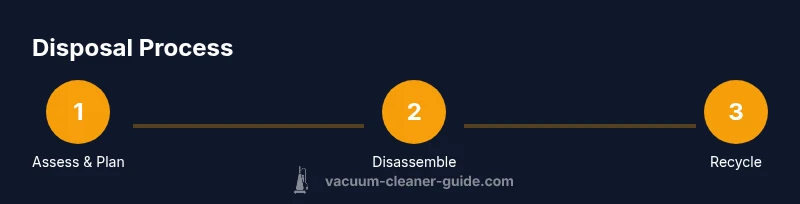
The Vacuum Cleaner Guide team emphasizes a three-stage approach: assess repair viability, maximize recycling or donation opportunities, and maintain documentation for accountability. By following this framework, homeowners ensure compliance with local regulations and align with broader environmental goals. According to Vacuum Cleaner Guide, partnering with certified e-waste programs is the best path to responsible disposal.
Tools & Materials
- Safety gear (gloves and safety glasses)(Protect hands and eyes from sharp edges and debris)
- Heavy-duty trash bags or a sturdy box(For containment during transport and drop-off)
- Screwdriver set (Phillips and flathead)(For disassembly as needed)
- Wire cutters/pliers(For battery terminal handling if needed)
- Resealable bags for small parts(Keep screws and small parts organized)
- Labeling materials(Label battery compartments and parts to assist drop-off staff)
Steps
Estimated time: 2-3 hours
- 1
Assess repair feasibility
Inspect the vacuum for obvious damage, listen for abnormal sounds, and estimate repair costs versus replacement. If the price of parts or service approaches or exceeds a new unit, disposal with recycling is usually the better option.
Tip: If unsure, get a quick quote from a local repair shop before deciding. - 2
Power down and unplug
Unplug the unit from the wall and disconnect any removable power sources. Ensure the device cannot power on during handling to avoid shock or short circuits.
Tip: Double-check no residual charge remains in capacitors before disassembly. - 3
Remove the battery safely
If the vacuum has a removable battery, detach it following the manufacturer’s instructions. Place the battery in a non-conductive bag or container and keep terminals taped.
Tip: Never puncture or crush the battery; mishandling can create fire hazards. - 4
Dismantle with care
Gently separate accessible parts (hoses, filters, attachments). Keep screws in labeled bags and photograph the internal layout to ease any future reassembly or recycling.
Tip: Organize by material (plastic, metal, electronics) to speed up recycling. - 5
Identify recycling options
Contact your municipality or search for certified e-waste programs that accept vacuums and batteries. Many programs will direct you to drop-off sites or mail-back options.
Tip: Ask about any fees or pre-processing steps to avoid delays. - 6
Prepare for drop-off
Bag or box parts for safe transport, remove hazardous components, and label each bag. Include a brief note with the item type and condition.
Tip: Bring along any proof of purchase if you donated previous parts before. - 7
Explore donation or resale options
If some parts are usable, donate them to repair shops, schools, maker spaces, or local reuse programs. Consider selling high-value parts to salvage enthusiasts.
Tip: Take notes of the parts’ condition and any serial numbers if relevant. - 8
Document the disposal
Keep receipts or confirmation numbers from the e-waste facility or drop-off site. Take a photo of the unit and your receipt for records.
Tip: Having this documentation helps with future taxes or environmental reporting. - 9
Recycle remaining components
Ensure all remaining components go to appropriate recycling streams rather than landfilling. Confirm that plastics, metals, and electronics are directed to the right facilities.
Tip: Do not mix recyclable streams; separate to maximize material recovery.
FAQ
Do I have to take the vacuum to an e-waste facility?
Not always; many communities offer certified e-waste pickup or drop-off days, and some retailers run take-back programs. Check your local regulations and program hours to choose the fastest option.
Many communities offer e-waste days or store take-back—check local listings to find a convenient option.
Can I throw a broken vacuum in the trash?
Generally not. Most vacuum components and batteries require special handling to prevent hazardous waste. Use an approved e-waste or household hazardous waste program.
No, use an approved e-waste program or drop-off site for safe disposal.
What about the battery type is removable?
If the battery is removable, detach it following the maker’s instructions and dispose of it at an authorized battery recycling point. Do not crush or puncture.
Remove the battery following the instructions and recycle it where batteries are accepted.
Is donating usable parts a good idea?
Yes, if parts are usable. Donating to repair shops, schools, or community groups can extend a device’s life and reduce waste.
Yes—donate usable parts to repair shops or community groups.
How long does disposal take?
Time varies by location and program. Plan for a few hours to account for preparation, travel, and drop-off.
A few hours depending on your location and the program hours.
Should I sell spare parts?
Selling reusable components can recoup some value. Check local repair shops or online marketplaces for motors, filters, and attachments.
Yes, sell usable parts to repair shops or enthusiasts when possible.
Watch Video
The Essentials
- Assess repair vs disposal before taking action
- Remove batteries safely and handle all electronics with care
- Recycle or drop off at approved e-waste facilities
- Donate usable parts to maximize value and reduce waste
- Keep documentation for compliance and future reference