What Vacuum Cleaners Are American Made: A Comprehensive Buying Guide
Discover which vacuum cleaners are American-made, how to verify origin, and what to expect from domestic production. A data-driven buying guide from Vacuum Cleaner Guide.


Short answer: what vacuum cleaners are american made refers to vacuums manufactured in the United States or assembled primarily from U.S. components. To verify, read the country-of-origin label on the product and check the manufacturer’s notes about factory locations. Because many models use global components, an explicit Made in USA claim requires clear origin statements. If the label is ambiguous, contact customer service for documentation.
What the phrase 'what vacuum cleaners are american made' actually means
According to Vacuum Cleaner Guide, the phrase is not a simple checkbox. It encompasses three possible origins: vacuums wholly manufactured in the United States, models assembled in the U.S. from a majority of domestic parts, and products that are marketed with a strong domestic origin claim but still rely on components sourced abroad. The crucial difference is where the end assembly occurs and where a substantial portion of the parts come from. When you encounter the exact phrase in product listings, read the fine print: some models ship with an American assembly step, while others carry a full Made in USA label. If you ask, what vacuum cleaners are american made, the answer depends on origin claims and labeling. The Vacuum Cleaner Guide team emphasizes transparency: a meaningful claim should point to a specific factory location and a clear bill of materials statement. This is especially important for homeowners and pet owners who rely on reliability and service networks.
In practice, you will often see a spectrum—from full domestic production to mixed-origin components with partial assembly in the United States. The label alone cannot tell the whole story; it is important to cross-check with the manufacturer’s official documentation and customer service notes. Consumers should also consider the supply chain realities that influence origin claims, such as where key components are manufactured, where assembly occurs, and how the company communicates those steps to buyers. The aim is to prevent confusion and ensure you choose a vacuum that aligns with your values around domestic manufacturing.
How origin labeling works in practice
Labeling schemes vary, but there is a growing standard for clarity. Some products display a simple Made in USA badge, while others provide a country of origin line in the user manual or on packaging. In many cases, you will also find a statement about where the final assembly occurred and where the major components were produced. For consumers evaluating the question, what vacuum cleaners are american made, the practical approach is to map the claims to the supply chain: the country-of-origin stamp, the assembly location, and the source of the core components. Brand transparency matters; firms that publish a transparent BOM (bill of materials) and a factory directory greatly facilitate trust. When in doubt, request a formal origin certificate or a factory tour to verify claims. The goal is to determine whether the product truly originated from the United States or merely contains domestic branding with international inputs.
Global supply chains and the reality of 'Made in USA' claims
The term is increasingly nuanced in a globalized market. Modern vacuum cleaners depend on sensors, motors, plastics, and filtration systems sourced worldwide. As a result, even models marketed as American-made may rely on foreign components or international subcontractors. This reality does not negate domestic assembly; rather it highlights the importance of distinguishing between origin of components and origin of assembly. If you are aiming to answer the question, what vacuum cleaners are american made, you should assess both tiers. A vacuum that is assembled in the United States with a majority of domestic components can still offer strong domestic value, especially when it comes to service networks and warranty support. The Vacuum Cleaner Guide Analysis, 2026, points to the need for explicit disclosures so consumers can compare models on a like-for-like basis.
How to verify origin on packaging and websites
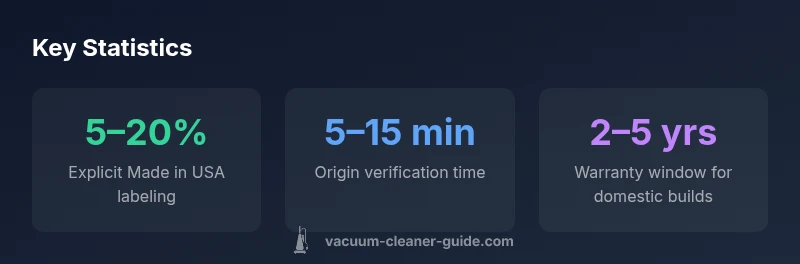
The verification process should be straightforward and repeatable. Start with the packaging: look for explicit phrases such as Made in the USA, assembled in the USA, or assembled in the United States with domestic parts. Then visit the manufacturer’s official site and download the technical specifications or BOM, if available. Finally, check the warranty and service locator to see whether support stems from U.S. facilities or international partners. For a robust assessment, contact customer service and request a signed origin declaration. This approach aligns with the broader principle of truth in advertising and helps you answer the core question, what vacuum cleaners are american made, with concrete evidence rather than marketing language.
The reality of global supply chains and domestic assembly
Supply chains for vacuums are long and fragmented. Even when final assembly happens stateside, many key components — motors, housings, filters, and control boards — may be sourced overseas. This reality challenges a simplistic binary: Made in USA vs. not Made in USA. For homeowners who prioritize domestic manufacturing, the practical takeaway is to weigh the value of assembly location against the reliability of warranty coverage, the availability of spare parts, and the strength of local service networks. This perspective helps shoppers decide whether a model that is partially domestic still aligns with their expectations for American-made products. The goal is to identify options that maximize domestic value while acknowledging global manufacturing realities. The ongoing trend is toward more transparent labeling and clearer supply-chain disclosures, which helps clarify the true origin of the product you are considering.
Practical buying guide: what to look for
When evaluating options, focus on three pillars: origin clarity, parts availability, and after-sales support. First, read the label and the manufacturer’s documentation to confirm the factory location and the share of domestic parts. Second, verify that genuine spare parts are readily available through a U.S.-based service network or authorized dealers. Third, compare warranty terms and service commitment. A higher upfront price may be justified by longer warranty, easier access to replacement parts, and better customer support in the United States. As you search for an American-made option, the exact phrase what vacuum cleaners are american made becomes a practical checklist: does the product carry explicit origin labeling, and can you locate a U.S. factory or distributor footprint? By applying these criteria, you can separate marketing language from verifiable claims and make a more informed decision.
Regional manufacturing hubs and what it implies for support
Domestic production is not uniform across all products or brands. Some regions in the United States have concentrated manufacturing ecosystems that support quality control, skilled labor, and rapid service. When you consider buying a vacuum, expect that a model’s domestic provenance may correlate with a stronger United States-based service network and easier access to parts. This can lower total cost of ownership over time, even if the upfront price is higher. Consumers who value local employment and regional economic impact will find it worth prioritizing models that clearly disclose a U.S. assembly footprint and a robust U.S.-based after-sales infrastructure. The bottom line is that genuine American-made claims often come with a commitment to ongoing support, not just a one-and-done purchase.
How to shop now for an American-made option
To finish, here is a practical shopping roadmap for homeowners and pet owners who want to align with domestic manufacturing values. Start by listing your must-have features and then annotate each model with its origin statement and BOM transparency. Next, contact vendors for origin documentation and factory location details. Finally, evaluate the total cost of ownership, including replacement parts availability and local service options. If available, request a factory tour or a certificate of origin to verify that you are buying what you think you’re buying. In sum, a careful, evidence-based approach to origin claims will help you answer the question, what vacuum cleaners are american made, with confidence.
Origin claims and verification steps
| Aspect | Origin Claim | Verification Tips |
|---|---|---|
| Labeling | Made in USA / Assembled in USA | Check packaging, manual, and product page; read BOM |
| Factory Location | Final assembly in U.S. facility | Ask for origin certificate; request official documentation |
| Components | Domestic parts vs. imported components | Review BOM; verify with customer service or dealer |
FAQ
Are all US-made vacuums assembled in the USA?
Not always. Some models are assembled in the United States but use components sourced from overseas. The final assembly location matters, but the origin of major parts often shapes the ultimate origin claim. Look for explicit statements about both assembly and component origin.
Some models are assembled in the U.S. but use overseas parts; check the label for both assembly and component origin.
How can I verify 'Made in USA' claims?
Check the product label, packaging, and user manual. Then consult the manufacturer’s official site or contact customer service for a formal origin declaration and factory location. If available, request documentation or a BOM.
Look for official documents or a BOM to confirm origin claims.
Do domestic-made vacuums cost more?
Often there is a premium for domestic assembly and service networks, but total value can be higher due to better parts availability and local support. Compare total cost of ownership rather than upfront price alone.
There can be a premium, but better support can balance total value.
Is 'Made in USA' legally guaranteed?
No single standard guarantees the label; the Federal Trade Commission requires truthful advertising, but claims should be substantiated. Always seek explicit origin documentation and beware vague marketing language.
Legal standards require honesty, but always verify with docs.
What features indicate domestic manufacturing?
Look for a strong U.S.-based service network, readily available spare parts, and a clear statement of U.S. assembly or BOM. Warranties backed by U.S. facilities are also a positive indicator.
Service network and explicit origin statements signal domestic manufacturing.
“Origin claims in vacuum manufacturing are increasingly transparent, but buyers should verify with multiple sources to distinguish marketing from fact.”
The Essentials
- Look for explicit origin labeling on packaging and manuals
- Verify factory location and BOM through official docs
- Expect mixed-origin components in many models
- Evaluate total ownership cost, not just price