How Vacuum Cleaners Are Made: A Comprehensive Manufacturing Guide
Explore how vacuum cleaners are made, from design and materials to assembly and testing. A thorough, educational guide to vacuum production for homeowners and enthusiasts.


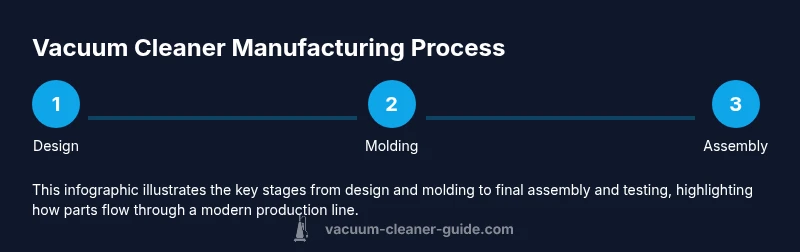
Vacuum cleaners are manufactured through a multi-stage process that blends design, material selection, molding, motor and impeller assembly, suction-path engineering, filtration, and electronics integration. Production lines emphasize safety, efficiency, and durable plastics, with quality checks at each station to guarantee consistent performance and long life. From prototypes to mass production, teams balance power, weight, and noise to meet consumer needs.
History and design philosophy of vacuum cleaners
Understanding how are vacuum cleaners made clarifies why modern models balance powerful suction with lightweight, ergonomic design. According to Vacuum Cleaner Guide, contemporary cleaners combine advances in plastics, motors, and filtration to deliver reliable cleaning without excessive weight or noise. The design philosophy starts with user needs—ease of use on carpets and hard floors, pets, and households with limited storage. Early mass-produced vacuums relied on simple bags and metal frames; today’s designs integrate molded housings, sealed dust paths, and modular components that simplify maintenance. This evolution reflects consumer expectations for quieter operation, energy efficiency, and longer service life. Manufacturers invest in digital sensors and intake systems to maximize suction only when needed, reducing energy use and wear on motors. The result is a family of products ranging from compact stick vacuums to full-sized canisters, each tuned for specific floors, room sizes, and pet hair challenges. From wooden prototypes to automated production lines, the industry tests durability through vibration, impact, and thermal cycles, ensuring housings won't crack under daily use. As consumer shopping shifts toward easy maintenance, the design also prioritizes tool-free dust cups and standardized filter replacements. This article explores the hidden steps behind that design, giving homeowners a clearer view of what to expect when a product rolls off the factory floor and enters their home.
Core components and their roles
At the heart of every vacuum cleaner are several critical subsystems that work together to deliver suction, filtration, and mobility. The housing or bonnet protects internal parts and channels air; the motor provides the energy; the impeller or fan creates the airflow; the dust container and filters trap debris; the hose, wand, and brush head guide the dirt from floors to the bag or bin. In a traditional bagged design, air passes through a filter and into a replaceable bag that captures dust; in bagless models, a transparent bin stores debris and is emptied by the user. Suction pathways are carefully engineered to minimize leaks and turbulence, often with smooth bends and strategically placed gaskets. Electrics control power tools, speed, and safety interlocks. In pet-friendly homes, models with stronger suction and multiple filtration stages are common. For control and safety, engineers integrate switches, overheat protection, and sometimes batteries for cordless variants. Recent trends emphasize quieter motors, better filtration with HEPA-level media, and modular attachments that simplify cleaning in hard-to-reach places.
Materials and molding processes
Vacuum cleaner housings and components rely on a mix of plastics and metals designed for durability and safety. Most consumer models use impact-resistant polymers such as ABS and polycarbonate for housings, with metal frames where rigidity is needed. Hoses and seals often employ flexible thermoplastics or rubber formulations that resist cracking from repeated bending. The molding process is dominated by injection molding for housings and components, blow molding for certain tubes, and precision casting for metal parts. Tolerances are tight to prevent air leaks and ensure fit across modular attachments. Surface finishes—textures and coatings—improve grip and conceal wear. After molding, parts go through trimming, drilling, and fit testing before assembly.
The electrical and control systems
The electrical system combines powerful motors with intelligent controls. Most cleaners use brushed or brushless motors, selected for efficiency and quiet operation. Impellers or fans are balanced to minimize vibration, which supports longer motor life and user comfort. Control boards manage speed settings, power modes, and safety interlocks, sometimes incorporating battery management for cordless variants. Filtration logic, airflow sensors, and motor-heat safeguards help protect the device from overload. In higher-end models, microcontrollers interface with sensors and provide smart features such as automatic suction adjustment and maintenance reminders. All electronics are designed to meet safety standards and are sealed to withstand dust exposure during operation.
Assembly line workflow and quality checks
Manufacturing lines integrate both automated equipment and skilled assemblers. Subsystems are assembled separately—housing, motor, filtration, and electronics—then combined in a controlled sequence. Each stage includes quality checks: air flow tests confirm suction efficiency, leak tests verify seals, and noise measurements ensure compliance with comfort targets. Dust containment and filtration performance are validated with standardized tests, and functional tests simulate real-world cleaning scenarios. The final QC stamp includes a visual inspection, packaging readiness, and labeling accuracy. Based on Vacuum Cleaner Guide research, manufacturers employ multiple stages of verification to reduce returns and prolong product life. The emphasis is on reproducibility, traceability, and minimizing waste during production.
Recycling, safety and compliance
Manufacturers design with end-of-life management in mind. Components are chosen for recyclability, and plastics are labeled to ease sorting. Compliance with RoHS, WEEE, and other regional safety standards ensures the product is safe to use and environmentally responsible. Dust bins and filters are designed for easy replacement, aligning with consumer expectations for low-maintenance operation. Safety interlocks prevent motor operation when attachments are removed, protecting users and preventing damage to the device. Industry standards also guide the use of non-toxic materials and the safe handling of potentially hazardous components during assembly and disposal.
How consumer models differ and price range expectations
Consumer models vary in motor power, filtration quality, and build materials. Entry-level cleaners prioritize cost efficiency and simplicity, typically offering basic suction and standard filtration. Mid-range models increase suction, add multiple filtration stages, and improve ergonomics and accessory options. Premium models feature stronger motors, advanced filtration (often HEPA or equivalent), quieter operation, enhanced durability, and smart features. While exact prices are not provided here, price ranges can reflect these differences, with cost brackets commonly spanning from affordable to premium tiers. Users should consider their cleaning needs—pet hair, carpet types, and household size—when weighing options and anticipated maintenance costs.
Sustainability and future trends in manufacturing
The industry continues to pursue lighter, more durable, and recyclable designs. Modular construction and standardized parts reduce waste and simplify repairs, while recycled plastics and sustainable sourcing gain importance. Manufacturers explore advanced filtration media that balance performance with environmental impact, and energy-efficient motors that deliver strong suction with lower power draw. As consumer expectations shift toward responsible manufacturing, brands emphasize transparency around materials, production methodologies, and end-of-life programs.
Tools & Materials
- Injection molding machine(Produces housings and internal components; high throughput)
- Die-casting equipment(For metal frames and structural parts)
- Motor assembly station(DC/AC motors and rotor assembly components)
- Fan balancing equipment(Ensures vibration-free operation)
- PCB assembly line(Soldering, testing, and assembly of control boards)
- Airflow and leak test rigs(Verify suction paths and seals)
- Quality inspection stations(Visual and functional checks throughout)
- Packaging and labeling line(Final presentation and compliance labeling)
Steps
Estimated time: 4-6 weeks
- 1
Define design goals and scope
Establish target suction power, noise level, weight, energy use, and user requirements. Document constraints for safety, size, and compatibility with attachments. A clear brief guides material choices and manufacturing feasibility.
Tip: Create a checklist of target metrics and ensure stakeholder sign-off before moving to prototyping. - 2
Select materials and components
Choose housings, filters, hoses, and internal parts based on durability, cost, and safety. Prioritize materials that resist cleaning agents and temperature changes and verify supplier certifications.
Tip: Prefer modular components to simplify upgrades and repairs. - 3
Design the suction path and airflow
Model the air channel layout to maximize suction while minimizing turbulence and leaks. Plan filter placement for easy replacement and maintainability.
Tip: Simulate airflow to prevent hotspots and ensure consistent performance across models. - 4
Choose motor and impeller
Select a motor size that balances performance with energy use and noise. Balance the impeller precisely to reduce vibration and wear.
Tip: Validate motor cooling and thermal limits under load conditions. - 5
Develop filtration and dust management
Decide between bagged and bagless designs, and select filter media that meets expected filtration levels without excessive pressure drop.
Tip: Design for easy filter replacement and bin cleaning. - 6
Prototype and test subsystems
Build partial assemblies to validate fit, airflow, and filtration before full integration. Iterate based on test results.
Tip: Document issues and link them to design changes for traceability. - 7
Integrate electronics and control software
Assemble control boards, sensors, and safety interlocks. Validate software behavior, energy-saving modes, and fault reporting.
Tip: Test safety interlocks in edge-case scenarios to prevent unexpected motor starts. - 8
Assemble final product and conduct quality tests
Complete the assembly, perform end-to-end airflow and durability tests, and confirm packaging accuracy. Approve units for packaging and shipment.
Tip: Run a full-load test to simulate real-world use before mass production.
FAQ
What is the main difference between bagged and bagless vacuums?
Bagged vacuums use a replaceable bag to trap dust; bagless models store debris in a bin you empty. Bagged designs often offer better dust containment and easier filters disposal, while bagless models can be more convenient and cost-effective over time if you manage filters regularly.
Bagged vacuums use replaceable bags for dust, while bagless vacuums store debris in a bin you empty. Bagged models typically trap dust more effectively, and bagless models save on bag costs but require regular filter maintenance.
How long does it take to manufacture a vacuum cleaner?
Manufacturing times vary by model and facility, but the process includes design, tooling, prototyping, production, and testing. In a typical industrial setting, development from concept to finished product can span several weeks to months depending on complexity.
Manufacturing a vacuum cleaner involves design, tooling, prototyping, production, and testing, usually taking several weeks to months depending on complexity.
Are vacuum cleaners tested for safety before packaging?
Yes. Manufacturers perform safety checks such as electrical insulation tests, leakage tests, impact and vibration tests, and functional tests of suction and filtration before packaging.
Yes, they undergo electrical, leakage, and functional safety tests before packaging.
What materials are vacuum cleaner housings made from?
Most housings use impact-resistant plastics like ABS or polycarbonate, chosen for durability, heat resistance, and lightweight properties.
Housings are typically made from tough plastics like ABS or polycarbonate for durability and lightness.
Do manufacturers recycle waste from production?
Many manufacturers implement recycling programs for plastic scrap and metal waste and work toward using recycled materials in new products where feasible.
Yes, many factories recycle waste and use recycled materials where possible.
What features most influence vacuum price differences?
Motor power, filtration level, noise reduction, weight, warranty, and smart features influence prices across models, with higher-end units offering stronger suction and better filtration.
Power, filtration, noise reduction, and smart features drive price differences.
Watch Video
The Essentials
- Understand the multistage process from design to testing.
- Material choices influence durability, noise, and cost.
- Quality checks at multiple stages reduce returns and waste.
- Different models balance suction, filtration, and weight.
- Sustainability and modular design are rising priorities in manufacturing.