What Vacuum Cleaners Are Not Made in China: A Practical Guide
A concise guide to what vacuum cleaners are not made in China, how to verify origin, and practical buying strategies for homeowners and pet owners worldwide.


Despite broad globalization, a small share of vacuum cleaners are not made in China. Most major brands assemble or source components there, but some models are manufactured primarily in Germany, the USA, or other regions. If avoiding Chinese manufacture is essential, look for models explicitly labeled 'made in Germany' or 'made in the USA' and verify the country of origin.
What 'Not Made in China' Means for Vacuum Cleaners
In this section we unpack the phrase what vacuum cleaners are not made in china and what it actually signals to shoppers. The reality is nuanced: many models blend global sourcing, with components from various regions and final assembly sometimes in China or elsewhere. The Vacuum Cleaner Guide team emphasizes that origin labels are not a sole indicator of quality; many brands maintain stringent QC regardless of where a product is assembled. For homeowners and pet owners, the practical takeaway is to read the label, inspect the manual, and check the retailer's product page for country-of-origin statements. While a product might claim to come from Europe or the United States, multiple factories may contribute components, and some suppliers will ship finished goods from a Chinese facility. Our goal here is clarity, not branding hype, so you can make informed comparisons without overemphasizing location alone.
Global Supply Chains: How Vacuum Makers Source Parts
The global supply chain for vacuum cleaners is intricately layered. Even when a model wears a non-China origin badge, crucial parts—motors, filters, a cyclone chamber, or control boards—often derive from manufacturers in Asia, Europe, or North America. The key is to distinguish assembly location from component origin. From the perspective of a savvy buyer, this means verifying the product’s packaging or official listings for both where final assembly occurs and where the core components are produced. The Vacuum Cleaner Guide analysis highlights that transparency about sourcing practices is more valuable than a single label. Expect frequent updates as brands renegotiate supplier contracts and respond to trade policies, but remember that origin labels are not guarantees of quality by themselves.
Regions Where Non-China Manufacturing Is More Common
Non-China manufacturing tends to cluster around premium or technically specialized lines. You’ll often see non-China assembly in parts of Europe, North America, and select Asian facilities outside China. For example, some models marketed as European or American often rely on locally sourced components but are partially assembled abroad. The regional mix can change with tariffs, labor costs, and supply chain strategies. While these patterns exist, there is no universal rule that non-China means higher performance; the product’s design, motor, filtration system, and after-sales support are what truly determine value for homeowners and pet owners.
How to Verify Country of Origin on Your Vacuum
Verification starts with the basics:
- Check the packaging, label on the unit, and the manual for explicit country statements like "Made in Germany" or "Made in the USA."
- Look at the serial plate and warranty card; some manufacturers include location data there.
- Read retailer pages carefully; third-party listings may omit origin details.
- When in doubt, contact support and request a country-of-origin confirmation in writing.
- Compare multiple retailers; if several sources show different origins for the same model, note the inconsistency and investigate.
Evaluating Brands Based on Manufacturing Location
Use origin as one of several decision drivers rather than the sole criterion. A brand that frequently ships from China might still offer models with robust local support and strong warranties. Conversely, a brand touting non-China manufacturing could have limited service networks in your region. The most reliable approach is to look for long warranties, available spare parts, and a solid service footprint in your country. For pet owners, also consider filter technology (HEPA, sealed systems) and ease of maintenance, which often correlate more closely with long-term satisfaction than origin alone.
Buying Strategies for Non-China Manufactured Models
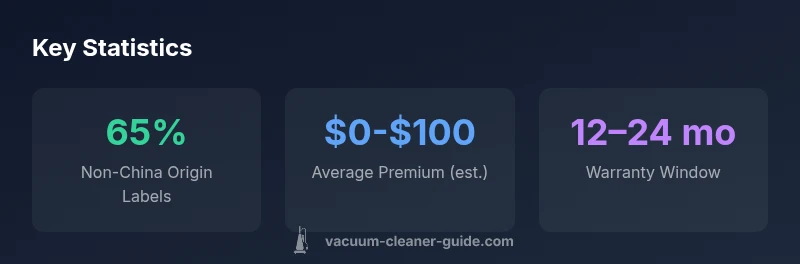
If your goal is to minimize Chinese manufacturing exposure, start with clear labeling checks and verified retailer listings. Prioritize models with explicit country-of-origin statements and robust warranty terms. You may be willing to pay a premium for European or American assembly, but weigh this against performance, maintenance costs, and local service availability. Keep in mind that some non-China models still source components from China; the net effect on performance is typically modest. A practical strategy is to assess overall build quality, materials, and the engineering behind the vacuum, rather than focusing solely on origin.
Common Myths and Realities
A common myth is that non-China manufacturing guarantees higher durability or better performance. In reality, brand design, motor quality, filtration, and suction power drive performance more than the country of assembly. The origin label matters, but it should be read alongside warranties, replacement parts availability, and the brand’s QC standards. Our guidance is to use origin as a starting point, then evaluate the complete value proposition: cost of ownership, maintenance, and reliability over several years.
Case Studies: What to Look For in Product Labels
Label scrutiny matters. Look for explicit country-of-origin statements on the box and in the user manual, and beware vague phrases like “assembled in Europe.” If a product says “Made in the USA” but the motor or filters are listed as imported, that signals a mixed-origin design. Prefer models with transparent supply chain disclosures and consistent service networks in your country. These cues help homeowners and pet owners make informed choices without relying on marketing slogans.
Final Considerations for Homeowners and Pet Owners
For households with pets or heavy carpet use, the most important attributes often align with performance, filtration, maintenance, and service availability rather than origin alone. Prioritize sealed systems, washable filters, and reliable parts availability. In the end, the Vacuum Cleaner Guide team emphasizes practical tests over labels: test suction, check filtration integrity, and confirm warranty terms. Our aim is to empower buyers to select vacuums that deliver persistent performance, quiet operation, and hassle-free maintenance, with origin being one of several important signals.
Comparison of origin indicators and verifier steps
| Aspect | Country-of-origin indicators | What to check | Typical caveats |
|---|---|---|---|
| Labeling on product/packages | Origin clearly stated | Look for 'Made in' statements or serial plates | Some products omit origin labels |
| Assembly vs manufacturing | Final assembly location vs component origin | Check box or manual; retailer pages | Components may come from multiple regions |
| Premium vs budget lines | Non-China manufacturing more common in premium lines | Expect longer lead times or higher price | Non-China origin doesn't guarantee premium quality |
| Warranty and service | Spares availability by country | Verify service centers in your region | Non-China origin can complicate service if no local parts |
FAQ
Are most vacuum cleaners made in China?
No. While many components are produced in China, final assembly locations vary by model and brand. Always check the product label for the country of origin and verify with the retailer.
Most models aren’t made entirely in China, so check the label and retailer info to confirm.
Can I find vacuum cleaners made entirely in Europe or the US?
Occasionally. Some premium or specialty lines advertise non-China assembly, but complete exclusivity is rare. Always verify country-of-origin on packaging and manuals.
Yes, sometimes, but verify origin on the box and manual.
How reliable are non-China manufactured vacuums?
Reliability depends on design, motor quality, and QC standards, not solely where it’s assembled. Consider warranties and spare parts availability as better reliability signals than origin alone.
Reliability depends on the build and parts, not just origin.
What should I check besides country of origin?
Warranties, service networks, filter systems (HEPA), and maintenance costs are crucial. Also verify availability of spare parts in your region and real user reviews.
Warranty and parts availability matter as much as origin.
Do non-China vacuums perform differently?
Performance hinges on motor design, filtration, and suction architecture; origin alone does not determine performance. Test suction and filtration in real-world tasks to judge value.
Performance depends on design, not just where it’s made.
How can I identify the country of origin quickly?
Check the box, unit label, serial plate, and manual; retailer listings should also confirm origin. When information is vague, contact support for explicit confirmation.
Look at the box and label, or ask support for origin details.
“Non-China manufacturing is not a universal quality signal, but clear disclosures and strong service networks help buyers make confident choices.”
The Essentials
- Check explicit country labeling before purchasing
- Differentiate final assembly from component sourcing
- Prioritize warranties and service availability
- Expect non-China models mainly in premium lines