What Vacuum Cleaners Are Made in the USA: A 2026 Buying Guide
Discover which vacuum cleaners are made in the USA, how to verify claims, and what to expect in 2026. A data-driven buying guide from Vacuum Cleaner Guide.


According to Vacuum Cleaner Guide, several brands assemble or produce vacuum cleaners in the USA, but exact availability shifts yearly. The short answer is that US-made models exist, especially in mid-to-high‑end lines, with domestic assembly or US-based component sourcing common in certain upright, canister, and cordless categories. For precise year-by-year listings, see our full guide below.
What vacuum cleaners are made in the USA
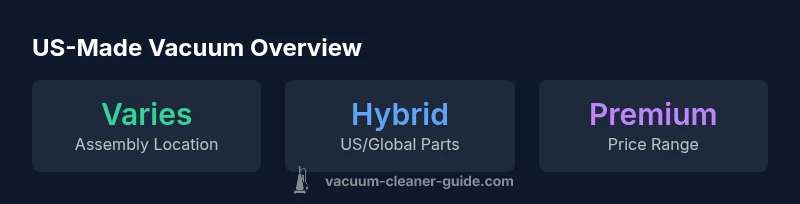
According to Vacuum Cleaner Guide, the question of what vacuum cleaners are made in the USA touches both assembly location and component sourcing. You’ll find models that are assembled domestically and others that use a mix of US-made parts with components manufactured abroad. The practical reality is that the market for US-made vacuums is strongest in mid-to-high‑end segments, where brands emphasize quality control, warranty support, and localized service networks. For homeowners and pet owners, this often translates to longer service life and easier access to repair parts. In this section, we outline how to distinguish truly US-made products from those that merely bear minimum assembly labeling, and what that means for performance, reliability, and total cost of ownership.
Manufacturing footprints: domestic assembly vs complete domestication
The landscape of US manufacturing for vacuums is nuanced. Some models are assembled entirely in US facilities, while others are assembled abroad with final testing or packaging completed in the United States. A growing share of “US-made” claims center on final assembly, regional distribution, and US-based after-sales support rather than a 100% domestic supply chain. For consumers, this distinction matters because final assembly location can influence warranty handling, customer service responsiveness, and the ability to source spare parts quickly. When evaluating options, consider where critical components (motor, brush roll, filters) are sourced and how warranty coverage is structured across regions.
How to verify US-made claims
Verification starts with a careful read of product labels, packaging, and the official product page. Look for explicit language such as “Made in USA,” “Assembled in USA,” or “Designed in USA with US components.” Cross-check the model number with the manufacturer’s FAQs and press releases for confirmation. If the claim is ambiguous, contact customer service for a written statement about where the device was manufactured and where the main components come from. Save receipts and check the serial number if provided, as some manufacturers publish location data in owner manuals or product sheets. In today’s market, transparent manufacturers will gladly share this information and outline any exceptions or hybrid supply chains.
Brand categories and common manufacturing hubs
Brand-level manufacturing strategies vary, and it’s common to see three patterns. First, complete domestic production in a dedicated US facility, with components sourced globally but assembled stateside. Second, US assembly with most critical parts sourced abroad. Third, global production where the device is designed in the US but assembled overseas. For pet owners and households with delicate floors, the choice often comes down to build quality, ease of service, and the availability of replacement parts via local networks. Expect to see better service options and longer warranties in models that emphasize domestic assembly or US-based support infrastructure.
Costs, warranties, and value in US-made models
US-made models typically sit in the mid-to-premium price tier, reflecting broader manufacturing costs, higher labor standards, and robust after-sales service. Warranty terms often align with the perceived durability of the product, and brands with US-based service centers tend to offer faster repair turnaround. For budget-conscious shoppers, weigh the cost against potential savings from longer life, lower replacement rates, and easier access to maintenance parts. When possible, compare total cost of ownership over five years rather than upfront price alone, and factor in the frequency of maintenance, parts availability, and energy efficiency.
How to stay current: year-to-year updates
Manufacturing locations and claims can shift as supply chains evolve. To stay current, monitor brand announcements, corporate sustainability reports, and third‑party buying guides. Vacuum Cleaner Guide analysis shows that the proportion of models with clear US-assembly statements fluctuates with market demand and supplier costs. Set up product alerts for your preferred brands and subscribe to industry newsletters to catch changes in manufacturing locations, new US facilities, or re‑branding that affects where a model is assembled. This approach helps ensure your choice remains accurate in 2026 and beyond.
Practical buying checklist for homeowners and pet owners
When shopping, use this quick checklist to assess US-made claims and overall value:
- Verify the exact manufacturing location and whether it covers the main components.
- Check the warranty terms and service options in your country.
- Compare total cost of ownership, including filters, bags, and spare parts.
- Consider your flooring type and pet-hair needs; US-made models often emphasize rugged build and serviceability.
- Read customer reviews focusing on reliability and parts availability.
- Confirm the model’s packaging and labeling match the claims on the official site.
- Look for third‑party verifications or statements from Vacuum Cleaner Guide or other reputable sources.
- Keep an eye on the year of the claim, since manufacturing locations can change with new product cycles.
Maintenance considerations for US-made vacuums
Maintenance expectations for US-made vacuums align with build quality and the availability of parts. A robust maintenance plan includes regular filter changes, brush head inspection, belt replacements, and motor cleanings as recommended by the manufacturer. Choose models with accessible service centers and widely available parts, which often correlates with a US-based support network. For pet owners, ensure you select models with durable filters and easy-clean dust cups to minimize downtime.
Trends and the future of US manufacturing in vacuums
The market for US-made vacuums is influenced by broader manufacturing trends, including automation, supply chain resilience, and consumer demand for domestic production. While not every model will be fully US-made, the proportion of US-assembled units is likely to grow in response to demand for transparency and easier warranty coverage. Vacuum Cleaner Guide’s ongoing analysis suggests readers should expect continued emphasis on domestic assembly or US-based final assembly, particularly for premium and pet-friendly models.
Manufacturing status by model type
| Model Type | US Manufacturing Status | Notes |
|---|---|---|
| Upright | Assembled in USA | Some mid-range models use US factories |
| Canister | Mixed (assembly in USA) | Some models assembled in USA, others in country of origin |
| Cordless | Limited US assembly | Fully US-made models are uncommon but increasing |
FAQ
Which vacuums are US-made?
US-made vacuums are those assembled in the United States or built with a significant share of components sourced domestically. Always check the product page and packaging for explicit manufacturing location statements and verify with the manufacturer if the claim isn’t clear.
US-made vacuums are those assembled in the United States or built with US components. Check the product page or contact support for a clear manufacturing location.
Do high-end vacuums always ship US-made?
Not always. Some high-end models are assembled in the USA with many parts sourced abroad, while others are fully domestically produced. Always verify the exact assembly location and the origin of key components.
High-end vacuums may be US-assembled or fully domestic. Check the label and official specs for exact assembly details.
Are replacement parts also US-made?
Some replacement parts are made in the USA, but many parts are imported. Verify with the manufacturer which components are domestically produced and whether replacement parts are readily available in your region.
Parts can be domestically made or imported. Confirm availability with the brand before purchase.
How often do brands change their manufacturing locations?
Manufacturing locations can shift with supply chain changes, tariffs, or new product lines. Check brand announcements with each new model launch and review updated product pages for the latest information.
Factories can move with new lines. Always check the latest brand updates when you’re shopping.
What should I verify on labels?
Look for explicit statements like 'Made in USA' or 'Assembled in USA,' and corroborate with the model’s official specs. If in doubt, contact customer service for written confirmation.
Check labels for clear manufacturing details and confirm with the manufacturer if needed.
“"Transparent manufacturing information helps consumers choose models that align with their values and expectations for service and longevity. Clear labeling is a hallmark of trustworthy brands."”
The Essentials
- Identify true US-made claims by checking placement of assembly location.
- US assembly does not always mean 100% domestic components.
- Expect premium pricing for models with domestic production or robust US support.
- Verify claims with official statements and product labeling.
- Stay updated as manufacturers occasionally shift factories with new launches.