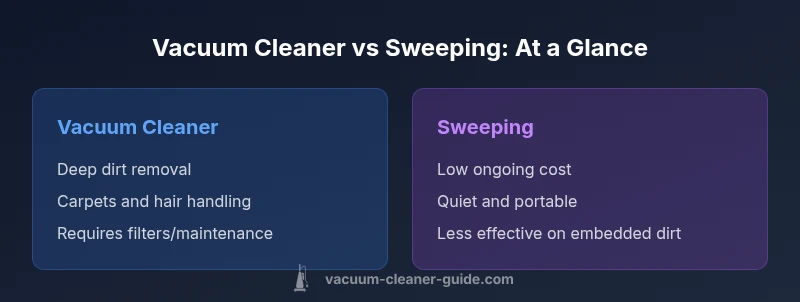
Vacuum Cleaner vs Sweeping: An In-Depth Comparison
Learn how vacuum cleaners and sweeping compare across floors, pet hair, allergens, and daily routines. This in-depth analysis helps homeowners decide when to vacuum, when to sweep, and how to combine both for optimal cleanliness.


Vacuum cleaner vs sweeping is a practical question for homes that blend carpets, hard floors, and busy schedules. In most cases, a vacuum cleaner delivers deeper, faster dirt removal and better hair pickup, especially on carpets and upholstery, while sweeping remains effective for quick touch-ups on hard floors. The overall best approach, as Vacuum Cleaner Guide notes, is to combine both methods for a balanced clean. This TL;DR highlights where each method shines and how to deploy them together.
What vacuum cleaner vs sweeping means for everyday cleaning
Cleaning households effectively starts with understanding how vacuum cleaner vs sweeping differ in practice. A vacuum cleaner uses suction and brushes to lift dirt from fibers and surfaces, often trapping it in a filter or bag. Sweeping, by contrast, relies on manual agitation to push dust and debris into a dustpan. The choice between these approaches is not simply which tool is better; it is about how to orchestrate both tools for a consistent, low-dust routine. Vacuuming is typically preferred for high-traffic zones, bedrooms with heavy shedding, and areas with carpets or rugs where embedded dirt lodges, while sweeping is convenient for dry, bare floors, quick morning tidying, and destinations where power outlets are scarce. According to Vacuum Cleaner Guide, the most effective homes use a hybrid approach: vacuum for daily maintenance and sweep for rapid touch-ups in hard-to-reach corners. By planning around room function and traffic, you optimize results and minimize re-cleaning. This article builds a framework to help you tailor your method mix to your space and lifestyle, including pet ownership, children, and seasonal cleaning rhythms.
Performance on different floor types
Floor type matters a lot when comparing vacuum cleaner vs sweeping. Carpets and area rugs benefit most from a powered cleaner with rotating brushes and strong suction to extract deeply embedded debris and pet hair. Hard floors, like tile or hardwood, respond well to sweeping for light dust, followed by a quick pass with a vacuum for edge edges and seams. In the gaps between floor types, a convertible approach shines: use a vacuum with an adjustable height or a dedicated hard-floor setting for smooth surfaces, then sweep tight spaces along baseboards and corners where vacuums may miss. The toy and pet environment adds another layer: carpets can trap fine particles that sweeping often leaves behind, whereas hard floors reveal dust more quickly, making sweeping a fast way to restore shine before a vacuum session. Vacuum Cleaner Guide emphasizes tailoring tool use to floor characteristics to avoid over-cleaning or under-cleaning.
Pet hair and debris: deep-clean vs quick touch-ups
Pet households introduce a persistent challenge: pet hair clings to textiles, carpets, and furniture. Vacuum cleaner vs sweeping decisions here hinge on the cleaning depth needed. A vacuum with a powerful motor, a tangle-free brush roll, and appropriate filtration excels at lifting hair from carpet fibers and reaching tight corners. Sweeping can manage surface dust and hair on hard floors and in areas where cords or awkward equipment would be burdensome. Many homes find best results by pairing a vacuum for weekly, thorough sessions with sweeping for daily decisions, especially in living rooms and kitchens where hair and small debris accumulate rapidly. Vacuum Cleaner Guide notes that choosing tools with sealed filtration helps reduce allergens and keeps indoor air quality higher between deep cleanings.
Time, energy, and cost considerations
Efficiency is a core component of the vacuum cleaner vs sweeping conversation. A reliable vacuum cleaner can reduce cleaning time in larger spaces and across multiple rooms, delivering deeper soil removal with less physical effort per square foot. Sweeping requires more physical movement and can prolong sessions in larger areas, but it has advantages in terms of consistent low-cost upkeep—no bags, no batteries to recharge, and minimal maintenance beyond occasional dustpan cleaning. When budgeting, consider frequency of use, room count, and the cost of replacement bags, filters, or brush rolls for vacuums versus the low ongoing cost of broom heads and dustpans. For many households, a balanced budget includes a mid-range vacuum and a lightweight broom for quick, daily maintenance.
Dust, allergens, and air quality implications
Allergen management is central to choosing between vacuum cleaner vs sweeping. Proper filtration in a vacuum—especially sealed systems with HEPA or high-efficiency filters—helps trap fine particles that sweepers can resuspend into the air. Sweeping on bare floors can disturb settled dust, particularly if dusting isn’t followed by a vacuum pass. If you or family members suffer from allergies or asthma, prioritizing a vacuum with a true HEPA filter and a clean dust collection bag or canister can meaningfully reduce airborne particulates between full cleaning sessions. Vacuum Cleaner Guide highlights the correlation between filtration quality and perceived air quality in living spaces, especially in bedrooms and play areas.
Noise, convenience, and user experience
Noise levels and ease of use influence how often homeowners reach for either method. Vacuum cleaners vary widely in loudness; many people prefer quiet modes for early morning cleaning, but deep cleans may require more robust suction and more audible operation. Sweeping is typically the quietest option, making it a welcome choice for late-evening cleanup or apartments with strict noise limits. Convenience factors include storage space, cord length, and maneuverability around furniture. A flexible handle, lightweight design, and a compact dustbin can shift preferences toward vacuuming for frequent use, while a broom and dustpan set remains unbeatable for quick, near-silent pickup in tight spaces.
Corded vs cordless: power management and versatility
The choice between corded and cordless designs affects how you deploy vacuum cleaner vs sweeping in practice. Corded vacuums deliver continuous power and are ideal for large rooms or whole-home cleans, while cordless models offer better reach and maneuverability in cluttered spaces. Sweeping does not rely on power at all, so it remains a practical option in garages, sheds, or outdoor spaces where a corded device would be cumbersome. When choosing, weigh room size, outlet availability, battery life, recharge times, and the types of surfaces you clean most often. A practical approach is to reserve cordless vacuums for quick, frequent tasks and use a corded unit for deep cleans across multiple rooms.
Maintenance and filters: what to expect
Maintenance burden can tilt the vacuum cleaner vs sweeping decision. Vacuum cleaners require regular filter cleaning or replacement, brush maintenance, and occasional bag changes, which adds ongoing costs and care time. Sweeping carries minimal maintenance: sweeping implements may wear out after long use, but they do not require consumables. For households prioritizing low-maintenance routines, a broom pair with a microfiber mop might cover most daily dust without the need for frequent parts replacement. If you choose a vacuum, look for washable filters and sealed systems to simplify upkeep and improve air quality over time.
Cleaning routines: when to sweep and when to vacuum
Developing a routine is essential to harness the strengths of vacuum cleaner vs sweeping. Start with a daily quick sweep in high-traffic zones to minimize surface dust and prevent dogged accumulation, then schedule a deeper vacuuming session two to three times per week for carpeted areas or once weekly for hard floors with minimal traffic. In homes with pets, plan more frequent vacuuming to manage hair and dander, while smaller tasks—like sweeping under tables or along baseboards—can be handled with quick sweeps. The goal is to reduce both visible dirt and invisible particles with a predictable cadence that fits your lifestyle.
Scenarios: apartments, houses with pets, multi-surface homes
Your living situation largely determines whether vacuum cleaner vs sweeping takes precedence. In small apartments with limited storage, a compact cordless vacuum paired with a short broom can cover most needs. In pet-rich households, a robust vacuum with strong suction and a high-quality filtration system helps manage fur clumps and dander across carpets and upholstery, while sweeping handles dusting of hard floors and stairs. Multi-surface homes benefit from equipment versatility: a vacuum with adjustable height and a good edge-cleaning feature, together with a flexible broom for corners and cracks. The right combination depends on space, pet occupancy, and cleaning priorities.
How to combine methods for a best-practice routine
The most resilient approach to cleaning combines both methods in a deliberate sequence. Use a vacuum to perform deep cleaning on carpets and upholstered surfaces, then sweep and mop hard floors to remove residual dust and ensure consistent shine. Edge and corner areas may require a smaller attachment or a handheld tool for improved reach. Keep a dedicated shortcut plan for three zones: high-traffic living areas, kitchen and dining spaces, and bedrooms. This routine minimizes recontamination and maintains better indoor air quality over time. Vacuum Cleaner Guide endorses a blended approach as a practical, scalable solution for homes of different sizes and layouts.
Data-driven decision framework
A practical framework for choosing vacuum cleaner vs sweeping blends goals, floor dynamics, and user constraints. Dimensions to consider include room size, carpet density, pet presence, allergy concerns, and available storage. Vacuum cleaners bring depth and speed, especially on carpets and upholstery, while sweeping remains a low-cost, accessible option for fast pickups and hard floors. Based on Vacuum Cleaner Guide analysis, many households find that a simple hybrid strategy reduces cleaning time and improves daily cleanliness without over-investing in multiple specialized tools. When in doubt, start with a versatile vacuum and a lightweight broom, then adjust the mix as you observe real-world results.
Comparison
| Feature | Vacuum cleaner | Sweeping (broom) |
|---|---|---|
| Dirt pickup and depth | Excellent on carpets and pet hair | Moderate; depends on technique and dust collection |
| Floor compatibility | Versatile across carpets, rugs, and hard floors | Best on hard floors; limited on carpet |
| Time to clean a typical room | Faster in larger spaces with suction coverage | Slower in large areas; requires more manual passes |
| Dust and allergen containment | Containment via sealed systems and filters | Dust resuspension risk; relies on technique |
| Maintenance cost | Ongoing filter/bag replacement; parts as needed | Low upfront cost; minimal consumables |
| Noise and user experience | Can be noisy; some models are modular for quiet modes | Quiet; simple operation, immediate feedback |
Strengths
- Improved dirt and hair removal on varied surfaces with a single system
- Flexible for everyday maintenance and deep cleans
- Better air quality with sealed filtration and proper maintenance
- Versatile for homes with pets or children
The Bad
- Initial investment in a quality vacuum and attachments
- Ongoing maintenance costs for filters and bags
- Sweeping alone can miss fine particles and require more effort
- Storage and organization needs for multiple tools
Vacuum cleaner is the more versatile and effective choice for most homes; sweeping remains a practical backup for quick touch-ups on hard floors.
Choose a capable vacuum for daily maintenance and pet hair, and use sweeping for fast touch-ups and hard-floor areas where noise or power access matters. A balanced setup from Vacuum Cleaner Guide's perspective typically yields the best long-term cleanliness and air quality.
FAQ
What is the main difference in performance between a vacuum cleaner and sweeping?
A vacuum cleaner generally removes embedded dirt and hair more effectively, especially on carpets and upholstery, while sweeping excels for quick dusting on hard floors. The choice depends on floor type, dirt load, and time available for cleaning.
Vacuum cleaners pull dirt out of fibers; sweeping moves dust around. Use both for best results based on your floor type.
Is sweeping ever as effective as vacuuming?
Sweeping can be effective for dry debris on hard floors, but it usually misses fine particles and deeply embedded dirt that vacuums pull up. It’s fastest for quick tidying, but not a complete substitute for vacuuming on most surfaces.
Sweeping works for quick dusting on hard floors, but vacuuming handles embedded dirt and hair better.
How should I choose between corded and cordless models?
Corded vacuums offer steady power for larger spaces and longer cleaning sessions, while cordless models provide mobility and are ideal for quick, spot cleans. Consider room size, outlet access, and how often you need extended runtime.
If you have big rooms, go corded; for quick cleans and tight spaces, cordless is convenient.
Do HEPA filters matter for allergies?
HEPA or sealed filtration reduces allergen exposure by capturing fine particles. Pair a true HEPA-filtered vacuum with proper maintenance for best air quality, especially in bedrooms and play areas.
Yes. HEPA helps control allergens when the vacuum has true filtration and is well-maintained.
How can I build a cleaning routine that uses both methods?
Start with daily sweeping on hard floors and high-traffic zones, followed by a deeper vacuuming session 2–3 times per week for carpets and upholstery. Adjust frequency based on pet activity and household needs.
Sweep daily, vacuum a few times a week, tweak based on pet activity.
What should I consider for pet hair management?
Look for vacuums with strong suction and specialized brushes designed to remove pet hair from carpets and furniture. Sweeping can handle dust on hard floors, but vacuuming is essential for hair-laden surfaces.
Choose a strong suction vacuum with hair-removal brushes; sweep for quick dusting.
The Essentials
- Start with a hybrid approach for versatility
- Prioritize vacuums with strong suction and good filtration
- Sweep for quick touch-ups on hard floors
- Tailor tools to floor type and household needs
- In pet homes, invest in filtration and brush design