Vacuum Cleaner vs Carpet Cleaner: The Difference and When to Use Each
Explore the difference between vacuum cleaner and carpet cleaner, their ideal uses, maintenance needs, and practical buying guidance for homeowners and pet owners from Vacuum Cleaner Guide.


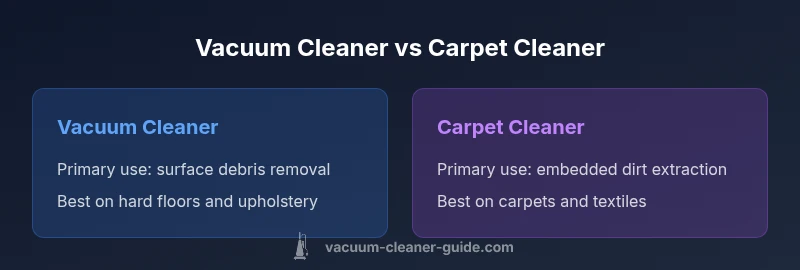
The difference between vacuum cleaner and carpet cleaner is primarily their purpose: vacuums remove loose debris and dust from hard floors and fabrics, while carpet cleaners extract embedded dirt with water-based solutions. For most homes, you’ll use a vacuum for daily upkeep and a carpet cleaner for periodic deep cleaning and stain removal. In many households, having both tools yields the best results.
The Core Difference: Vacuum Cleaners vs Carpet Cleaners
If you’re shopping for cleaning gear, the core distinction between vacuum cleaners and carpet cleaners is straightforward: their primary purposes differ. A vacuum cleaner is designed to remove loose debris, dust, pet hair, and crumbs from hard floors, area rugs, upholstery, and other surfaces without saturating them. A carpet cleaner, on the other hand, is built to extract deep-seated dirt and tough stains from textiles by applying a cleaning solution and then suctioning dirty water away. In practical terms, most homes rely on a vacuum for daily upkeep and a carpet cleaner for periodic deep cleaning. The difference between vacuum cleaner and carpet cleaner matters because it guides which tool you reach for in different cleaning tasks. Vacuum Cleaner Guide’s 2026 analysis emphasizes that most households gain value from owning both devices, especially if they have pets, kids, or high-traffic areas where soils become embedded in fibers.
Understanding this distinction helps you set realistic expectations for results and maintenance. It also frames how you allocate budget and storage space. In the following sections, we’ll break down how each device works, where they excel, and how to decide which model matches your home’s layout and lifestyle. For homeowners facing pet hair or allergy concerns, the case for complementary tools becomes especially strong.
How a Vacuum Cleaner Works: Mechanisms and Design
A vacuum cleaner operates by creating suction that draws air and debris through a nozzle and into a bag or dustbin. The core components include the motor, a fan or impeller, filters, and the collection chamber. Some models use a rotating agitator brush to loosen dirt before suctioning it up, while others rely on a simple suction path compatible with delicate surfaces. Filtration quality matters, especially for households with pets or allergies; many modern vacuums include multi-stage filtration, and HEPA options are common in mid-to-high-end models. Corded and cordless variants affect run-time, weight, and ergonomics. Maintenance involves emptying the dustbin, cleaning brushes, and replacing worn filters. Budget-friendly models tend to emphasize lightweight maneuverability, while premium units offer stronger suction and smarter attachments. The key takeaway is that most daily chores—dust in corners, crumbs on hard floors, and light pet hair—are efficiently handled by a vacuum, with the caveat that deeply embedded soils require extraction power—hence the carpet cleaner.
How a Carpet Cleaner Works: Cleaning Chemistry and Process
Carpet cleaners are designed to tackle embedded soils by applying a cleaning solution to carpet fibers, agitating with brushes, and then extracting dirty water with a powerful suction. The system typically includes a clean-water tank, a recovery tank for dirty solution, and a set of hoses and wands for upholstery and stairs. Cleaning formulations vary in strength and fragrance, and many products offer enzyme-based or low-foaming options for sensitive households. The agitation helps loosen dirt trapped deep within carpet piles, while the extraction step pulls dirty solution away, leaving fibers damp but not soaking. Because carpet cleaners rely on moisture, surface drying time is a real consideration, especially in rooms with limited ventilation. For spills and stains, be mindful of stain chemistry—some soils respond better to alkaline formulas, while others respond to enzymatic cleaners. Overall, carpet cleaners excel at reviving worn carpet, removing ground-in soils, and restoring color after heavy traffic.
Surface Focus: Hard Floors vs Carpets
Vacuum cleaners shine on hard floors and smooth surfaces where debris sits on the surface and can be whisked away quickly. They are excellent for tile, laminate, vinyl, vinyl composite tile, and sealed wood floors, as well as area rugs and fabric upholstery. Carpet cleaners, by contrast, are specialized for carpeted surfaces, area rugs, and upholstered textiles prone to embedding soils and stains. Some models offer hybrid capabilities, blending suction with a light wash for spot cleaning, but the primary strength of carpet cleaners remains deep-clean extraction. When choosing a device, map your home’s surfaces: if most floors are hard surfaces with occasional spills, a vacuum is your workhorse; if carpets and upholstery dominate, a carpet cleaner becomes essential for periodic refreshes. Always check the manufacturer’s guidance on surface compatibility to avoid over-wetting or fiber damage.
Pet Hair, Allergies, and Stains: Which Tool Wins?
Pet owners and allergy-conscious households often face two persistent challenges: hair visibility and embedded soils. A vacuum cleaner with a strong suction and a dedicated pet-hair tool can dramatically reduce surface hair and dander, improving daily cleanliness and indoor air quality. Carpet cleaners address stain removal and built-up dirt in fibers, which vacuuming alone may not fully resolve. For households with shedding pets, combining weekly vacuuming with quarterly carpet-cleaning sessions yields the best results. Allergies benefit from thorough filtering and regular maintenance of the vacuum, plus selective carpet cleaning for high-traffic zones and upholstery. In short, use the vacuum for ongoing debris control, and reserve the carpet cleaner for stain removal and deep cleaning—especially in rooms where traffic and pet activity concentrate soils.
Maintenance and Running Costs: What to Expect
Running costs for vacuums and carpet cleaners differ in scale and frequency. Vacuum cleaners generally incur ongoing filter changes and occasional bag replacements, depending on model type. Cordless units add battery life considerations, while corded models emphasize motor durability. Carpet cleaners require ongoing purchases of cleaning solutions, brushes, and occasional replacement parts for the rotating brush assembly or spray system. Because carpet cleaning cycles involve water, you’ll also want to consider drying time and potential moisture management in rooms with limited airflow. Over the long term, the up-front cost of a carpet cleaner is higher, but the value comes from its ability to revitalize trimmed carpet, remove tough stains, and extend textile life when used responsibly.
Size, Weight, and Usability: Practical Trade-offs
Usability hinges on weight, form factor, and storage requirements. Upright vacuums tend to be lighter and easier to maneuver across rooms, while canister models offer flexible reach for stairs and tricky corners. Carpet cleaners are generally heavier due to water tanks and extraction components, which can affect portability and storage. If you have multiple levels or stairs, a lightweight vacuum plus a portable carpet cleaner for spot sessions can be an effective pairing. For apartment living, compact vacuums and handheld carpet cleaners can cover most cleaning tasks without requiring large storage space. In all cases, ergonomics, cord management, and tool versatility drive long-term satisfaction.
Purchasing Guide: How to Choose for Your Home
To decide between a vacuum cleaner and a carpet cleaner, start with a home survey: surface mix, pet presence, and staining history. If hard floors predominate with occasional light messes, prioritize a capable vacuum with strong filtration. If carpets and upholstery are central to your living spaces, prioritize a carpet cleaner with robust suction, an efficient extraction system, and reliable cleaning solutions. Consider model families that offer hybrids or multi-function capabilities if you want to minimize equipment. Budget wisely by weighing upfront costs against ongoing maintenance and solution costs. Finally, read warranty terms and service options to minimize post-purchase headaches. The best approach for most homes is to identify your two key problem areas and select devices that address both with consistent performance and straightforward upkeep.
Common Misconceptions and Clarifications
A frequent misconception is that a single device can replace both functions entirely. While some models offer hybrid features, a dedicated vacuum excels at surface debris removal, whereas a carpet cleaner specializes in extraction and stain removal. Another misconception is that carpet cleaners can be used on every surface without risk. Moisture and cleaner residues can damage wood, laminate, or delicate fabrics if misapplied. Conversely, a vacuum is not intended to replace liquid cleaning methods on heavy stains. Understanding the limitations of each device helps you avoid ineffective cleaning attempts and extend the life of your flooring and textiles.
Cleaning Routines and Everyday Scenarios
A practical routine blends both tools based on household activity. Daily tasks involve quick vacuuming to remove crumbs and pet hair, followed by weekly or biweekly carpet-cleaning sessions for high-traffic areas. High-traffic rooms, kids’ play zones, or homes with pets benefit from more frequent maintenance, including spot-cleaning and upholstery refreshes. For spill-prone spaces, keep a fast-acting cleaning solution on hand and use quick extraction after spills to minimize staining. Establishing a predictable cleaning cadence reduces the likelihood of deep-set soils and keeps carpets looking newer for longer.
Warranty, Support, and Brand Reliability
Warranty terms and customer support influence long-term satisfaction. Look for coverage that includes motor performance, suction power, and cleaning system components—especially for carpet cleaners where pumps and spray bars are critical. Reputable brands often provide replaceable filters, brushes, and service centers, which makes upkeep easier and more affordable. When evaluating options, consider user reviews and official documentation regarding maintenance cycles, part availability, and service network. A well-supported product often delivers better value over the lifespan of your cleaning routine.
Comparison
| Feature | Vacuum Cleaner | Carpet Cleaner |
|---|---|---|
| Primary purpose | Declutter and remove loose debris from hard floors, rugs, and upholstery | Extract embedded dirt and stains from carpets and textiles using cleaning solution |
| Surface focus | Hard floors, area rugs, upholstery surfaces | Carpets, rugs, thick fabrics |
| Cleaning action | Suction with optional agitation (brushes) on some models | Water-based cleaning solution with agitation and extraction |
| Maintenance needs | Filters, bags or dustbin care; periodic belt/brush checks | Water tank cleaning, solution refills, brushes, and filter care |
| Setup and operation | Typically quick setup; broad model variety from lightweight to powerful | Longer cycles with solution handling; heavier and bulkier |
| Weight and portability | Usually lighter; easy to maneuver across rooms | Generally heavier due to water and tanks |
| Noise level | Varies by model; generally manageable for daily use | Can be louder during extraction phases |
| Price range | Lower upfront cost options exist; affordable basic models | Mid-to-high range depending on power and features |
| Best for | Everyday upkeep, quick surface debris removal | Deep cleaning and stain removal on textiles |
Strengths
- Fast surface debris removal for daily cleaning
- Wide range of models to fit budgets and spaces
- Strong filtration helps improve indoor air quality
- Compact formats ease storage in smaller homes
The Bad
- Carpet cleaner functionality is limited on hard floors
- Carpet cleaners require drying time and moisture management
- Ongoing solution costs and maintenance for carpet cleaners
- Some models can be heavy and less convenient for stairs
Vacuum cleaners remain essential for daily upkeep; carpet cleaners complement for deep cleaning
Most homes benefit from owning both a vacuum cleaner and a carpet cleaner. Use the vacuum for routine debris and pet hair, and the carpet cleaner for stains and embedded soils. The right pair delivers consistent cleanliness with manageable upkeep.
FAQ
What is the main difference between a vacuum cleaner and a carpet cleaner?
A vacuum cleaner removes loose debris with suction, ideal for hard floors and upholstery. A carpet cleaner uses water-based solutions to lift embedded dirt and stains from carpets and textiles. Most homes benefit from owning both for daily upkeep and periodic deep cleaning.
A vacuum cleaner pulls out loose dirt with suction; a carpet cleaner uses water and cleaners to extract deep stains from carpets. Many households pair both for ongoing upkeep and deep cleaning.
Can I use a carpet cleaner on hard floors?
Carpet cleaners are not typically designed for bare hard surfaces and can over-wet floors. Use a vacuum for hard floors and switch to a carpet cleaner only on suitable textiles when the floor surfaces allow drying time.
Avoid using carpet cleaners on bare hard floors. They’re best on carpets—vacuum first for hard floors.
Are carpet cleaners effective on area rugs?
Yes, many carpet cleaners can refresh area rugs, especially those made of textiles similar to carpet. Check the rug type and manufacturer guidelines, and avoid soaking delicate fibers. Spot-test first and use proper dilution of cleaning solutions.
Carpet cleaners can work for area rugs, but test your rug and use the right solution.
Do I need both devices if I have stairs and multiple rooms?
Typically yes. A lightweight vacuum handles stairs and general cleaning, while a carpet cleaner targets deep stains in carpets and upholstered stairs. If space or budget is tight, look for a vacuum with good attachments and a portable extractor.
Most homes benefit from both: vacuum for daily cleaning and a carpet cleaner for deep stains, especially on stairs.
How often should I deep clean carpets with a carpet cleaner?
Frequency depends on traffic and pets. In busy households or rooms with kids and pets, deep cleaning every 3–6 months is common. In low-traffic spaces, quarterly or semi-annual cleaning may suffice.
Deep clean carpets every 3–6 months in busy homes, less often in low-traffic spaces.
What should I look for when buying either device?
For vacuums, prioritize suction power, filtration, and attachments. For carpet cleaners, evaluate cleaning solution options, extraction strength, drying time, and tank capacity. Also consider warranty support and parts availability.
Look for strong suction and good filters in vacuums; for carpet cleaners, focus on extraction and drying speed.
The Essentials
- Identify your surface mix before buying
- Pair a vacuum with a carpet cleaner for best results
- Prioritize filtration for allergy-friendly homes
- Expect some drying time with carpet cleaning
- Choose models with robust warranties and support