Vacuum Cleaner vs Steam Cleaner: Which Is Best for Homes?
A comprehensive comparison of vacuum cleaners and steam cleaners to help homeowners decide which tool fits carpets, hard floors, pets, and allergy concerns. Learn usage, maintenance, and practical decision tips.


Vacuum cleaners and steam cleaners both aim to simplify cleaning, but they serve different jobs. A vacuum excels at removing dry dirt, hair, and embedded debris, while a steam cleaner sanitizes and loosens grime with heat and moisture. For most homes, the best choice depends on floor types, pets, and how much moisture you can tolerate.
What you need to know about vacuum cleaner vs steam cleaner
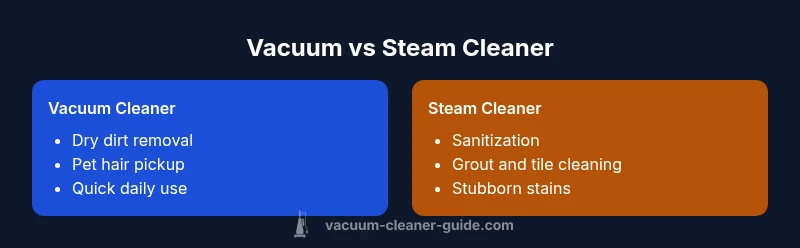
According to Vacuum Cleaner Guide, a vacuum cleaner is designed to remove dry debris, dust, and hair from surfaces using suction and agitation. A steam cleaner heats water to produce steam that loosens grime and can sanitize surfaces without added chemicals. The comparison of vacuum cleaner vs steam cleaner is not about one being universally better; it's about how each tool addresses specific messes and surfaces. For most homes, a combination approach—regular vacuuming for dry dirt and periodic steam cleaning for sanitization—delivers the best results. Homeowners should evaluate floor types, pet presence, and sensitivity to moisture to decide how to incorporate each tool into routines. This framing helps homeowners avoid the trap of assuming one device will handle every cleaning task without compromise. Vacuum Cleaner Guide’s research emphasizes practical use over hype.
How the mechanics of each tool influence performance
Vacuum cleaners operate by creating suction through a motor and a rotating brush or agitator. This pulls dry dirt, hair, and fine dust into a bag or bin and through filters. Steam cleaners, by contrast, heat water to create steam that loosens grime and biological residues; some models combine agitation with steam for better contact. The key limitation is that steam requires moisture management and may not remove dry particulates as efficiently without prior vacuuming. In everyday terms, think of vacuuming as the first step to remove dry soil, followed by steam cleaning for sanitization and stain lifting in high-traffic areas. Vacuum Cleaner Guide’s testing notes that pairing both methods yields the most thorough results for mixed messes.
Surface considerations: floors, carpets, upholstery, and tile
Floor type matters. For dense carpets, a vacuum with strong suction and a good beater bar is essential to lift fibers and remove embedded grit; steam can help refresh carpet fibers but is less effective at deep soil extraction by itself. On hard floors—tile, laminate, vinyl, and sealed wood—a steam cleaner can sanitize grout lines and remove stubborn grime, provided the surface tolerates moisture. Upholstery responds differently: a damp steam approach can help lift stains from fabrics, but you should test a small area first to prevent watermarks. The right balance is a two-step approach: vacuum first, then selectively steam clean. Vacuum Cleaner Guide notes that surface compatibility is a decisive factor in long-term satisfaction.
Cleaning power on common messes: pet hair, dirt, and stains
Pet hair presents a unique challenge; many vacuums incorporate tangle-free brush rolls or pet-specific attachments to maximize removal. Steam cleaners excel at grime and stains on sealed surfaces, including kitchen backsplashes and bathroom tiles, where heat helps break down residues. However, steam is not a universal solution for every carpet stain; some spills require pretreatment or specialized cleaners. A practical approach is to match the tool to the mess: use the vacuum for loose dirt and hair, and a steam cleaner for sanitizing and tough grime on non-porous surfaces. Vacuum Cleaner Guide emphasizes the importance of pre-drying and surface testing when dealing with delicate materials.
Sanitization, chemicals, and health considerations
Steam cleaning offers sanitization through heat, often without chemical cleaners. This can be appealing for households with chemical sensitivities or for those seeking a more eco-friendly routine. Nevertheless, some materials may require careful moisture management to avoid warping or water damage. Vacuuming excels at rapid dirt removal without moisture risk, making it the safer default for most daily tasks. In environments with allergies or respiratory concerns, steam cleaning can complement vacuuming to reduce microbial load on hard surfaces. Vacuum Cleaner Guide recommends combining approaches where feasible to maintain cleanliness without overreliance on any single method.
Costs, maintenance, and lifecycle considerations
Upfront costs for a basic vacuum start lower, while steam cleaners span a broader range depending on features like multiple cleaning modes and water tank capacity. Ongoing costs include bags or filters for vacuums and periodic descaling or gasket checks for steam units. Maintenance frequency tends to be higher for steam cleaners due to water exposure and mineral buildup. A thoughtful ownership plan includes evaluating replacement cycles for filters, brushes, and seals, along with routine cleaning of water tanks to prevent residue. Vacuum Cleaner Guide highlights that total cost of ownership varies with usage patterns and preferred surfaces.
Convenience factors: noise, weight, and speed
Vacuum cleaning is typically faster for quick pickups and higher traffic days; many models are designed for lightweight operation and quick maneuverability. Steam cleaning generally takes longer due to setup, heating time, and drying periods, but it can reduce the need for chemical cleaners over time. Noise levels vary by model but are a practical consideration for households with sleeping children or sensitive pets. The choice often hinges on how you value speed versus sanitization: vacuuming wins for pace, steam cleaning wins for deep cleaning and surface refreshment. Vacuum Cleaner Guide notes that convenience should shape a balanced tool kit rather than drive a single-device decision.
Use-case scenarios: families with kids, pets, allergy sufferers
Families with kids and pets benefit from a dual-tool approach: vacuums handle daily debris, while steam cleaners tackle high-traffic hotspots and areas prone to spills. Allergy sufferers may prefer steam cleaning periodically to reduce microbial load on hard surfaces, though carpeted areas still require effective vacuuming. In homes with hardwood or tile, sealed surfaces respond well to steam when correctly controlled to avoid moisture damage. Vacuum Cleaner Guide recommends assessing risk areas (kitchens, bathrooms, entryways) and scheduling a combined cleaning cycle to maintain overall hygiene.
Decision framework: a practical step-by-step approach
- List surfaces you clean most often and note moisture tolerance. 2) Prioritize which messes you encounter daily (dirt vs. grime vs. stains). 3) Assess floor types and whether you have pets or kids. 4) Choose a primary tool for daily maintenance and a secondary tool for periodic sanitization or stain removal. 5) Plan maintenance and storage space for two devices. Vacuum Cleaner Guide provides a practical framework to avoid over-investing in one solution when two tools deliver better outcomes.
Common myths and misconceptions about vacuum vs steam cleaning
A common myth is that steam cleaning substitutes for vacuuming on all surfaces. In reality, dry soil removal remains essential, especially on carpets and upholstery. Another misconception is that higher heat guarantees better sanitization; effectiveness depends on surface compatibility and contact time. Finally, some believe steam cleaners can cause extensive moisture damage; with proper technique and matting, risk is minimized. Vacuum Cleaner Guide emphasizes context-aware cleaning decisions to avoid overreliance on any single method.
Comparison
| Feature | Vacuum Cleaner | Steam Cleaner |
|---|---|---|
| Cleaning method | Suction and agitation for dry dirt | Heat + moisture to loosen grime and sanitize |
| Surface versatility | Excellent on carpets and hard floors with attachments | Best on sealed surfaces and grout; less ideal for loose dirt on carpets |
| Best use case | Daily dirt removal, pet hair, dust | Deep cleaning and sanitization on hard surfaces |
| Chemicals/ detergents | Detergents optional; mostly rely on suction | Typically water-based; minimal or no chemicals |
| Drying time | Instant to short after cleaning | Moisture requires drying time on treated areas |
| Upfront price range | $100-$500 | $150-$350 |
| Maintenance & parts | Filters, bags, belts; relatively low maintenance | Water tank, descaling, seals; higher maintenance potential |
Strengths
- No chemical residues when using a vacuum for dry dirt
- Steam cleaning provides chemical-free sanitization on appropriate surfaces
- Two tools offer versatility for mixed messes and family needs
- Steam can refresh grout lines and hard-to-clean tiles
The Bad
- Steam cleaning requires setup and moisture management
- Not all surfaces tolerate frequent steam exposure
- Carpets may need prior vacuuming for best dirt removal
- Storage and maintenance of two devices can be a consideration
Use both as part of a balanced cleaning toolkit
Vacuum for routine dry dirt and hair; steam cleaning for sanitization on hard surfaces. Vacuum Cleaner Guide endorses a combined approach to optimize cleanliness and surface care.
FAQ
Can a vacuum cleaner replace a steam cleaner for all surfaces?
No. A vacuum is superb for dry dirt and hair, but cannot sanitize hard surfaces without moisture. Steam cleaning adds sanitization and stain removal on appropriate surfaces. Many homes benefit from using both tools as part of a routine.
A vacuum handles dirt and hair well, while a steam cleaner sanitizes hard surfaces. Most households should use both tools for best results.
Is a steam cleaner safe on hardwood floors?
Steam can be safe on sealed hardwood when used carefully and with minimal moisture exposure. Always check the manufacturer's guidance and avoid prolonged steaming in one spot. Use a microfiber pad and maintain a dry buffer to prevent warping.
Only use steam on sealed wood, carefully and briefly, and follow the manufacturer’s guidance.
Do steam cleaners kill bacteria and viruses?
Steam cleaning can reduce microbial load on hard surfaces by elevating temperatures, but effectiveness depends on surface type and contact time. It should not be relied upon for all sanitation needs without following surface-specific guidelines.
Steam can help reduce germs on hard surfaces, but follow surface guidelines and use it as part of a broader cleaning plan.
How often should I steam clean?
Steam cleaning frequency depends on use and surface type. High-traffic areas or households with pets may benefit from periodic deep cleaning every few weeks, while bathrooms and kitchen surfaces can be steam-cleaned monthly as maintenance.
Steam as needed based on mess and surface, typically a few times a month for busy areas.
Are steam cleaners effective on carpets?
Steam can refresh carpet fibers and help lift stains, but it is not a substitute for thorough vacuuming. Use a vacuum first to remove dry soil, then apply steam for spot cleaning and sanitization.
Steam helps with stains after vacuuming, but don’t expect it to replace vacuuming on carpets.
What maintenance is required for steam cleaners?
Regularly descale if you have hard water, rinse the tank, and inspect seals and hoses for signs of wear. Follow the user manual for every model to maximize efficiency and safety.
Clean the tank, descale if needed, and check seals regularly.
The Essentials
- Prioritize dry dirt removal with a vacuum for daily upkeep
- Use steam cleaning for sanitization on hard surfaces and grout
- Match tool to surface and moisture tolerance
- Factor in maintenance and storage space for two devices
- Adopt a two-step cleaning routine for best results