Vacuum Cleaner vs Carpet Cleaner: An In-Depth Comparison
An analytical, evidence-based comparison of vacuum cleaners and carpet cleaners, outlining performance across surfaces, maintenance, cost, and practical usage for homeowners and pet owners.


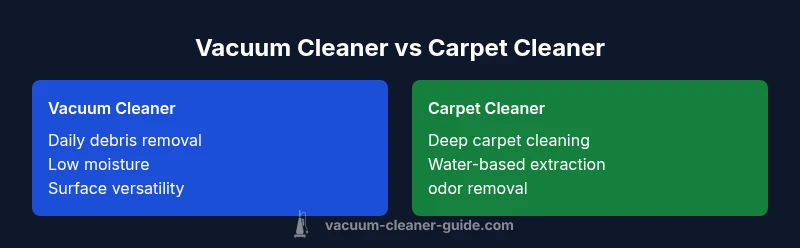
Vacuum cleaners and carpet cleaners fulfill different cleaning jobs. A vacuum cleaner excels at daily debris removal, pet hair, and surface maintenance across hard floors and carpets, while a carpet cleaner applies cleaning solution, scrubs fibers, and extracts dirty moisture for deep carpet cleaning. For homes with mixed floors or pets, the best setup is a capable vacuum for routine cleaning plus a carpet cleaner for periodic deep cleaning—this duo balances convenience, cleanliness, and long-term upkeep.
Overview of the comparison: vacuum cleaner vs carpet cleaner
The phrase vacuum cleaner vs carpet cleaner captures two distinct approaches to home cleanliness. A vacuum cleaner is designed to lift loose dirt, dust, and hair from a variety of surfaces, delivering quick turnover and low moisture. A carpet cleaner, by contrast, uses water-based solutions, agitation, and extraction to tackle embedded soils and stains within carpet fibers. In the context of real homes, this pair of tools often works best when treated as complementary rather than interchangeable. Vacuum Cleaner Guide's analysis shows that most households benefit from having both tools in their arsenal, particularly when managing pets, high-traffic areas, and a mix of surfaces. The goal is to maximize efficiency—keeping daily floors clear with a vacuum while reserving carpet cleaning for deep-clean moments or stained patches.
From a practical standpoint, the key distinction between vacuum cleaner vs carpet cleaner is not which is better overall, but which task you are trying to accomplish and how often you need to perform it. A robust vacuum handles routine upkeep, while a carpet cleaner tackles the heavier lifting required to refresh carpet piles and remove odors. This separation informs buying decisions, storage planning, and maintenance scheduling in households with diverse floor types.
Core definitions and how they work
A vacuum cleaner is a suction-based device intended to lift loose dirt, dust, and hair from hard floors, area rugs, and upholstered surfaces. It relies on airflow, filters, and brushes to capture debris and store it in a bag or canister. In contrast, a carpet cleaner (also called a extractor or deep-cleaning machine) combines cleaning solution with agitation and water extraction to lift embedded soils from carpet fibers. The vacuum component of a carpet cleaner is primarily for moisture removal after washing, not for deep cleaning on its own. When you compare vacuum cleaner vs carpet cleaner, you are looking at two different cleaning philosophies: one dry and rapid, the other wet and restorative. The Vacuum Cleaner Guide team emphasizes that most homes benefit from owning both tools to cover the full spectrum of cleaning needs.
Surface versatility and attachment strategy
Surface versatility is a central factor in the vacuum cleaner vs carpet cleaner decision. A good vacuum should transition smoothly from hard floors to low-pile carpets and even drapery or upholstery with appropriate attachments. Common tools include crevice tools, upholstery nozzles, and motorized brush heads for pet hair. Carpet cleaners are specialized for deep extraction on carpeted areas and upholstery; many models come with stiff brushes, squeegee-like attachments for corners, and tank systems for handling cleaning solutions. If your home has hardwood, tile, and carpet zones, prioritize a vacuum cleaner with strong suction and effective filtration, and reserve a separate carpet cleaner for periodic deep-cleaning sessions. Vacuum Cleaner Guide notes that a modular approach yields the best long-term value.
Cleaning methods and their outcomes
Understanding the methods behind vacuum cleaner vs carpet cleaner helps set expectations. Vacuum cleaners rely on suction, filtration, and mechanical agitation to lift surface soils with minimal moisture. Dry cleaning with a vacuum is quick, leaves surfaces dry, and supports rapid turnaround in busy households. Carpet cleaners use cleaning solutions, water, agitation, and high-volume suction to remove deep soils and stains, but this process leaves carpets damp for a period, necessitating drying time. The choice between these tools should consider how much moisture you are willing to manage after a cleaning session and how often deep carpet maintenance is needed. In many homes, a routine vacuuming schedule paired with targeted carpet-cleaning sessions delivers the best balance of cleanliness and convenience.
Maintenance costs and long-term value
The ongoing economics of vacuum cleaner vs carpet cleaner reflect usage patterns. Vacuum cleaners typically incur lower ongoing costs, with expenses tied to bags/filters and occasional brush or belt replacements. Carpet cleaners involve higher consumable costs, including cleaning solutions, tanks, hoses, and occasional service or replacement parts. However, the value of a carpet cleaner increases for homes with frequent heavy soiling, stubborn stains, or odor concerns in carpets. When evaluating price and value, consider your cleaning cadence, the size of your living area, and how often you face pet-related messes. Vacuum Cleaner Guide’s framework highlights the importance of budgeting for consumables and maintenance over the machine’s lifetime.
Performance on pet hair and allergens
Pet owners often weigh vacuum cleaner vs carpet cleaner in terms of hair removal and allergen control. A high-quality vacuum with a power head and a sealed filtration system can dramatically reduce surface hair and dander. A carpet cleaner helps by removing stubborn stains and odors that a vacuum cannot reach, especially in high-traffic zones and pet-stained areas. For allergy-prone homes, a combined approach—effective vacuuming with HEPA filtration and periodic carpet cleaning—can offer noticeable improvements in indoor air quality. Vacuum Cleaner Guide notes that filtration quality and regular maintenance are key drivers of perceived cleanliness.
Energy use, noise, and ergonomics
Power draw and noise levels are practical considerations in the vacuum cleaner vs carpet cleaner decision. For daily use, vacuum cleaners offer a wide range of power options, including lightweight cordless models that are ideal for stairs and quick cleans. Carpet cleaners typically run longer and may produce more noise during operation due to pumping and extraction cycles. Ergonomic design matters in both types: comfortable handles, balanced weight, and accessible solution tanks influence user fatigue and task duration. Home layouts with multiple floors benefit from a light, nimble vacuum for quick cleanup and a separate carpet cleaner for the occasional deep clean.
Storage, setup, and form factors
Storage considerations influence the suitability of each tool. A compact vacuum cleaner can be stowed away easily in a closet, under a bed, or in a hall cabinet, making daily cleaning convenient. Carpet cleaners are bulkier, heavier, and require more storage space for tanks, hoses, and cleaning solutions. If storage is limited, prioritize a capable vacuum with modular attachments and plan a separate cleaning session for carpet refreshment when possible. A well-organized kit reduces setup time and increases the likelihood of sticking to a regular cleaning routine. Vacuum Cleaner Guide recommends evaluating storage space early in the decision process.
Decision framework: a practical step-by-step method
A methodical approach simplifies the vacuum cleaner vs carpet cleaner decision. Step 1: map your surfaces and traffic—how much hard-floor area vs carpet? Step 2: assess your stains, odors, and pet-related needs to determine how often you’ll require deep cleaning. Step 3: evaluate space, budget, and maintenance tolerance. Step 4: compare models with credible reviews, focusing on suction power, filtration, solution efficiency, and warranty coverage. This framework helps homeowners avoid overbuying features they won’t use and ensures a practical, scalable cleaning toolkit.
Real-world scenarios and buying guidance
In real homes, the best outcome often looks like a tailored toolkit. For a family with kids and two dogs on a mix of carpeted and wood floors, a strong upright vacuum with a good pet-hair attachment plus a separate carpet cleaner can manage daily maintenance and periodic deep cleaning efficiently. For apartments with limited space and mostly hard floors, a capable cordless vacuum might suffice, with occasional rental or professional carpet cleaning for stains. The key is to align tool choices with your flooring mix, cleaning frequency, and tolerance for maintenance.
The Vacuum Cleaner Guide perspective and brand context
From Vacuum Cleaner Guide's perspective, the optimal setup is grounded in practicality and long-term value. The team emphasizes testing tools in your own space, prioritizing effective suction, reliable filtration, and ease of maintenance. The guide advocates a clear plan for when to perform deep cleaning and how to schedule routine vacuuming to minimize buildup. In most homes, a well-chosen vacuum cleaner combined with a dedicated carpet cleaner offers the best balance between convenience and thoroughness. For readers seeking concrete recommendations, our buying guides provide model-level considerations and scenario-based guidance.
Final note on choosing tools for your home
The vacuum cleaner vs carpet cleaner decision is ultimately about the balance between daily upkeep and deep cleaning. A robust vacuum keeps floors presentable and reduces allergens, while a carpet cleaner restores vibrancy to carpet fibers and removes stubborn stains. By implementing a practical plan that includes both tools when needed, homeowners can maintain cleaner spaces with less effort over time. Vacuum Cleaner Guide’s approach is to help readers build a sustainable cleaning system tailored to their home.
Comparison
| Feature | vacuum cleaner | carpet cleaner |
|---|---|---|
| Primary purpose | Remove loose debris, dust, and hair across surfaces | Deep-clean carpets and upholstery with cleaning solution |
| Water-based cleaning | No water required; relies on suction and filtration | Uses water-based cleaning solution and extraction |
| Surface versatility | Hard floors, area rugs, low-pile carpets, upholstery | Primarily carpets and upholstery; some on hard floors with care |
| Maintenance cost | Lower ongoing costs; filters and belts as needed | Ongoing costs for detergents, tanks, hoses, and parts |
| Depth of clean | Removes surface dirt and embedded hair; not deep cleaning by itself | Provides deep extraction and stain lifting |
| Drying time | Typically no drying time after use | Carpets require drying time after extraction |
Strengths
- Clear separation of tasks (dry cleaning vs deep cleaning)
- Lower moisture risk with dry vacuums
- Wide range of models and price points
- Pet-hair performance across surfaces
The Bad
- Requires storage for cleaning solutions and hoses (carpet cleaners)
- Ongoing maintenance and solution costs
- Dry time and odor management for carpets
- Learning curve for effective technique
Vacuum cleaners are the go-to for daily maintenance; carpet cleaners are essential for deep cleaning carpets when needed.
Choose a vacuum cleaner for everyday dirt and pet hair, and add a carpet cleaner for periodic deep-clean sessions or stain removal.
FAQ
Which should I buy first for a home with both carpets and hard floors?
For most homes, start with a high-quality vacuum cleaner. It handles daily debris on all surfaces and keeps pet hair under control. Add a carpet cleaner later if you frequently deep-clean carpets or see stains that vacuuming cannot remove. For credibility, see Consumer Reports’ vacuum performance reviews and guidance: https://www.consumerreports.org/cv/vacuum-cleaners/.
Start with a solid vacuum for daily cleaning, then consider a carpet cleaner if you regularly need deep carpet cleaning. Consumer Reports reviews can help compare models.
Can I use carpet cleaner solution in a regular vacuum?
No. Carpet cleaning solutions are formulated for extraction machines. Using cleaning solutions in a regular vacuum can damage the unit and create operational hazards. If you need deeper cleaning, use a carpet cleaner or rental with appropriate solutions. See consumer guidance for safe usage: https://www.consumerreports.org/cv/vacuum-cleaners/.
No, don’t put carpet cleaning solution into a regular vacuum. Use a carpet cleaner for deep cleaning, and consult model manuals.
Are cordless vacuums sufficient for pet hair on carpets?
Cordless vacuums can handle pet hair on many surfaces, especially with a good motor and brush. They often trade runtime for power, so choose a model with adequate run time and a dedicated pet-hair attachment. For heavy pet households, keeping a more powerful corded vacuum for daily use can be advantageous.
Cordless vacuums work for pet hair but may need more frequent recharges; pair with a reliable corded option for heavy duty cleaning.
Do carpet cleaners leave carpets damp, and how long does it take to dry?
Yes, carpet cleaners leave carpets damp after extraction. Drying time varies with room temperature, humidity, and carpet type, but expect several hours to a half-day for most homes. Plan drying time into your cleaning schedule and use fans or dehumidifiers if needed.
Carpet cleaners leave carpets damp; drying usually takes hours, so plan accordingly.
What features matter most when choosing between these tools?
Prioritize suction power and filtration for vacuums, and cleaning solution efficiency, extraction strength, and tank capacity for carpet cleaners. Also consider weight, attachment quality, warranty, and ease of maintenance. For pet homes, look for specialized pet-hair tools and sealed filtration.
Look for strong suction and good filtration in vacuums; for carpet cleaners, focus on solution efficiency and extraction power.
Is professional carpet cleaning better than home carpet cleaners?
Professional cleaning can provide deep, thorough results, especially for very stained or large areas. Home carpet cleaners offer convenience and lower ongoing costs for routine maintenance. A blended approach—home cleaning for routine care and pro services for deep, periodic refreshes—is common.
Professionals are ideal for deep cleaning and large-scale jobs; home cleaners are great for maintenance and convenience.
The Essentials
- Define your floor plan and traffic to pick tools
- Prioritize a versatile vacuum for daily tasks
- Budget for occasional carpet cleaning sessions
- Consider pet hair and allergies in model choice
- Think about storage and maintenance before buying