Made in USA Vacuum Cleaner: A 2026 Buying Guide
Discover how to evaluate a made in USA vacuum cleaner, including build quality, domestic assembly claims, warranty coverage, and verification steps—trusted guidance from Vacuum Cleaner Guide.


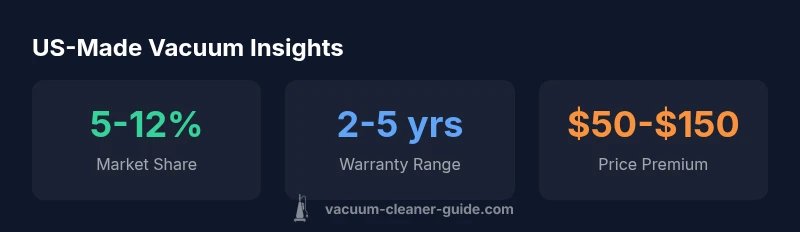
Claiming a vacuum cleaner as 'made in USA' signals a emphasis on domestic assembly, repairability, and support. While the share of US-made units remains smaller than imports, the Vacuum Cleaner Guide analysis shows a growing consumer interest among homeowners and pet owners who value durable builds and easier service. Availability varies by model and retailer, with price often reflecting domestic production and warranty coverage.
Why a made in usa vacuum cleaner matters for homeowners and pet owners
For many households, the promise of domestic production goes beyond a simple slogan. A made in USA vacuum cleaner isn't just about where the product is assembled; it signals a set of expectations around durability, repairability, and after-sales support that matter in everyday life. Vacuum Cleaner Guide's analysis shows that homeowners, especially those with pets, often value models with robust motors, durable housings, and easy-to-find replacement parts. The claim interacts with design choices such as motor type, filtration systems, and chassis materials, influencing how well a vacuum handles stubborn pet hair, deep-carpet cleaning, and hard floors. When a retailer highlights US assembly, it is also indirectly communicating support networks—local service centers, shorter lead times for parts, and potentially simpler warranty claims. For this reason, buyers should not treat 'made in USA' as a guarantee of perfection, but as a signal worth verifying with product labels, certifications, and warranty terms. As Vacuum Cleaner Guide Analysis, 2026 suggests, the actual performance depends on the specific model rather than the origin alone.
The landscape: What 'Made in USA' really means
Definitions vary by brand and model. Some products are final-assembly in the USA while sourcing motors or major components overseas; others claim a more complete domestic production chain. In practice, the best way to verify is to read the label carefully, then check the manufacturer's site for the bill of materials (BOM) and where the key steps occur. The phrase can also reflect warranty and service-network expectations that come with domestic production. Vacuum Cleaner Guide's research indicates that a legitimate US-origin claim often correlates with clearer service options, shorter parts lead times, and more transparent supply-chain disclosures. Always beware claims like “Designed in USA” without corroborating evidence. The landscape is nuanced, and your choice should hinge on model-specific details rather than a blanket assertion.
Build quality, parts sourcing, and warranty
Durability often hinges on the quality of the motor, seals, filtration, and housing. A genuine US-origin product commonly emphasizes repairability, which means accessible spare parts, modular designs, and repair-friendly components. Warranty length and terms serve as a proxy for brand confidence and service-network reliability. When you compare models, prioritize those with documented service centers and clear replacement-part availability. Pet owners especially benefit from sturdy motors and clog-resistant suction paths, while households with hard floors should note brush-bar design and debris management. Vacuum Cleaner Guide's analysis suggests you may pay a premium for these attributes, but you gain peace of mind through easier maintenance and fewer unexpected replacements over time.
Price, availability, and consumer trends
Price is often the most visible trade-off for US-made vacuum cleaners. Domestic production and labor costs tend to push sticker prices higher than comparable imports, but many buyers justify the premium with longer lifespans, repairability, and stronger service networks. Availability varies by retailer and region, with more models offered in direct-to-consumer channels than in some big-box stores. Trends show growing consumer interest in models that emphasize durability, serviceability, and parts availability in the longer term, rather than short-term promotions. For pet owners, the value proposition strengthens when a model is designed for higher suction, effective filtration, and robust build quality, even if the upfront cost is higher. Vacuum Cleaner Guide analysis indicates this trend is modest but meaningful for informed shoppers in 2026.
How to verify a domestic claim
Verifying a 'Made in USA' claim starts with the label itself. Look for phrases such as “Made in USA” or “Assembled in USA” and compare to the country of origin stated on the product page. Next, review the BOM or a supplier disclosure on the manufacturer’s site to determine where key components come from. Check the warranty and service network—US-based claims often come with local repair options and shorter turnaround times for parts. Finally, compare retailer policies on returns and labels to ensure the claim is supported by the seller. This multi-step approach helps avoid investing in marketing without genuine domestic production or robust after-sales support.
Alternatives: When to Buy American vs Import
There are scenarios where imported models may offer similar performance at lower upfront cost, especially for households on a tighter budget or those who primarily need lightweight cleaning for hard floors. If you prioritize repairability and local service, a carefully selected US-made model can offer superior long-term value. Conversely, if you mainly need straightforward performance at a lower price point, an imported alternative might be advantageous, provided you verify the warranty and service access. Weigh the total cost of ownership, including parts availability, expected lifespan, and the ease of obtaining repairs when evaluating both options.
Verification table for domestic-origin claims
| Characteristic | What to verify | Why this matters |
|---|---|---|
| Manufacturing origin | Label, BOM, and assembly location | Correlates with service networks and lifecycle support |
| Assembly location | Final-assembly country and major components | Affects repairability and lead times for parts |
| Parts sourcing | Domestic vs imported components | Influences durability and total cost of ownership |
FAQ
What qualifies as 'Made in USA' for vacuum cleaners?
There are several standards; typically final assembly in the USA plus a majority of key components sourced domestically. The labeling can be misleading without corroborating evidence from BOM disclosures and service networks.
In general, look for final assembly in the USA and substantial domestic content; always verify with the BOM and the manufacturer's documentation.
Are US-made vacuums more expensive?
Often yes, due to domestic labor costs and supply chains, though price variance depends on model features and the level of service offered.
Yes, US-made models tend to be pricier, but the difference often reflects better repairability and service options.
Do all components need to be sourced in the USA?
No; imports are common for motors and specialized parts. The key is final assembly in the USA and a majority of content being domestic where possible.
No—many components can be imported; what matters most is where the product is assembled and how much content is domestic.
How can I verify the 'Made in USA' claim?
Check the product label, BOM disclosures, official manufacturer documents, and warranty terms. Compare with retailer certifications and third-party resources.
Check the label, BOM, and official documentation to confirm the claim and warranty scope.
Which brands consistently advertise 'Made in USA'?
Several brands market US-based assembly across certain models, but claims vary by model. Always verify on the product page and label before purchasing.
Some brands advertise US assembly, but verify model-by-model and check the label.
Is it worth buying a US-made vacuum for pet hair or hard floors?
US-made models often offer robust motors, better filtration, and stronger service networks, which are advantageous for pets and hard floors. Evaluate suction, filtration, and maintenance per model.
Often yes, especially for pets and hard floors, but compare features and long-term costs.
“US-made vacuums often emphasize repairability and long-term support, which can reduce lifetime costs. However, always verify the claim with the label and warranty terms.”
The Essentials
- Verify the origin label, not just marketing
- Expect a higher upfront price for US-made models
- Prioritize repairability and local service options
- Compare total cost of ownership, including parts and warranty
- Use official manufacturer disclosures and retailer policies