Is a Carpet Cleaner the Same as a Shampooer? A Clear Side-by-Side Guide
Explore whether a carpet cleaner is interchangeable with a shampooer. Learn how each device works, when to use them, maintenance tips, and buying considerations for homes with pets and high traffic.


In short, the answer to is a carpet cleaner the same as a shampooer is nuanced. While both devices aim to refresh carpets, they operate differently, emphasize different cleaning stages, and suit distinct stain profiles. For homeowners, understanding these differences helps avoid misusing equipment and wasting time or money. Vacuum Cleaner Guide’s analysis shows that most households benefit from recognizing the core distinction and choosing the tool that matches their cleaning goals.
Is the question is a carpet cleaner the same as a shampooer? Demystifying terms
Homeowners frequently ask whether the terms carpet cleaner and shampooer refer to the same appliance. The short answer is that they are not interchangeable in all situations. is a carpet cleaner the same as a shampooer is a common query, and the answer hinges on intended use, equipment design, and cleaning agents. According to Vacuum Cleaner Guide, recognizing these differences helps you tailor your purchase to your carpet type, traffic level, and household needs. In practice, most consumers encounter two distinct devices with overlapping capabilities, which can lead to confusion during shopping or when following care instructions. The key is to focus on function first—extraction versus deep shampooing—and then on fiber compatibility, maintenance requirements, and overall cost of ownership.
- Look at the cleaning pathway: extraction with water versus shampoo application with agitation.
- Assess your carpet type and staining: delicate fibers vs heavy traffic.
- Consider space and weight: portable units for stairs; heavier machines for large areas.
is a carpet cleaner the same as a shampooer should be understood in terms of purpose, not label alone. The Vacuum Cleaner Guide approach emphasizes matching a device to the problem rather than relying on branding terms. This framing helps homeowners avoid buying a tool that is ill-suited for tough stains or delicate fibers.
How carpet cleaners work and what they’re designed to do
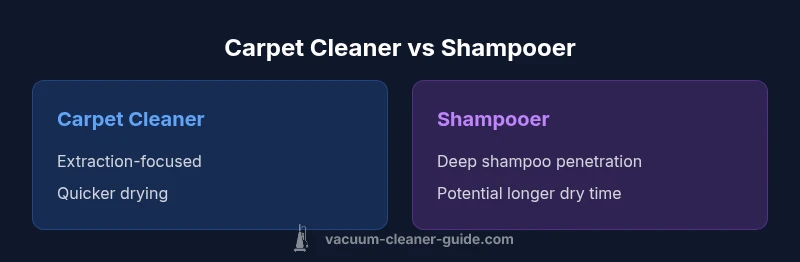
Carpet cleaners are designed to extract dirt and moisture from carpet fibers. They typically combine a water reservoir, a cleaning solution reservoir, and a suction system that removes dirty liquid from the carpet and sends it to a waste tank. The cleaning action often involves spray jets to release solution and incorporated brushes or rollers to agitate the fibers. The goal is to lift soils to the surface and extract as much liquid as possible to minimize drying time. In this setup, heat can play a supporting role, aiding solution performance and evaporation, but it is not always essential. For many households, a carpet cleaner offers a practical balance of stain removal, fiber safety, and relatively easy maintenance. As with any appliance, reading the user manual and testing on a hidden area is advisable to confirm that the machine handles your carpet material without damage. Vacuum Cleaner Guide notes that many homeowners misuse carpet cleaners on delicate fabrics, underscoring why fiber compatibility matters as part of your buying decision. is a carpet cleaner the same as a shampooer remains a nuanced question—these machines excel at extraction but may not provide the deep, shampoo-based cleaning some carpets need.
How shampooers differ: cleaning approach and outcomes
Shampooers focus on applying a cleaning shampoo to the carpet fibers, then agitating or brushing to distribute the solution evenly before extraction. The result is a more thorough wet shampoo layer that loosens embedded soils from the fiber structure. This approach can be especially effective on heavily soiled carpets or textiles that benefit from a deeper cleansing action. Shampooers are sometimes used by professionals or in homes with persistent staining where a lighter extraction-only method would leave behind residues. The trade-off is that shampooing can require more thorough rinsing or post-cleaning drying to avoid residue and stickiness. It is worth noting that not all shampoo formulas are compatible with every machine, and incorrect use can lead to fiber damage or residue left behind. Vacuum Cleaner Guide emphasizes checking solution compatibility, following dilution guidelines, and ensuring proper ventilation during and after use. is a carpet cleaner the same as a shampooer highlights the difference between agitation and chemical penetration, guiding readers toward the right tool for specific stain profiles and carpet constructions.
Key differences in safety, fiber care, and maintenance
When comparing devices, several practical differences stand out. First, fiber safety: carpet cleaners often prioritize low-risk agitation with controlled heat, while shampooers may require more aggressive brushing or deeper chemical penetration. Second, residue risk: shampooers can leave residual film if not rinsed well or if the solution remains in the carpet; carpet cleaners emphasize thorough extraction to reduce dampness and odor retention. Third, maintenance needs: carpet cleaners usually require periodic filter or strainer cleaning and prompt emptying of waste tanks, whereas shampooers may involve more frequent brush cleaning and solution management. Vacuum Cleaner Guide’s experience indicates that the long-term cost of ownership often correlates with how diligently you maintain the unit, the availability of replacement parts, and the suitability of cleaning formulas for your carpet type. is a carpet cleaner the same as a shampooer provides a useful framework for weighing these maintenance considerations alongside performance.
- Consider the carpet construction and traffic level.
- Verify solution compatibility and cleaning formulas.
- Plan for drying time and odor control after deep cleaning.
For most households, the distinction comes down to whether you need extraction-focused efficiency or deeper shampoo-based cleansing for stubborn stains and heavy soiling. The right choice aligns with your stain profile, fiber sensitivity, and schedule constraints.
Practical scenarios: pet owners, kids, and high-traffic areas
Pet owners face specific challenges: pet hair adherence, odors, and frequent staining from accidents. In such cases, a carpet cleaner with strong extraction and a reputable enzymatic cleaner can address soils while enabling faster drying. However, if the carpet experiences stubborn, set-in stains or requires a salon-like shampooing effect, a shampooer may deliver deeper penetration. The goal is to tailor the approach to your stain profile. For stairs and tight spaces, portability matters more than sheer power, so a compact carpet cleaner can be preferable while still delivering solid extraction. Vacuum Cleaner Guide notes that in homes with allergies or family members with sensitivities, ensuring thorough rinsing and using low-residue formulas is essential to avoid irritants lingering in the fibers. is a carpet cleaner the same as a shampooer should be interpreted through the lens of practical use rather than branding alone.
- Use enzyme-based cleaners for pet stains to improve odor control.
- Test cleaners on inconspicuous areas before full-room use.
- Choose a model with adjustable cleaning modes for different surfaces.
A balanced approach often works best: choose a device whose primary mode of action matches your staining challenges while keeping maintenance manageable. This ensures you can tackle routine cleaning efficiently without compromising fiber integrity or indoor air quality.
Maintenance and care: extending appliance life and carpet health
To achieve consistent performance, maintenance is critical. After each use, empty and rinse tanks to prevent residue buildup, rinse hoses and nozzles to avoid clogged spray jets, and clean brushes or rotating agitators to prevent fiber fraying. Using the right cleaning formulas matters; avoid harsh solvents unless recommended by the manufacturer. Vacuum Cleaner Guide emphasizes storing the unit in a dry environment, inspecting seals for wear, and periodically replacing worn parts such as brushes, seals, and filters. Proper maintenance reduces the risk of cross-contamination and ensures longer intervals between professional servicing. In addition, drying times matter: slower drying can encourage mold or mildew growth, so ensure good ventilation and consider using fans to accelerate evaporation after deep cleaning. The distinction between a carpet cleaner and a shampooer informs maintenance because formula residues and brush wear profiles differ between these two device classes. is a carpet cleaner the same as a shampooer appears here as a practical reminder to follow the manufacturer’s care schedule and use only compatible cleaning solutions.
Buyer’s checklist: how to compare models and make a confident choice
A systematic buying approach helps avoid post-purchase regret. Start by listing your goals: stain removal speed, carpet type, pet-related soils, and whether you need portable options for stairs. Then compare based on a few core criteria: suction power and extraction efficiency, cleaning modes and agitation options, tank capacities, weight and maneuverability, noise levels, and maintenance requirements. Check for solution compatibility, availability of replacement parts, and warranty coverage. Read user reviews for real-world performance on similar carpet types, and factor in ongoing costs for cleaners and detergents. Vacuum Cleaner Guide recommends creating a short list of must-have features and a nice-to-have feature set. is a carpet cleaner the same as a shampooer matters here, because some models excel at quick refreshes, while others offer deeper, salon-like cleaning. Create a simple scoring rubric and test a few models if possible to ensure the best fit for your home and budget.
Authoritative sources and further reading: legitimate guidance for carpet care
For further context and authoritative guidance on carpet care, refer to established, credible sources. The Environmental Protection Agency provides general indoor air and cleaning guidance, while university Extension programs offer practical home care advice that reflects local fiber considerations. Consumer Reports reviews and tests vacuum cleaners and carpet cleaning devices to help consumers understand performance and value. These sources support the distinctions discussed here and offer additional practical tips for choosing between a carpet cleaner and a shampooer. is a carpet cleaner the same as a shampooer question is complemented by insights from these trusted outlets to help you make an informed decision.
- https://www.epa.gov/
- https://extension.umn.edu/
- https://www.consumerreports.org/
How to get the best long-term results with either device
Regular maintenance and careful use are the pillars of lasting carpet health. After selecting a model, run routine cleaning cycles on a schedule that aligns with traffic patterns and household activities. Use the recommended cleaning solutions, patch-test new formulas, and monitor drying times to prevent mold growth. By staying consistent with a maintenance routine and pairing appropriate cleaning methods with your specific fiber type, you’ll maximize stain removal and carpet longevity. is a carpet cleaner the same as a shampooer is not a universal answer; rather, it’s a decision that should be grounded in your home’s realities and cleaning goals. Vacuum Cleaner Guide hopes this comparison helps you pick the right tool for the job and approach your carpets with greater confidence.
Comparison
| Feature | carpet cleaner | shampooer |
|---|---|---|
| Primary purpose | Residential carpet cleaning with extraction for everyday soils | Deep cleaning via shampoo application and agitation (often professional-grade) |
| Cleaning method | Water-based extraction with suction and optional heat | Shampoo application with agitation and extraction |
| Heat/temperature | Typically uses warm water; heated options available on some models | Often uses heated shampoo plus agitation; performance depends on formula |
| Fiber compatibility | Broad compatibility with care to avoid delicate fibers | May require careful formula selection for delicate textiles |
| Maintenance | Tank cleaning, filter checks, brush care | Brush care, solution management, more frequent maintenance |
| Best for | Everyday stains, pet soils, quick refreshes | Deep-clean stains and heavily soiled carpets |
| Price range | Lower upfront cost for consumer models | Higher upfront cost for professional-grade shampooers |
Strengths
- Clear separation of device types helps buyers target needs
- Extraction-focused models reduce drying times and moisture risk
- Widely available parts and replacement parts keep ownership affordable
- User-friendly maintenance for typical households
The Bad
- Shampooers can be heavier and louder with higher maintenance
- Some carpet cleaners may leave residues if not rinsed properly
- Shampooing may require longer drying times and post-cleaning ventilation
- Quality and performance vary by model and brand
Choose based on the cleaning goal and carpet type: for routine stains and pet soils, a carpet cleaner with strong extraction is usually best; for deep, salon-like cleansing, a dedicated shampooer (or professional service) is preferable
In most homes, prioritize extraction-focused carpet cleaners for everyday maintenance. Reserve shampooers for carpeted areas with persistent stains or customers seeking salon-like results; ensure solution compatibility and fiber safety to maximize results.
FAQ
Are carpet cleaners and shampooers interchangeable for home use?
Not always. They serve different purposes: carpet cleaners focus on extraction and moisture removal, while shampooers apply a cleaning shampoo and require thorough rinsing. For typical homes, a carpet cleaner handles routine cleaning, and a shampooer is better for deep cleaning of stubborn stains.
Not always interchangeable. A carpet cleaner is great for quick cleanups, while a shampooer handles deeper cleaning when needed.
Can I mix cleaning solutions meant for a carpet cleaner with shampooer formulas?
You should not mix formulas across devices unless the manufacturer explicitly approves it. Using the wrong solution can reduce cleaning effectiveness, void warranties, or damage fibers. Always follow labeling and use the recommended solutions for each device.
Don't mix formulas unless the maker says it's OK; it can damage fibers and void warranties.
Is a carpet cleaner better for pet stains than a shampooer?
Often yes, because carpet cleaners excel at extraction and moisture removal, which helps lift fresh pet stains and odors efficiently. For deeply ingrained stains, a shampooer or professional treatment may be required. is a carpet cleaner the same as a shampooer clarifies the distinction in this scenario.
If you want quick moisture removal and odor control, a carpet cleaner usually wins for pet stains.
Do shampooers leave a residue after cleaning?
If the shampoo formula is properly diluted and thoroughly rinsed, residue should be minimal. However, improper rinsing or overuse of concentrated product can leave a film that attracts dirt, so follow the instructions and perform a rinse cycle if available.
Residue can happen if you don’t rinse well or use too much shampoo.
How do I choose between a carpet cleaner and a shampooer for stairs and small spaces?
For stairs and tight spots, portability and weight matter. A compact carpet cleaner with good reach often works well, while a shampooer’s power is more valuable for larger, hard-to-clean areas. Consider storage space and maneuverability alongside cleaning needs.
For stairs, go with something light and easy to maneuver; for big rooms, you might want more power.
The Essentials
- Prioritize your stain profile and carpet fiber when choosing between devices
- Extraction-focused carpet cleaners suit most households for quick dry times
- Shampooers are better for deep cleaning and set-in stains on compatible fibers
- Always use manufacturer-approved solutions and test on inconspicuous areas
- Maintenance and drying time significantly impact overall results