Difference Between Vacuum Cleaner and Dust Extractor
A thorough comparison of vacuum cleaners and dust extractors, covering use cases, filtration, noise, maintenance, and buying guidance for homeowners and workshop setups.


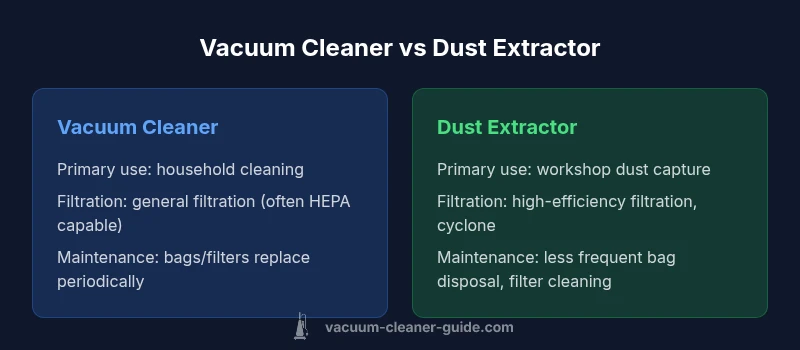
According to Vacuum Cleaner Guide, the difference between vacuum cleaner and dust extractor hinges on intended use, filtration, and dust handling. A vacuum cleaner is designed for household cleaning of floors and upholstery, while a dust extractor is a dedicated workshop tool that captures dust at the source with higher filtration. Choose based on space, dust type, and cleanliness requirements.
The difference between vacuum cleaner and dust extractor explained
In everyday language, a vacuum cleaner and a dust extractor serve related but distinct roles. A vacuum cleaner is a general cleaning tool intended for domestic environments: living rooms, bedrooms, carpets, hard floors, and soft furnishings. It emphasizes convenience, portability, and versatility, often offering attachments for upholstery, stairs, and cars. A dust extractor, by contrast, is a workshop-oriented device designed to capture dust generated at the source during woodworking, metalworking, or similar activities. Its primary goal is to keep the air and work area cleaner and to reduce the spread of ultrafine dust. This fundamental distinction—home cleaning versus source capture—drives most of the subsequent design choices and performance expectations.
Core design and filtration: how they differ in construction
Design decisions reflect the environments they serve. A household vacuum cleaner typically focuses on compactness and ease of use. It often uses a bag or a bagless bin with a relatively straightforward filtration system aimed at catching dust and larger debris, suitable for carpet and hard surfaces. Filtration remains important for indoor air quality, but the emphasis is on convenience and maintenance cycle speed. A dust extractor prioritizes robust dust capture and clean air return. Expect larger, more powerful motors, longer suction runs, and filtration systems designed to handle fine particulates produced by cutting, sanding, or turning materials. Cyclones, high-efficiency filters, and sealed dust paths help prevent fines from escaping back into the room.
Suction dynamics and air flow fundamentals
Suction performance is a key differentiator. Vacuum cleaners optimize for consumer-scale airflow suitable for room cleaning, often balancing suction with maneuverability and noise. Dust extractors prioritize steady airflow at higher static pressures to pull dust directly from workpieces or tools. This can mean a higher effective capture rate for fine dust, especially when paired with a properly sealed duct or tool port. In practice, you will notice dust extractors draw dust from the source more efficiently and keep the surrounding air cleaner during heavy-duty tasks, whereas a household vacuum may struggle with very fine dust generated by certain power tools.
Dust capture and filtration details
Filtration quality is central to the dust management story. Household vacuums usually employ a sequence of filters designed to trap dust and allergens for indoor use, with HEPA-capable models available in higher-end designs. Dust extractors concentrate on fine dust control and often include sealed housings, cyclone pre-separation, and high-efficiency filters or HEPA equivalents rated for workshop environments. The goal is to minimize re-entrainment of dust into the work area and the indoor air supply of adjacent living spaces. When shopping, assess the filter class, the presence of a cyclone stage, and whether the unit is designed for dry dust only or can handle small amounts of liquids as well.
Use cases: home cleaning vs workshop dust control
For home environments, a vacuum cleaner is typically sufficient for routine cleaning and maintenance. It handles pet hair, carpet fibers, and surface debris with a reasonable balance of suction, noise, and cost. In a workshop or garage, a dust extractor shines because it captures dust at the source before it becomes airborne, lowers exposure risk, and helps keep tools clean. If your work involves sanding, sawing, or engraving, a dust extractor connected to portable power tools or a centralized system can dramatically reduce dust dispersion and improve overall air quality. In rare cases, a hybrid approach—using both devices in a coordinated setup—offers the most comprehensive solution.
Maintenance costs and lifecycle: bags, filters, and care routines
Maintenance costs and schedules matter for total ownership. Vacuum cleaners typically require occasional bag replacements, filter changes, and motor upkeep. The frequency depends on use intensity, floor type, and household allergen load. Dust extractors demand attention to pre-separation stages, primary filters, and occasional bag or cartridge replacements. Accessory wear rises with heavy use, but many workshop units are built for durability and sustained airflow. Plan for buying replacement filters, bags, and potentially cyclone accessories as part of the long-term cost of ownership, rather than as an afterthought.
How to choose: a practical decision framework
Develop a simple framework to decide which tool fits your situation. Start with dust type and exposure risk: is there a lot of fine wood dust or mineral dust? Next, evaluate space and mobility: can you tolerate a larger footprint or need a compact, maneuverable unit? Consider power needs and noise tolerance: workshop environments may justify louder, more powerful units, while living spaces benefit from quieter operation. Finally, price and availability of accessories should factor into the decision. A methodical approach—assessing use-case, environment, and maintenance costs—will lead to a rational choice rather than chasing features you don’t need.
Practical scenarios and decision trees: applying the rules to real life
Imagine a small home workshop where occasional woodworking creates fine dust. If the primary goal is gradual dust control near the workbench, a dust extractor with a portable ported hose can capture chips and dust efficiently. For a living room full of pet hair and daily vacuuming needs, a versatile vacuum cleaner with good filtration and attachments is appropriate. In a larger shop with multiple tools and longer runs, installing a centralized dust collection system or a robust dust extractor network can provide consistent air quality benefits. Use flow diagrams or simple yes/no checklists to guide tool selection in each scenario, keeping the decision pragmatic and practical.
Common misconceptions and myths about these tools
A frequent misconception is that a dust extractor is just a high-powered shop vac. While there is overlap in capabilities, dust extractors are designed for uninterrupted operation, source capture, and better filtration for fine dust, not just larger debris. Another myth is that these devices are interchangeable for all tasks; they are not. Using a household vacuum to manage workshop dust can lead to clogged filters, reduced suction efficiency, and elevated air contaminants. Conversely, using a dust extractor for household cleaning may be inefficient and expensive. Finally, some assume that louder equipment is always better; in reality, many modern devices balance performance with acceptable noise levels.
Integrating both tools in a hybrid setup: when it makes sense
For some homeowners and small shops, a hybrid approach delivers the best of both worlds. Pair a compact vacuum cleaner for everyday cleaning with a dedicated dust extractor for tasks that generate fine dust. This arrangement minimizes downtime and keeps air quality high in living spaces. If space and budget allow, a centralized dust collection system linked to multiple tools can provide scalable dust management across a workshop, while a portable vacuum handles daily cleanup in adjacent living areas. The key is to design an arrangement that minimizes dust escape and prioritizes user safety.
Comparison
| Feature | Vacuum Cleaner | Dust Extractor |
|---|---|---|
| Primary use | Household cleaning (floors, carpets, upholstery) | Workshop dust capture at the source |
| Filtration emphasis | General filtration; HEPA capable in premium models | High-efficiency filtration with cyclone pre-separation |
| Dust collection method | Bag or bagless bin; straightforward disposal | Cyclone pre-separation; bagged or bagless cartridges |
| Portability/size | Typically compact and light for home use | Heavier, may require mounting or longer ducts |
| Noise level | Lower to moderate; designed for home environments | Often louder due to continuous operation and airflow |
| Maintenance cost | Filter and bag replacements; occasional maintenance | Regular filter changes; possible cyclone cleaning |
| Price range | $50–$300 (entry-level models) | $150–$800+ (quality workshop units) |
| Best for | Everyday cleaning in homes with allergy considerations | Dust control in woodworking, metalworking, or crafting environments |
Strengths
- Versatile for household cleaning tasks and quick messes
- Widely available with broad accessory options
- Better indoor air quality control with enhanced filtration
- Compact models fit small living spaces
The Bad
- Dust extractors excel at dust control but can be bulky
- Higher upfront cost for quality workshop units
- Maintenance of bags/filters adds ongoing costs
Dust extractors win for workshop dust control; vacuum cleaners win for home cleaning versatility.
Choose a dust extractor when source capture and fine dust control are priorities. Opt for a vacuum cleaner for everyday household cleaning and simple maintenance.
FAQ
What is a dust extractor and how does it differ from a vacuum cleaner?
A dust extractor is a workshop tool designed to capture dust at the source during cutting, sanding, or grinding, using high-efficiency filtration and often cyclone pre-separation. A vacuum cleaner is a general-purpose device for household cleaning, targeting floors and fabrics with more portable design and everyday filtration needs.
A dust extractor captures dust at the source in a workshop, while a vacuum cleaner cleans floors and fabrics at home with standard filtration.
Can a dust extractor be used for home cleaning?
Dust extractors can supplement home cleaning but are not typically optimized for everyday household tasks. They are heavier, louder, and designed for continuous dust collection from tools, not general surface cleaning. For living spaces, a traditional vacuum cleaner remains more practical and user-friendly.
Dust extractors are primarily for workshops; use a vacuum cleaner for home cleaning unless you need source capture for heavy dust tasks.
Are vacuum cleaners suitable for workshop dust?
Some vacuum cleaners are capable of handling workshop dust if they have robust filtration and a design for dry dust collection; however, they may struggle with fine dust and long continuous operation. A dedicated dust extractor generally performs better for workshop environments due to higher filtration efficiency and source capture.
A workshop-focused dust extractor usually performs better than a standard vacuum for fine dust and continuous use.
Do dust extractors require bags or canisters?
Many dust extractors offer both bagged and bagless options. Bags can simplify disposal, while bagless designs rely on cartridges or cyclones. Check your model for compatibility with your preferred disposal method and maintenance routine.
Most dust extractors support bags or bagless cartridges; choose what fits your disposal preference.
How should I choose between the two for a mixed-use space?
Assess dust type, space, noise tolerance, and budget. If you frequently generate fine dust, a dust extractor is advantageous. For flexible cleaning needs with limited space, a capable vacuum cleaner may be the better starting point, with a future addition of a dust extractor if needed.
If you work with dust often, pick a dust extractor; for mixed-use spaces, start with a good vacuum and plan for a dust extractor later.
Can I connect a dust extractor to power tools for filtration?
Yes. Many dust extractors offer tool ports that connect directly to power tools, enabling dust capture at the source. This setup improves air quality and reduces cleanup time, especially in woodworking or metalworking tasks.
You can connect it to power tools via tool ports for effective source capture.
The Essentials
- Define your use-case before buying.
- Prioritize filtration quality and dust class.
- Consider space, noise, and maintenance costs.
- Budget for bags/filters and potential accessories.
- A hybrid setup can cover both home and workshop needs.