Robot Vacuum Cleaner Price in 2026: What to Expect Now
Explore robot vacuum cleaner price ranges in 2026, what features drive cost, and how to balance upfront price with long-term value. Practical guidance for pet-friendly homes.


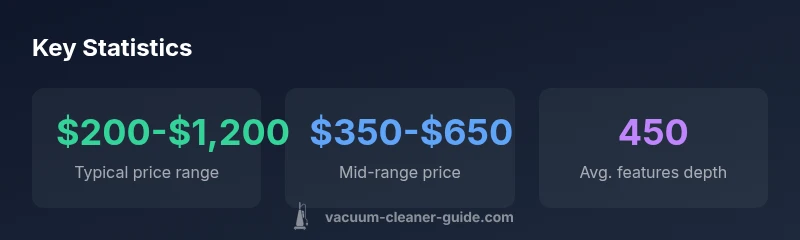
In 2026, robot vacuum prices range from roughly $200 to $1,200, with core differences driven by navigation tech, suction power, dustbin size, filtration, battery life, and smart features. Entry-level models cover basics, mid-range adds mapping and app control, and premium units offer advanced sensors, multi-floor memory, and self-emptying docks.
Why Price Varies Across Robot Vacuums
The price tag on a robot vacuum cleaner is rarely about one feature alone; it reflects a bundle of capabilities, hardware quality, and software support. When evaluating robot vacuum price, homeowners should weigh navigation technology, suction power, dustbin size, filtration, battery life, and smart integration. Entry-level models typically focus on basic cleaning and simple scheduling, while mid-range options introduce robust mapping, better app control, and multi-floor memory. Premium units justify their higher price with advanced mapping accuracy (often using LIDAR), faster motors for deeper cleaning, self-emptying docks, extended battery life, and enhanced maintenance alerts. In 2026, consumers increasingly expect long-term reliability and software updates, which can influence the sticker price. According to Vacuum Cleaner Guide, the best value often sits at the intersection of durable build, reliable mapping, and reasonable ongoing costs. For pet owners, price often tracks pet-hair performance, filter quality, and brush design. Consumers should also consider warranty length and availability of replacement parts when assessing total ownership costs.
Key Price Tiers and What They Include
Robot vacuum price typically falls into three broad tiers: Entry-level, Mid-range, and Premium. Entry-level models (roughly $200-$300) cover essential cleaning, scheduling, and basic navigation. Mid-range models (roughly $350-$650) add better mapping, room-by-room cleaning, app control, and longer battery life. Premium units (roughly $650-$1,200) feature advanced mapping (often with laser or mapping cameras), self-emptying docks, multi-floor memory, and robust app ecosystems. In practice, the best-value choice for many homes sits in the mid-range, while premium models are worth it for large homes, pets, or heavy dirt loads. Pricing also reflects build quality, service availability, and the likelihood of future software updates.
Features That Drive Price (and Value)
Price increases are typically tied to technology depth and build quality. Navigation technology such as LIDAR vs camera-based systems adds to cost but improves accuracy. Self-emptying docks reduce daily maintenance but add upfront expense. Stronger suction and better filtration raise price but can lower long-term maintenance costs by trapping more dirt and pet hair. Higher-end models often offer multi-room mapping, no-go zones, voice assistant integration, and robust app diagnostics. App customization and diagnostics also factor into the value proposition. In short, you’re paying for precision, reliability, and convenience rather than just raw cleaning power.
Hidden Costs and Long-Term Ownership
Beyond the sticker price, robot vacuums incur ongoing costs. Replacement filters and brushes are regular expenses, and some models require periodic battery checks or replacements after many charge cycles. Self-emptying docks may demand compatible bags or cartridges. Warranty length and access to affordable spare parts can significantly affect total ownership costs over several years.
Shopping Strategies for Pet Owners
Pet owners should prioritize models designed for hair pickup, with strong suction, tangle-free brushes, and high-quality filtration. Consider noise levels for households with sleeping pets, and evaluate maintenance time and disposal needs for used debris. Look for bundles that include extra brushes or filter sets to reduce future costs. A price-conscious shopper should compare across brands and read independent reviews to verify claimed pet-hair performance.
How to Use Price Insights to Decide
Start by listing must-have features (mapping, self-emptying, battery life) and your budget. Compare three models in each tier, focusing on feature sets that align with your home size and dirt load. Calculate approximate annual maintenance costs, including filters and part replacements, and weigh them against upfront price. This approach helps you find the best balance of upfront cost and long-term value.
Robot vacuum price tiers at a glance
| Model Tier | Typical Price Range | Key Features |
|---|---|---|
| Entry-level | $200-$300 | Basic cleaning, scheduling, limited mapping |
| Mid-range | $350-$650 | Improved suction, mapping, app control, multi-floor |
| Premium | $650-$1,200 | Advanced mapping, self-emptying, robust app, wide feature set |
FAQ
What is the typical price range for robot vacuums in 2026?
In 2026, robot vacuums generally range from $200 to $1,200, depending on features such as mapping, suction, and self-emptying capabilities. Mid-range models often provide the best balance of features and cost.
Robot vacuums usually cost between two hundred and twelve hundred dollars, with mid-range models offering the best value.
Do pet-hair optimized models cost more?
Yes. Models designed for pet hair typically carry higher price tags due to stronger suction, better brushes, and enhanced filtration.
Yes, pet-hair focused models tend to be pricier because they handle hair better.
Is it worth paying for a self-emptying dock?
For homes with pets or heavy debris, a self-emptying dock can save time on maintenance and reduce ongoing work, though it isn’t essential for smaller spaces.
If you have pets or lots of debris, a self-emptying dock can be worthwhile.
What maintenance should I budget for?
Plan for periodic filter and brush replacements and occasional battery checks. Ongoing costs can add up over years, so include these when comparing upfront price.
Expect ongoing costs for filters and brushes.
How can I compare prices effectively?
Create a checklist of must-haves, compare map tech, suction, battery life, and warranty, and watch for bundles or seasonal promotions to maximize value.
Make a simple checklist and compare several models side by side.
“Price is a strong proxy for capabilities, but true value comes from how well the model fits your space and routine.”
The Essentials
- Define your budget across tiers
- Mid-range models offer best value for most homes
- Premium adds advanced mapping and self-emptying
- Consider maintenance costs in total ownership
- Use price insights to guide your purchase decision