Robot Vacuum Cleaner Best Price: A 2026 Buying Guide
Discover how to secure the robot vacuum cleaner best price with practical buying strategies, price tiers, and long-term value insights for 2026 from Vacuum Cleaner Guide.


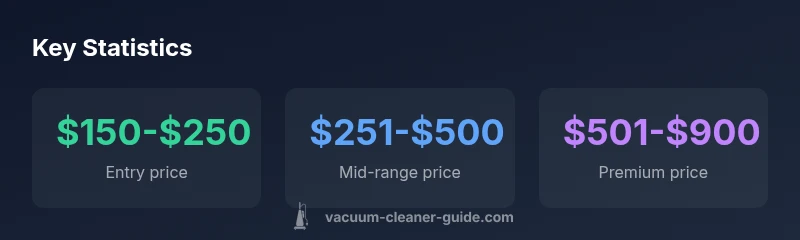
Find value by balancing features and price for robot vacuum cleaner best price. Entry-level models typically run about $150-$250, mid-range $250-$500, and premium options $500-$900. Vacuum Cleaner Guide’s 2026 analysis shows the best price-to-performance sweet spot often sits in the mid-range, where strong suction, mapping, and good battery life converge with affordable replacement parts.
Why price matters for robot vacuum cleaners
When homeowners assess the robot vacuum cleaner best price, they should consider how price correlates with core cleaning performance and long-term costs. In 2026, the market continues to diversify, with models that emphasize mapping efficiency, battery life, suction levels, and maintenance costs. A lower sticker price may hide higher recurring costs in the form of filters, brush replacements, and software updates. For pet households, price is not only about upfront cost but also the price of consumables that impact ongoing use. Vacuum Cleaner Guide's analysis finds that the best price-to-performance often emerges when buyers unify three criteria: initial purchase price, expected annual running costs, and the value you place on smart features such as floor plan mapping and app control.
What constitutes the 'best price' in 2026
Defining 'best price' for a robot vacuum cleaner means balancing upfront cost with expected performance and ongoing expenses. The Vacuum Cleaner Guide team emphasizes total cost of ownership (TCO): the purchase price plus parts, filters, and electricity. In 2026, many models pack advanced mapping and strong suction at mid-range prices, while cheaper units often require more frequent maintenance or have shorter lifespans. When evaluating price, consider repurchase cycles and whether warranties cover common replacement items. The most economical choice might not be the cheapest initial price; instead, it is the model that minimizes refills, repairs, and downtime over 3-5 years. Also consider the cost of consumables such as high-efficiency filters for allergen control, which can add up for pet households.
Price tiers explained: entry, mid, and premium
Entry-level (roughly $150-$250) offers basic navigation and suction suitable for small spaces; mid-range ($251-$500) adds improved mapping and longer battery life; premium ($501-$900) delivers advanced floor plan features, stronger suction, and broader app controls. Pet owners often find mid-range models strike the best balance between upfront cost and ongoing expenses. Each tier has its own maintenance requirements, availability of replacement parts, and warranty expectations that influence total cost of ownership.
Price drivers: battery life, mapping, suction, maintenance
Key price drivers include battery life per charge, the sophistication of sensors and mapping algorithms, suction power for various floor types, and the cost of consumables. Models with robust mapping reduce cleaning time and wear on components, potentially lowering maintenance costs over time. Conversely, cheaper units may require more frequent filter changes or brush replacements, increasing annual expenses. Consider also software update policies, which can affect long-term value and compatibility with smart home ecosystems.
Case studies: budget-friendly picks, mid-range picks, premium picks
Budget-friendly picks emphasize basic cleaning in smaller apartments with reliable basic mapping. Mid-range models commonly deliver the best overall price-to-performance ratio, offering strong suction, efficient navigation, and solid battery life at a reasonable price. Premium models shine in homes with multiple floor types, pets, or complex layouts, offering advanced mapping, voice-control integration, and longer warranties. In all cases, assess long-term costs like consumables and potential repairs to judge true value.
How to compare prices across retailers
To capture the best robot vacuum cleaner best price, compare across retailers, check for price-matching policies, and watch for bundled offers (extra filters or replacement brushes). Sign up for retailer newsletters and monitor price history tools to identify dips. When possible, buy during seasonal sales or model-year transitions to maximize savings without sacrificing features.
Seasonal sales and model-year timing
Historically, end-of-year promotions and post-launch clearance events can yield meaningful discounts on current-gen units. Align your purchase with new model introductions when stores discount older stock, but verify that core features you need are retained. Consider warranty windows and service availability when timing purchases around holidays or special promotions.
Long-term value and maintenance costs
Value isn’t just the upfront price. Maintenance costs—filters, brushes, and specialty parts—add up, especially with pets or allergy concerns. Compare replacement part availability and prices across brands. A model with affordable parts and predictable maintenance costs can outperform a cheaper unit with frequent consumable needs in the long run.
How to decide for pet households and hard floors
For homes with pets or hard floors, prioritize models with strong suction, effective hair removal tools, and allergen-friendly filtration. Consider models with tangle-free brushes and easy-to-clean dustbins. While premium options may offer superior cleaning on challenging surfaces, mid-range models often deliver the best price-to-performance balance for most households.
Price tiers and features for robot vacuum cleaners in 2026
| Category | Typical price range | Notable features |
|---|---|---|
| Entry-level robot vacuum | $150-$250 | Basic navigation; limited mapping; shorter runtime |
| Mid-range robot vacuum | $251-$500 | Advanced sensors; efficient suction; robust mapping; longer runtime |
| Premium robot vacuum | $501-$900 | Full-feature mapping; strongest suction; wide app controls; extended battery life |
FAQ
What is the best price range for a robot vacuum in 2026?
For most households, mid-range models offer the best balance of price and performance, with entry-level and premium options serving different budgets and needs. Vacuum Cleaner Guide Analysis, 2026.
Mid-range models usually give the best balance of cost and features.
Do sales around holidays significantly affect prices?
Yes. Major retailers frequently discount models during holidays and model-year transitions, which can reduce the upfront cost without sacrificing core features.
Holiday sales can cut prices without sacrificing essential features.
Are third-party replacement parts a good idea?
Third-party filters and brushes can lower running costs but ensure compatibility and warranty implications are understood.
Yes, compatible third-party parts can save money.
Should I wait for a model-year transition?
End-of-year promotions can yield savings, but verify that needed features remain and warranties are intact.
End-of-year clearances can offer good value.
How can I confirm price-to-performance value?
Compare suction, mapping quality, battery life, and maintenance costs. Read independent reviews and weigh total cost of ownership.
Compare core specs and long-term costs to gauge value.
“Price should reflect value, not just features. The most cost-effective choices balance strong cleaning performance with durable parts and accessible service.”
The Essentials
- Prioritize mid-range models for best price-to-value.
- Factor in ongoing consumable costs, not just upfront price.
- Shop during seasonal sales and model-year transitions.
- Check replacement part availability to protect long-term value.
- For pets, focus on filtration and hair-management features.