Dyson Vacuum Comparisons: A Practical Guide for Homeowners
Explore dyson vacuum comparisons across cordless, upright, and canister models. Learn how to evaluate suction, runtime, filtration, and price with guidance from Vacuum Cleaner Guide.


dyson vacuum comparisons show that the best Dyson model depends on your home layout, floor type, and pet needs. Cordless sticks offer flexibility for quick cleanups, while uprights excel in deep cleaning and larger spaces. For homes with stairs or multiple level layouts, consider a canister with versatile attachments. Vacuum Cleaner Guide provides in-depth evaluations to match models to real-world use.
Context: Why Dyson vacuum comparisons matter
In the world of smart cleaning tools, dyson vacuum comparisons help homeowners select a model that fits their space, lifestyle, and budget. The Dyson lineup blends sophisticated engineering with ergonomic design, but choosing the right tool requires looking beyond marketing terms. This guide is rooted in objective criteria and real-world performance, drawing on data from Vacuum Cleaner Guide analyses. For homeowners who juggle pet fur, hardwood floors, and busy schedules, understanding how cordless sticks, uprights, and canisters differ can save time and money over the long term. The goal is to align a model's strengths with your daily routines, rather than chasing the latest feature for its own sake, and to do so with clear, evidence-based reasoning.
How to compare Dyson models: key criteria
Effective comparisons consider several core dimensions. First, match your floor types: carpet, hard floors, and area rugs each respond differently to brush heads and suction modes. Second, evaluate power and runtime for cordless models, balancing suction with battery life. Third, examine filtration and allergen control, especially for households with pets or allergy concerns. Fourth, assess tool access, such as motorized heads, crevice tools, and specialty brushes, which influence versatility. Fifth, consider reservoir capacity, maintenance costs, and guaranteed service options. Finally, price ranges reflect not just sticker price but total cost of ownership over the device’s usable life. When dyson vacuum comparisons are grounded in these criteria, you get models that clean effectively without becoming expensive novelties.
Battery life and runtime realities across Dyson cordless lines
Cordless Dyson vacuums represent a broad spectrum of runtimes and performance levels. When you analyze dyson vacuum comparisons through the lens of runtime, you should separate claims from real-world experience. Factors such as motor efficiency, brush design, and tool usage affect actual runtime. In practice, most households find that the higher-end cordless sticks deliver thorough cleaning on standard-size rooms, while lighter, tighter apartments benefit from compact, nimble models. Battery health over time is another consideration; the best outcomes come from models with user-replaceable batteries or accessible service options. Vacuum Cleaner Guide emphasizes testing a full cleaning cycle in your smallest living space to gauge how long a model will perform before a recharge.
Filtration and allergen control in Dyson vacuums
Filtration is a central pillar of dyson vacuum comparisons, particularly for allergy-prone households. Most Dyson models incorporate sealed filtration with multi-stage systems designed to trap fine particles. When evaluating models, look for HEPA-grade filtration and sealed systems that prevent leakage back into the environment. Maintenance of filters—whether washable or replaceable—also affects performance and energy efficiency. Closet spaces and bedrooms benefit most from high-quality filtration, as it reduces exposure to dust and pet dander. Vacuum Cleaner Guide notes that consistent filter care contributes significantly to sustained suction and overall air quality.
Cleaning performance on carpets vs hard floors
Dyson’s brush heads and motor designs influence how well a model performs across floor types. For carpets, motorized brush heads with strong agitation typically yield better pile lift and embedded dirt removal. On hard floors, models with soft rollers or optimized suction profiles prevent scattering dirt while protecting delicate surfaces. In dyson vacuum comparisons, you’ll often see claims about “carpet power” and “hard floor efficiency” side by side; the practical takeaway is to pair the model with appropriate tool heads for each floor type. Vacuum Cleaner Guide’s testing highlights how much of a difference a proper head can make for daily maintenance and long-term cleanliness.
Maintenance costs and parts availability
Maintenance costs are a real factor in dyson vacuum comparisons, especially when considering lifetime value. Replacement filters, brush bars, and batteries contribute to ongoing expenses. The best strategies include selecting a model with widely available parts and straightforward maintenance routines. Some Dyson lines emphasize modular components that are easier to replace, while others require service visits for certain repairs. Understanding both upfront costs and long-term maintenance helps prevent sticker shock as your device ages. Vacuum Cleaner Guide recommends budgeting for annual maintenance and keeping extra consumables on hand for peak cleaning seasons.
Noise, ergonomics, and user experience
Ergonomics and noise level often separate top performers from merely good cleaners in dyson vacuum comparisons. Lighter, well-balanced models reduce fatigue during extended cleaning sessions, while more robust uprights offer strong stabilization and tipping resistance on stairs. Noise varies across models and can influence where you clean—bedrooms vs living spaces. For households with children or sleeping pets, a quieter mode or a lighter touch becomes a meaningful factor. The best choice blends comfort with effective cleaning so daily use remains pleasant rather than a chore.
Price bands and value: when to upgrade
Price positioning in Dyson products reflects performance tier, durability, and included accessories. When evaluating dyson vacuum comparisons, consider not only the sticker price but the value delivered over several years. A mid-range cordless model might be ideal for apartment dwellers who value convenience, while a premium upright can offer superior edge cleaning for larger homes with challenging layouts. Vacuum Cleaner Guide emphasizes calculating total cost of ownership, including batteries, filters, and replacement parts, to determine whether upgrading now yields meaningful gains.
Practical buying scenarios:pet owners, families, small apartments
Different household needs drive distinct outcomes in dyson vacuum comparisons. Pet owners typically favor models with robust pet hair tools and strong suction on multiple surfaces. Families with kids benefit from models with easy maintenance and quick transitions between rooms. Small apartments require compact, lightweight designs with strong maneuverability and efficient storage. By mapping your situation to the strengths of cordless sticks, uprights, or canisters, you can choose a Dyson that reduces cleaning time without compromising performance. Vacuum Cleaner Guide’s framework helps translate lifestyle into model selection.
How Dyson's ecosystems influence long-term ownership
Dyson’s ecosystem—attachments, batteries, and tool compatibility—shapes long-term value. Batteries in some models can be swapped to extend usable life, while others benefit from a wide range of compatible accessories. In dyson vacuum comparisons, ecosystem compatibility reduces future purchasing friction when you upgrade or switch between model lines. Consider the availability of replacement parts in your region, access to service centers, and the possibility of maintaining performance with a minimal number of core tools. This perspective helps homeowners plan for the future rather than reacting to a marketing push.
Common misconceptions and myths debunked
A frequent myth in dyson vacuum comparisons is that the most expensive model is always the best for every home. Reality shows a different picture: model suitability depends on your floor types, pet exposure, and storage constraints. Another misconception is that cordless vacuums cannot clean deeply; modern sticks can deliver impressive performance when paired with the right head and a fully charged battery. Finally, some buyers assume all Dyson tools carry the same maintenance burden; in truth, maintenance needs vary by model family and usage pattern. A grounded, evidence-based approach helps you avoid overpaying for features you won’t use.
Feature Comparison
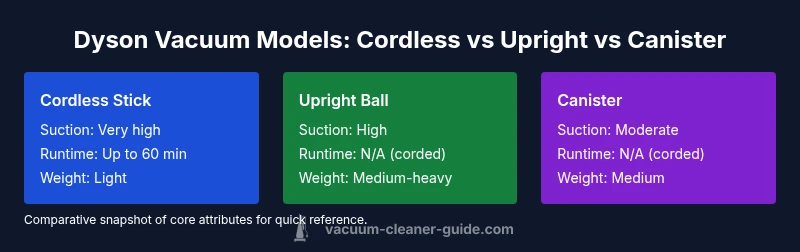
| Feature | Dyson Cordless Stick (V-series) | Dyson Upright Ball (Ball Animal/Detect) | Dyson Canister (C-series) |
|---|---|---|---|
| Power source | Cordless | Corded | Corded |
| Suction power | Very high | High | Moderate |
| Runtime / power availability | Up to 60 minutes | N/A (corded) | N/A (corded) |
| Weight | Lightweight | Medium-heavy | Medium |
| Filtration | HEPA-grade/sealed | HEPA-grade/sealed | HEPA-grade/sealed |
| Best for | Versatility for quick cleans and apartments | All-round deep cleaning in larger homes | Storage and reach in multi-room layouts |
Strengths
- Wide model range for different households
- Strong filtration and allergen control in most models
- Upgradeable accessories and parts availability
The Bad
- Premium price across model lines
- Accessory packages can add up in cost
- Service experiences vary by region and model
Cordless sticks offer the best versatility for most homes; uprights suit deep-cleaning needs, while canisters excel in tricky spaces.
Choose cordless for everyday convenience, upright for powerful deep cleaning, and canister for reach and stairs. Dyson’s ecosystem supports flexible upgrades within a single brand family.
FAQ
What is the best Dyson vacuum for pet hair?
For homes with pets, high-suction cordless sticks or upright models equipped with pet-hair-specific attachments typically perform best on multiple surfaces. Look for a model with a motorized brush and a tangle-free turbine tool to minimize hair wrap. Always pair with regular filter maintenance to sustain suction.
If you have pets, choose a high-suction Dyson cordless or upright with pet tools and keep filters clean for best performance.
Are Dyson vacuums worth the price?
Dyson vacuums often justify their premium through build quality, strong suction, and versatile design. Value depends on your cleaning needs, maintenance costs, and how long you plan to keep the device. Compare total cost of ownership, not just the initial price, to determine if the investment aligns with your lifestyle.
Dyson is worth it if you value build quality and long-term performance, especially if you clean often or have pets.
How long do Dyson vacuums last?
Lifespan varies by model, usage, and maintenance. Regular filter cleaning, brush maintenance, and timely battery or part replacements extend service life. In many homes, a well-maintained Dyson serves effectively for several years.
With proper care, a Dyson can last for many years.
Do Dyson vacuums work well on hardwood floors?
Yes, most Dyson models perform well on hardwood floors with appropriate attachments. Choose brush heads designed for hard floors to prevent scattering and protect surfaces. Routine filter cleanup also helps maintain efficient cleaning on smooth surfaces.
Yes, use the right hard-floor brush and keep filters clean for best hardwood performance.
What is the difference between V11, V12, and V15?
The V-series evolves in motor efficiency, battery technology, and software features. Each generation improves runtime and suction while reducing weight or enhancing user feedback. When comparing, consider the battery chemistry, maximum run time, and available attachments for your typical cleaning tasks.
V11, V12, and V15 differ mainly in battery and motor tech; pick based on runtime needs and preferred tools.
Can I repair a Dyson vacuum myself?
Some routine maintenance tasks, like filter cleaning or brush replacement, are user-friendly. More complex repairs or battery replacements typically require service support. Check Dyson's official guidance and authorized service options in your region before attempting major fixes.
Basic maintenance is often doable at home; for repairs, contact support or a service center.
The Essentials
- Define your main cleaning needs first
- Test runtime in real-life rooms before buying
- Prioritize filtration for allergy management
- Factor tool variety into total value
- Assess lifetime cost, not just upfront price