Vacuum Cleaner Compared to Dyson: An Analytical Guide
A data-driven, analytic comparison of a standard vacuum cleaner versus Dyson models, covering performance, cost, maintenance, filtration, and usability for homeowners and pet owners.


TL;DR: When comparing a standard vacuum cleaner to Dyson, most households get strong daily cleaning at a lower price with non-premium models. Dyson models typically excel in suction, filtration, and design features, but command a higher cost. If value and reliability matter, a conventional vacuum offers similar everyday performance with better long-term affordability.
vacuum cleaner compared to dyson: What matters for homeowners
According to Vacuum Cleaner Guide, evaluating a vacuum cleaner compared to Dyson requires weighing performance, value, and daily usability. For many homeowners, the question isn't whether a Dyson outperforms every other model in every setting; it's whether the incremental gains justify the higher price. This comparison framework highlights the core dimensions that determine real-world results: suction effectiveness across carpet and hard floors, filtration quality and allergen control, ongoing maintenance costs, noise and ergonomics, and the reliability and spare-part ecosystem you can actually count on.
We will not assume that Dyson is always superior; instead, we examine how typical households use vacuums—pets, kids, multi-surface homes—and how price and access to parts influence long-term satisfaction. In short, the vacuum cleaner compared to dyson question becomes a balancing act between premium performance versus value, ease of use, and total cost of ownership over several years. The goal is a practical verdict you can apply to your own home and lifestyle.
Performance dimensions to compare
Performance is the most visible axis in any vacuum cleaner compared to dyson review. Dyson models are often celebrated for strong suction on multiple surface types, advanced cyclone technology, and efficient filtration. However, many conventional vacuums deliver competitive cleaning on carpets and hard floors, especially when equipped with robust motors and wide nozzles. In this section we compare suction consistency, airflow, heat management, and compatibility with different floor types. We also consider how model design influences maneuverability around furniture and stairs. Remember, the goal is to align your cleaning needs with the right balance of power, control, and efficiency.
Vacuum Cleaner Guide analysis shows that the most meaningful differences come from practical use rather than lab specs alone. A model with high peak suction can underperform if the nozzle design or filtration causes clogs or heat buildup. Conversely, a well-tuned conventional vacuum can deliver reliable results across daily chores with fewer premium features. The real-world impact of suction and filtration is felt when you tackle pet hair, fine dust, and mixed flooring in everyday environments.
Sizing up cost and value
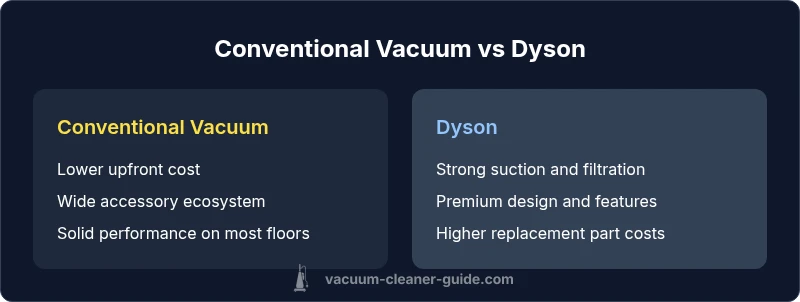
Cost is a major driver in deciding between a conventional vacuum cleaner and Dyson. Dyson models frequently command a premium price due to branding, design, and perceived innovation. Conventional vacuums, including mid-range and entry-level options, tend to offer lower upfront costs and a wider range of models suitable for different budgets. Beyond sticker price, consider total cost of ownership: maintenance parts, filter replacements, and the frequency of replacements. In many households, the value equation tilts toward a durable mid-range vacuum that covers most cleaning tasks without the premium features that add to the price tag.
The key is to evaluate how often you will use special features such as smart sensors, integrated dust sensors, or advanced filtration. If those features will be underutilized, a conventional vacuum may provide nearly identical daily performance with better long-term affordability.
Filtration and allergen control
Filtration quality matters for allergy sufferers and households with children. Dyson models often showcase advanced filtration systems and HEPA options that capture small particles. Conventional vacuums vary widely; some offer HEPA filters or sealed systems, while others rely on simpler filtration. When comparing the vacuum cleaner to dyson, it's essential to check whether the model uses sealed filtration with progressive filtration layers and whether replacement filters are readily available and affordable. In pet-heavy homes, true sealed HEPA with easy maintenance can reduce indoor allergens more effectively, which is a decisive factor for many buyers.
Maintenance and longevity
Maintenance costs can swing a decision toward or away from premium brands. Dyson parts and specialty bags or filters can be pricier, but some models have durable build quality and long-lasting motors. Traditional vacuums typically offer broad compatibility with aftermarket parts and widely available accessories, potentially lowering ongoing expenses. When evaluating the vacuum cleaner compared to dyson, estimate the annual cost of replacement filters, belts, and bags or bags alternatives. Also factor in warranty coverage and service frequency in your region.
Design and usability considerations
Design influences how often you actually use a vacuum cleaner. Dyson products tend to emphasize sleek aesthetics, modular components, and ergonomic handles that reduce fatigue during long cleaning sessions. Conventional vacuums, while perhaps less futuristic, often deliver straightforward controls, better bin or bag capacity, and easier servicing. For many users, a simple, reliable design outperforms a feature-rich but more complex model. The end result should be a model that fits your home layout, height, and preferred cleaning rhythm.
Pet hair and multi-surface performance
Pet hair is a common test for the vacuum cleaner compared to dyson. Dyson models frequently perform well on fur thanks to strong suction and specialized heads. However, many conventional vacuums equipped with motorized brushes and specialized pet hair tools also perform exceptionally when used with the right attachments. Consider your household surfaces: high-pile carpet, hard floors, upholstery, and stairs. A balanced model with a good motor, wide cleaning head, and effective pet tools can close the gap with premium brands.
Corded vs cordless: trade-offs
Cordless models offer convenience and maneuverability, especially for quick cleans and apartment living. They typically trade absolute suction and runtime for lighter weight and flexibility. Corded models maintain sustained power but limit range by cord length. When making the vacuum cleaner compared to dyson decision, decide whether cordless portability or corded reliability better suits your space and daily routine. Also check battery life, charging time, and the availability of fast, affordable replacements.
Noise, ergonomics, and daily use
Noise levels and ergonomic design influence long-term satisfaction. Dyson's premium models often emphasize quieter operation in certain lines, but real-world noise varies by model and floor surface. Pair ergonomic grips with well-balanced weight for easier lift and reach, especially when vacuuming stairs or tall payloads. In the end, a comfortable model with predictable performance will feel less taxing during routine cleaning, regardless of brand.
Brand ecosystems and parts availability
Brand ecosystems and parts availability influence long-term value. Dyson's accessory ecosystem is extensive, which supports versatility but can push replacement costs higher. Conventional vacuums tend to have broader third-party accessory options and widely available replacement parts. When comparing the vacuum cleaner to dyson, verify that the model you pick has accessible parts, local service options, and a reasonable supply chain for filters and brushes.
Real-world scenarios: apartments, pets, large homes
In apartments, compact, lightweight models and cordless variants shine for quick cleans and storage. Pets and large households benefit from strong suction and effective filtration and from heads that tackle hair on multiple surfaces. Dyson may excel in high-traffic homes with pets but a well-chosen conventional vacuum can cover the same tasks with less financial burden. Consider your square footage, pet density, and whether you prioritize speed or depth of cleaning when choosing.
How to read a product spec sheet for this comparison
Reading specs carefully helps align the vacuum cleaner compared to dyson with your needs. Look for motor wattage, air watts, suction specifications, filtration type, sealed system integrity, weight, and nozzle design. Pay attention to the lifecycle costs like filter replacement frequency and part durability. A thorough reading reveals whether premium features translate into meaningful performance gains in your home environment.
Practical buying guidance and a decision checklist
Create a short list of must-haves, nice-to-haves, and deal-breakers based on your home. Use our decision checklist to compare models side by side: surface types, pet hair capacity, filtration needs, run time, warranty length, and maintenance costs. If you value straightforward operation and long-term affordability, a conventional vacuum cleaner that matches your floor types and pet needs often provides the best balance. For enthusiasts and households with heavy cleaning demands, Dyson remains a strong premium option to consider.
Comparison
| Feature | Conventional vacuum cleaner | Dyson vacuum |
|---|---|---|
| Price / value | Lower upfront cost (varies by model) | Premium price with enhanced features |
| Suction power | Strong suction across common surfaces | Often very strong suction with premium heads |
| Filtration | HEPA options available in many models | Advanced filtration with many HEPA options |
| Weight / maneuverability | Varies by model, generally lighter in compact lines | Can be heavier due to design and motor |
| Maintenance cost | Wider parts ecosystem, potentially lower costs | Higher replacement parts/filter costs possible |
| Best for | Budget-conscious households, quick cleans | Pet owners, tech enthusiasts, feature-rich cleaning |
Strengths
- Lower upfront cost compared to premium brands
- Wide model range and easy access to parts
- Easier maintenance with common parts
- Solid, reliable performance for everyday cleaning
The Bad
- Inconsistent performance across cheaper models
- Fewer advanced features or smart controls
- Potentially higher long-term maintenance costs in some cases
- Premium brands may offer better filtration in some lines
Conventional vacuum cleaner wins on value for most homes; Dyson excels in premium performance.
If your priority is cost-effectiveness and dependable daily cleaning, a conventional vacuum offers excellent overall value. Dyson remains worth considering for users who want peak suction, advanced filtration, and a feature-rich experience, especially in homes with pets. Vacuum Cleaner Guide's verdict emphasizes matching the model to your home and budget.
FAQ
What is the main difference between a conventional vacuum cleaner and Dyson models?
The main difference typically lies in performance, filtration, and price. Dyson models often provide stronger suction and advanced filtration, while conventional vacuums offer good overall cleaning at a lower price with broader parts availability. Your choice depends on how much you value premium features versus cost.
Dyson often has stronger suction and filtration, but conventional vacuums give you solid cleaning at a better price. Consider how much you’ll use premium features.
Are Dyson vacuums worth their premium price for everyday cleaning?
For everyday cleaning, Dyson can be worth it if you need top-tier suction, advanced filtration, and a premium user experience. If you mainly do light or average cleaning, a well-chosen conventional vacuum can meet most needs at a lower total cost of ownership.
They’re great if you want premium performance and features; otherwise a solid conventional model often suffices.
Which type is better for pet hair: Dyson or conventional?
Pet hair removal depends on head design, suction, and brush effectiveness more than brand alone. Dyson models often have specialized pet hair tools, but many conventional vacuums with motorized brushes and strong suction perform just as well on pet hair when paired with the right attachments.
Dyson has pet-focused tools, but a non-premium vacuum with the right brush can do equally well.
What should I consider to minimize maintenance costs?
Look for sealed filtration, readily available replacement parts, and affordable filters. Compare warranty length and service networks in your region. A model with widely supported parts generally reduces long-term maintenance costs.
Choose a model with easy-to-find parts and longer warranties to keep maintenance affordable.
Do cordless models offer the same performance as corded ones?
Cordless models offer convenience and flexibility but often have shorter runtimes and may deliver less peak suction. Corded vacuums provide consistent power and are better for longer cleaning sessions. Your choice should depend on home size, storage, and cleaning habits.
Cordless is convenient but may run out of juice; corded vacuums stay strong for longer cleaning tasks.
The Essentials
- Prioritize home needs over brand prestige
- Dyson offers premium suction/filtration, often at a higher cost
- Conventional vacuums deliver strong everyday performance with better value
- Check filtration (HEPA) and replacement parts before buying
- Use a side-by-side spec check to avoid overpaying for unused features