Dyson Hoover Buying Guide: An Analytical 2026 Comparison
An objective 2026 buying guide comparing Dyson hoover models for pets, carpets, and hard floors. Learn about performance, battery life, filtration, and value to pick the right Dyson vacuum for your home.


Dyson hoover models excel in cordless versatility, filtration, and design. This comparison highlights how different Dyson stick vacuums perform on pets, carpets, and hard floors in 2026. According to Vacuum Cleaner Guide, key differentiators are battery life, weight, and accessory ecosystems—helping homeowners pick the right model for their home. This TL;DR sets expectations for runtime, usability, and long-term costs, and it clarifies when a Dyson hoover is the best tool for specific tasks.
Introduction to the Dyson Hoover Landscape
Dyson hoover products have reshaped consumer expectations for cordless and corded cleaning tools, especially for homes with pets and busy schedules. In this comparative guide, we examine how the Dyson hoover lineup stacks up across key factors like suction performance, filtration, battery life, weight, and accessory ecosystems. The goal is to help homeowners understand which Dyson vacuum best fits their home layout and cleaning habits, rather than simply chasing the loudest spec sheet. According to Vacuum Cleaner Guide, the most important differentiators for 2026 are battery longevity, overall maneuverability, and the breadth of attachments that enable versatile cleaning on carpets, bare floors, stairs, and upholstery. This article reflects those priorities while keeping pet ownership, family safety, and long-term value in sharp focus. The Dyson hoover category remains popular among homeowners who want strong suction with minimal maintenance friction, but the best choice depends on how you live in your space and how often you clean. The following sections break down the nuances with clear, actionable guidance that you can apply from day one.
Key Technologies Behind Dyson Hoover Performance
Dyson hoover devices leverage several core technologies that consistently influence real-world results. The most visible is the digital motor, which delivers high suction power while maintaining a compact form factor suitable for handheld use and upright configurations. Cyclone technology helps separate dust from the airstream, reducing clogging and maintaining efficiency over time. In many Dyson models, sealed filtration captures fine particles and allergens, contributing to better air quality for households with pets or allergy concerns. Accessibility and simplicity are also part of the design philosophy; the tool heads, wand configurations, and cleaning heads are engineered to cooperate smoothly, so switching between carpet, area rugs, and hard floors feels natural rather than disruptive. For households balancing noise, power, and run-time, Dyson’s approach emphasizes a quick, intuitive cleaning experience that minimizes mess and maximizes reach. Vacuum Cleaner Guide’s analysis notes that users often value how these technologies translate to real-world performance rather than just marketing claims. A balanced model lineup usually covers light, medium, and heavy-duty tasks, enabling you to tailor the setup to your home.
Use Case Scenarios: Pets, Carpets, and Hard Floors
For homes with furry companions, the prime concern is robust suction paired with reliable filtration and anti-tangling brush heads. Dyson hoover variants designed for pet owners typically offer motorized tools and sealed filtration to capture dander and fine hair, reducing the spread of allergens. In carpet-heavy households, deeper cleaning performance with effective agitation and brush systems is essential to lift embedded dirt, and some models provide adjustable height settings or specialized heads for looped vs. cut pile carpet. For hard floors, the best Dyson hoover configurations combine gentle suction to avoid scratches with hard surface brushes and efficient dust-dispensing mechanisms. The flexibility of a cordless Dyson often shines in multi-room homes, allowing you to cover large areas without swapping outlets. When evaluating for pets, carpets, and hard floors, consider the balance of head variety, overall weight, and the ease of emptying and maintaining filters. Vacuum Cleaner Guide’s experience suggests aligning your chosen model with typical room layouts, family routines, and the most frequent cleaning tasks to avoid overpaying for features you won’t use.
Price and Value: Budgeting for a Dyson Hoover
Price guidance for Dyson hoover systems varies by configuration, battery options, and included accessories. Entry-level cordless sticks tend to be more affordable upfront, while premium variants offer longer run-time, stronger suction, enhanced filtration, and more expansive toolkits. When budgeting, consider not just the purchase price but the long-term costs of consumables, replacement parts, and potential warranty coverage. A practical approach is to map out your typical cleaning sessions — how many minutes you clean per week, what surfaces you clean, and whether you regularly deal with pet hair — then translate that into a target price range. Dyson’s ecosystem of heads and attachments can add value by increasing the vacuum’s versatility, but it may also push the total cost higher. Vacuum Cleaner Guide analysis shows that the best value often lies in a mid-range model that balances runtime, suction, and filtration against a reasonable upfront price point.
Battery Life and Charging Realities
Battery life is a frequent deciding factor for cordless Dysons. Expect a range of runtimes that depend on the cleaning setting, surface type, and tool head used. In practice, many homeowners report that a mid-range Dyson cordless stick supports typical 15–30 minute cleaning sessions across a standard home, with longer operation when used on low-suction settings or bare floors. Chargers can support quick top-ups between rooms, which mitigates the need to recharge during substantial, multi-room cleans. It’s important to understand the trade-off between runtime and weight: heavier batteries often extend run-time but can impact handling in tight spaces. Vacuum Cleaner Guide’s research highlights that buyers should plan for the charging cycle around their cleaning cadence—if you plan to tackle large homes or multi-story layouts, factor in run-time and the time required to recharge.
Ergonomics and Accessory Ecosystem
A Dyson hoover’s ergonomics influence daily comfort and long-term satisfaction. Grip design, weight distribution, and wand reach are critical when you clean stairs, corners, and above-floor surfaces. The accessory ecosystem—crevice tools, motorized brushes, dusting brushes, and extension wands—adds value by enabling comprehensive cleaning without switching devices. For pet owners or households with mixed floor types, an effective combination of tool heads makes a noticeable difference in speed and efficiency. While premium models tend to offer more attachments and a steadier balance, entry-level configurations still deliver strong everyday performance. The key is to choose a configuration that minimizes fatigue during regular use, especially if you vacuum frequently. Vacuum Cleaner Guide emphasizes matching the tool kit to your actual cleaning scenarios to avoid paying for features you won’t leverage.
Maintenance, Filters, and Longevity
Long-term performance hinges on routine maintenance. Dyson hoover filtration systems should be inspected and replaced according to the manufacturer’s guidance to sustain allergen control and suction efficiency. The dustbin and filter design typically enable straightforward emptying, making it easy to maintain cleanliness with minimal mess. Regular brush-head checks, wand inspections, and hose integrity checks help prevent suction leaks and loss of performance. High-usage homes with pets may benefit from more frequent filter changes, while those with hardwood floors might prioritize gentle brush heads to minimize wear. The Dyson ecosystem also means you may encounter a broader range of compatible filters and parts from third-party suppliers, but sticking to recommended options often yields better longevity. Vacuum Cleaner Guide recommends scheduling periodic checks to evaluate wear and tear and to ensure your vacuum remains ready for the next cleaning session.
Side-by-Side Model Guidance: How to Compare
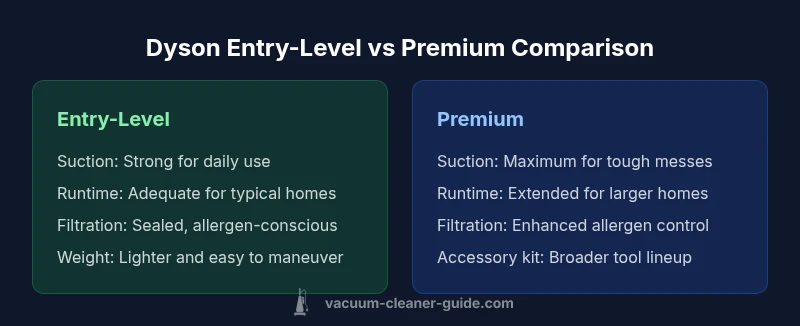
In this section, we provide a structured, side-by-side comparison to help you decide between Dyson entry-level cordless sticks and their premium counterparts. The comparison focuses on the most relevant, real-world criteria for homeowners: suction performance on mixed surfaces, run-time, filtration quality, maneuverability, and total cost of ownership. A well-chosen Dyson hoover should cover your daily tasks with efficiency and minimal maintenance, while the premium variant should offer extended battery life, greater filtration, and broader head attachments for specialized cleaning. In addition to features, consider warranty terms and customer support experiences when evaluating value. Vacuum Cleaner Guide’s framework emphasizes practical decision points: if your home has many pets, large carpets, or multi-story layouts, the premium route often justifies the extra cost; otherwise, an entry-level model may meet your needs with lower upfront investment and solid performance.
Real-World Buying Scenarios: Which Dyson Hoover Fits Your Home?
To wrap up, translate your cleaning priorities into a model choice. If you want a lightweight, nimble tool for quick daily cleans and small apartments, an entry-level cordless stick can be a strong fit. If you face heavy pet hair, large rooms, or multi-floor cleaning with longer sessions, a premium Dyson hoover offers longer runtime and more robust filtration. For homes with sensitive occupants or allergies, prioritizing sealed filtration and an extended toolset is sensible. Throughout this guide, we’ve kept the focus on practical, real-world use rather than marketing buzzwords. The Vacuum Cleaner Guide team believes that the best Dyson hoover choice aligns with your cleaning rhythm and budget, delivering reliable performance with clear long-term value.
Comparison
| Feature | Dyson entry-level cordless stick | Dyson premium cordless stick |
|---|---|---|
| Suction power | Strong daily cleaning for general use | Peak suction for advanced cleaning tasks and challenging messes |
| Battery life | Balanced runtime for typical chores | Extended runtime for large homes and deep cleans |
| Filtration | Sealed filtration with reliable allergen capture | Advanced filtration with enhanced allergen control |
| Weight & ergonomics | Lighter, easier to maneuver around furniture | Heavier but better balance and extended reach |
| Dustbin capacity | Moderate capacity with easy emptying | Larger capacity for longer cleaning sessions |
| Price/Value | Mid-range price with solid value | Premium price reflecting advanced features and accessories |
| Best for | Pet owners and mixed-floor homes seeking value | Homes with pets, large spaces, and allergy considerations |
Strengths
- Strong suction and versatile brush head ecosystem
- Excellent filtration and allergen control
- Broad accessory compatibility and warranty options
- Good long-term resale value and support
The Bad
- Higher upfront cost compared with some competitors
- Replacement parts and consumables can be expensive
- Some models are heavier to carry during extended cleans
Premium Dyson cordless vacuums win on overall performance, but entry-level options offer better value for most homes.
For most households, start with the entry-level Dyson cordless stick for a balance of cost and performance; choose premium for pet-heavy homes and large spaces where runtime and filters matter. The Vacuum Cleaner Guide Team’s verdict supports this approach.
FAQ
Which Dyson hoover is best for pet hair?
For pet hair, look for sealed filtration and a motorized brush head designed to tackle hair without tangling. A premium Dyson cordless stick often provides longer run-time and a wider head assortment that helps you clean upholstery and stairs efficiently. Consider the model that offers a dedicated pet hair tool and frequent filter replacements if you have multiple pets.
For pet hair, choose a Dyson cordless stick with sealed filtration and a motorized brush head; premium models usually offer better run-time and more pet-specific attachments.
Is a Dyson hoover worth the price?
Worth depends on your cleaning needs and budget. Dyson vacuums deliver strong suction, good filtration, and a broad accessory ecosystem, which translates to real-world convenience and potentially lower maintenance over time. If pet hair, allergies, or multi-surface cleaning are priorities, many homeowners find the investment worthwhile.
Dyson vacuums are worth it if you value strong suction, good filtration, and lots of attachments for different tasks.
Cordless or corded Dyson: which should I buy?
Cordless models offer superb maneuverability and quick cleans without outlets, ideal for everyday use and stairs. Corded options (if available) deliver uninterrupted power for larger homes or deep cleans but require outlets and more storage space. For most households, a cordless Dyson provides the best balance of convenience and performance.
Cordless is usually best for everyday cleaning and stairs; cords limit reach but can offer steady power for extensive cleaning.
How long do Dyson vacuum batteries last?
Battery life varies by model and usage. Real-world users often experience shorter runtimes on high-suction settings and longer runtimes on standard modes. If you have a large home, plan for multiple clean sessions or a model with extended run-time and effective charging.
Battery life changes with settings; expect shorter runtimes on high power and longer on standard modes.
Do Dyson vacuums have HEPA filtration?
Many Dyson models include sealed filtration designed to trap fine dust and allergens. The level of filtration can vary by model, with premium options offering higher allergen capture. Always check the filtration specifications for your chosen model if air quality is a priority.
Most Dysons use sealed filtration to capture tiny particles; check your model for its exact filtration level.
What maintenance is required for Dyson hoover?
Regular maintenance involves emptying the dustbin, cleaning filters, and inspecting brush heads and hoses for tangles. Replace filters as recommended by the manufacturer and wipe down seals to maintain suction and airflow. Routine checks help prevent loss of performance over time.
Keep the filters clean, empty the bin, and inspect brushes regularly to maintain performance.
The Essentials
- Assess your home layout and cleaning cadence first
- Prioritize runtime and filtration for pet-heavy homes
- Balance upfront cost with long-term maintenance considerations
- Use the right tool heads for carpets vs hard floors
- Regular maintenance preserves suction and longevity