Vacuum Cleaner or Hoover: A Comprehensive Buying Guide for 2026
A detailed comparison of vacuum cleaner vs Hoover options, focusing on form factors, filtration, pet-hair handling, and long-term value for homeowners and pet owners.


In most homes, a versatile vacuum cleaner or Hoover that balances power, filtration, and maintenance offers the best value. The term 'hoover' is regional branding, but performance is what matters. This comparison weighs generic vacuum cleaners against Hoover-brand options to help homeowners choose the right fit for pets, carpets, and hard floors.
Why the vacuum cleaner or hoover distinction matters
According to Vacuum Cleaner Guide, the terms vacuum cleaner and hoover are often used interchangeably in everyday speech, but the practical differences in design, maintenance, and performance can dramatically affect cleaning results. For homeowners and pet owners, choosing between canister, upright, cordless, or robotic options hinges on space, furniture layout, and the type of floors you manage. The distinction also matters for availability of parts and service networks, which influence long-term reliability and total cost of ownership. In this section we lay out the reasons why the brand and terminology matter, and how your decision will ripple through daily routines, allergies, and energy use across a typical week.
A solid baseline is to map your space before selecting a model. If you live in a multiroom home, you’ll want a form factor that can maneuver around furniture without excessive weight. If you have pets, filtration matters as much as suction. The Hoover brand has strong recognition in many regions, but the best value comes from models that meet your specific cleaning needs rather than reputation alone. Remember that purchase cost is just one part of ownership; maintenance, filter replacements, and the availability of replacement parts also weigh into the total cost over several years.
Defining your cleaning needs before you shop
A systematic approach starts with your living space: floor types, presence of pets, and the size of your home. If you have heavy traffic on mixed floors, you may prioritize a model with strong suction and efficient filtration. If you live in a single-story apartment with mostly hard surfaces, a compact cordless or lightweight upright might be ideal. Consider accessories such as crevice tools for tight corners, upholstery nozzles for furniture, and a motorized brush for pet hair. By mapping your exact needs, you can narrow from dozens of models to a focused shortlist and avoid buyer’s remorse.
Next, think about storage and charging routines. If space is tight, a slim, wall-mountable model or a compact canister can be tucked away behind a door. For homes with stairs, a lightweight option that carries well up and down the steps matters more than peak raw power. Finally, assess your tolerance for ongoing costs, including bags or filters and any specialized HEPA components. The goal is a balance between upfront cost, long-term maintenance, and cleaning performance that suits your family’s daily rhythm.
Core vacuum types and how they differ in practice
Vacuum cleaners come in several core form factors, each with distinct strengths. Uprights tend to deliver strong suction on carpets and are easy to push across large areas, while canister models offer greater maneuverability for stairs and tight corners. Cordless vacuums provide portability and quick pickups, but their runtime and recharge cycles must align with household cleaning patterns. Robotic vacuums, meanwhile, handle routine maintenance automatically but often rely on smarter navigation and boundary rules. In hybrid homes with mixed floors, a combination of an upright for quick daily clears and a compact cordless for quick spills can cover most scenarios. When evaluating options, prioritize those that provide a comfortable balance between weight, reach, and the availability of replacement parts.
Useful considerations include motorized brush performance for pet hair, brush bar width for larger debris, and tool versatility for upholstery and car interiors. Filtration quality becomes critical in homes with allergy concerns, particularly if you or a family member has sensitive airways. Look for sealed systems and at least a multi-stage filtration setup in premium models. Remember that Hoover-branded products span a broad range of designs; in many cases, the best choice is a model that fits your cleaning routine rather than a brand badge alone.
Bagged vs bagless: cleaning performance and upkeep
Bagged vacuums often provide reliable suction and clean exhaust air with minimal dust spillage when bags are changed, making them a popular choice for allergy sufferers. Bagless units offer the appeal of zero ongoing bag costs and easy debris disposal, but emptying can release dust back into the room if you aren’t careful. In practice, the best solution depends on your household’s tolerance for dust, the presence of family members with allergies, and how often you vacuum. If you prefer simplicity, a bagged model with a sealed filtration system minimizes exposure during disposal. If you want to minimize ongoing consumables, a bagless model with an effective cyclonic system and washable filters can be cost-effective in the long run. Hoover-branded options span both bagged and bagless approaches, so your choice should align with maintenance comfort and the clean air you expect in living spaces.
When evaluating filtration, prioritize models that offer HEPA or equivalent filtration, especially in homes with children or allergy-prone residents. Filter maintenance is a practical consideration: washable filters save money but require regular cleaning, whereas disposable filters demand recurring replacement. The selection should reflect your cleaning frequency, the kinds of debris you typically encounter, and your willingness to manage filter upkeep.
Corded vs cordless: power, run time, and convenience
Corded vacuums generally deliver uninterrupted power, steady suction, and often more endurance for large cleaning sessions. Cordless vacuums trade persistent runtime for portability and reach, enabling quick cleans without dragging a cord around furniture or through stairs. The best cordless models offer intelligent battery management, fast charging, and spare batteries for extended sessions. If you have a large home, a corded main vacuum paired with a cordless secondary unit is a practical strategy. In spaces with limited storage, compact cordless models shine, while in multiroom homes with heavy carpet cleaning needs, a corded model can provide consistent performance. Hoover’s cordless lines emphasize compact designs with easy-to-use controls, which can be appealing for busy households seeking rapid pickups.
The key performance question is whether you value continuous power over mobility. If you vacuum daily, a high-capacity cordless with robust filtration might meet your needs, but if you vacuum less frequently, a corded machine will likely offer more reliability without worrying about battery life. Consider the typical cleaning tasks in your home and choose a pairing of corded and cordless that keeps your routines seamless.
Upright, canister, and cylinder: handling and footprint
Upright vacuums are standout options for wide-area carpet cleaning and quick pickups in living rooms, while canister vacuums excel in tight spaces, corners, stairs, and under furniture. Cylinder models tend to be lighter and more compact, offering easy maneuverability for smaller apartments or RVs. When selecting, think about the shape of your rooms, the presence of stairs, and your ability to lift and shoulder-weight the unit. A common strategy is to pair an upright for main floor cleaning with a canister or cylinder for hard-to-reach spots and drapes. Hoover’s product range includes models in each form factor; the choice should be dictated by how you navigate your home most of the time.
Weight, balance, and the length of hoses or wands influence daily usability. A heavier unit may offer greater stability but can be tiresome to carry. Conversely, lighter models are easier to reach high or low areas, though some may compromise suction power or filtration. Your best pick will harmonize with your physical layout and cleaning schedule rather than brand identity alone.
Filtration for allergies and air quality
Air quality inside the home depends as much on filtration as on suction. A sealed system with multi-stage filtration helps capture fine particles such as dust mites, pollen, and pet dander. In practice, look for HEPA or equivalent filtration on premium models, along with easily accessible pre-filters and post-filters. Regularly replacing or washing these components helps maintain suction and reduces exhaust dust. For households with allergy concerns, an upright or canister with a sealed filter system and a well-sealed dustbin is a smart pairing. Hoover-branded models often emphasize filtration features across different price tiers, giving buyers a range of choices that align with their air-quality goals.
Beyond filtration, consider how debris is collected and disposed of. Some models offer cyclonic separation with straightforward bin emptying that minimizes contact with dust. Others rely on bagged designs that seal debris more completely during disposal, a useful feature for allergy-prone households. In all cases, the goal is a clean exhaust and a straightforward maintenance routine that keeps performance high over time.
Pet hair prowess: choosing a model that tackles fur
Pet owners require reliable suction, strong agitation, and a brush bar that resists tangling. Look for turbo brushes or motorized heads designed to lift fur from carpets and upholstery. A well-sealed system helps minimize pet dander escaping back into the room. In practice, choose a model with a wide cleaning path for large areas and a tool kit that includes a pet hair brush for furniture and car interiors. While brand names vary by region, the best value comes from models that combine powerful suction with an efficient brush design and an accessible maintenance routine. Hoover-branded options often feature pet-friendly attachments and easy-to-clean components that are appealing to households with dogs or cats.
Cost of ownership and long-term value
Total cost of ownership includes upfront price, ongoing consumables, and maintenance tasks. Bags, filters, and accessories add up over years, while durable motors and robust filters reduce the need for frequent replacements. To compare value, assess how often you will replace filters, bags, or brushes, and whether a particular model offers washable or reusable components that lower ongoing costs. In practice, a model with a sturdy build, durable filtration, and widely available replacement parts tends to deliver higher long-term value. Hoover-branded products provide a broad service and parts network, which can contribute to lower maintenance friction over time.
Warranty, service, and parts availability
Warranty length and service support are practical indicators of a vacuum’s reliability. A longer warranty on key components and a clear path to service centers can reduce ownership stress. Before purchase, verify what the warranty covers, including motors, seals, and filters, and confirm how easy it is to obtain genuine replacement parts locally or online. Households with busy schedules may especially value prompt service and widely available accessories. Hoover offers service and parts networks across many markets, which can ease repairs or replacements if needed in the future.
Where Hoover fits in a modern cleaning toolkit
Hoover-brand options sit alongside a spectrum of generic/other-brand vacuums, with each category offering different advantages. For households that value consistent service access and brand-era familiarity, Hoover can be a strong fit thanks to a broad distribution network and a familiar parts ecosystem. For buyers who prioritize ultra-low weight, a compact ultraportable might be more suitable, even if it means trading some suction or runtime. In most homes, the best choice is a model that aligns with cleaning tasks, floor types, and lifestyle rather than chasing a brand badge alone. Hoover’s range is particularly compelling for shoppers who want easy procurement, straightforward maintenance, and well-supported replacement parts.
When in doubt, test in-store with your typical debris and furniture arrangement. It’s easier to evaluate weight, maneuverability, and noise levels with your own hands than rely on specs alone.
How to test a vacuum before you buy
Testing a vacuum before purchase helps you avoid buyer’s remorse. Try models with high-traffic floors and common obstacles—think sofas, stairs, and area rugs—so you can assess weight, balance, and suction at the point of use. Check the ease of switching between floor types, the effectiveness of any pet-hair attachments, and the accessibility of filters and bags. Ask store staff to demonstrate bagless disposal and filter cleaning to gauge maintenance friction. If you are buying online, review video demonstrations and user testimonials focused on real-world performance with pet hair and mixed flooring.
Finally, consider the out-of-box experience: how easy is it to assemble, how intuitive are the controls, and what is included in the package (crevice tools, upholstery nozzle, motorized brush). A model that feels natural to use in daily life will be the one you actually reach for, not just the one with the strongest marketing claim.
Comparison
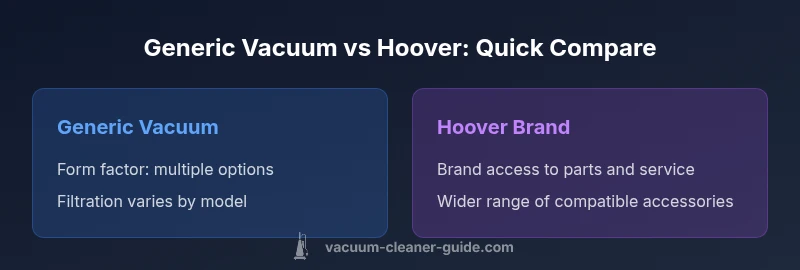
| Feature | Generic vacuum cleaner | Hoover brand vacuum |
|---|---|---|
| Form factor options | Upright, canister, or cordless options; broad compatibility | Hoover models span upright, canister, and some cordless designs with brand-specific features |
| Filtration options | Varies by model; higher-end units offer multi-stage filtration | Hoover offers models with advanced filtration and sealed systems |
| Maintenance requirements | Bagged or bagless systems; bagged models require bag replacements | Hoover maintains a wide range of bags, filters, and parts; maintenance varies by model |
| Warranty and service | Standard warranties; coverage varies by price tier | Hoover provides service networks and warranty terms with major retailers |
| Noise and usability | Noise levels vary; some models emphasize quiet operation | Hoover emphasizes ergonomic design and user-friendly controls |
| Best for | Large homes with mixed flooring and storage flexibility | Homes seeking brand support and easy procurement across rooms |
Strengths
- Wide range of models and price points
- Strong parts and accessory availability
- Good pet-hair handling with appropriate models
- Sealed filtration options for better air quality
The Bad
- Long-term consumable costs (bags/filters) can add up
- Cordless models have limited runtime and require charging
- Heavier canister/upside models may be harder to maneuver in tight spaces
Choose a versatile, well-filtrated vacuum cleaner with flexible form factors as the core of your toolkit; Hoover-branded options are worth considering for service and parts access.
A balanced approach favors models that balance suction, filtration, and usability. If you prioritize service and easy part procurement, Hoover offers compelling choices; otherwise, select a model that best fits your space and cleaning routine.
FAQ
What is the difference between a vacuum cleaner and a Hoover?
Hoover is a brand with a long history of vacuum cleaners. In practice, performance depends on the model, not the brand name alone. Compare form factors, filtration, and maintenance requirements to choose the best option for your home.
Hoover is a brand, but what matters most is the model’s performance and features for your home.
Bagged versus bagless: which is better for allergies?
Bagged models can minimize dust exposure during disposal, which helps allergy-prone households. Bagless designs can be convenient and cost-effective but may release more dust when emptying. Look for sealed filtration and HEPA or equivalent filtration regardless of bag type.
Bagged often helps with allergies during disposal; bagless can be convenient but keep filters well maintained.
Are cordless vacuums as powerful as corded models?
Corded vacuums typically provide consistent power for extended cleaning sessions, while cordless units offer portability and quick cleanup. Today’s high-end cordless models can rival many corded options on common tasks, but for large homes or deep-cleaning sessions, a corded main unit still shines.
Corded usually offers steady power; high-end cordless can handle most daily tasks, but check runtime and battery health.
What vacuum is best for pet hair?
Models with motorized pet-hair brushes, strong suction, and sealed filtration work best for hair on carpets and furniture. Consider a larger cleaning path and a toolkit designed for upholstery and stairs, plus easy filter maintenance.
Look for pet-hair brushes and strong suction to tackle fur on carpets and furniture.
How long do vacuum cleaners last?
Lifespan depends on build quality, maintenance, and usage. A well-maintained model from a reputable brand can last several years, while frequent use or neglect of filters and belts may shorten its life.
With good care, you’ll get many years out of a solid vacuum.
Is a robot vacuum worth it for a busy household?
Robot vacuums are ideal for regular upkeep and busy schedules but typically require companion models for deep cleaning on carpets or heavy messes. They work best as part of a broader cleaning toolkit.
Robot vacuums are great for maintenance, but a primary upright or canister may still be needed for deep cleaning.
The Essentials
- Assess your floor types and pet-hair needs before buying
- Prioritize filtration and sealed systems for better air quality
- Choose a form factor that matches home layout and stairs
- Consider maintenance costs (bags/filters) over the long term
- Evaluate service networks and part availability when comparing brands