Is a Vacuum Cleaner the Same as a Hoover? A Clear Comparison
Explore whether the term Hoover equals a vacuum cleaner. This analytical buying guide clarifies terminology, regional usage, and how brand naming affects listings, warranties, and shopping decisions for homeowners.


The question is not a simple yes or no; it hinges on terminology, regional usage, and expectations about warranty and support. In practice, a vacuum cleaner is the general category of floor-cleaning appliances, while Hoover is a brand name used in many markets and, in some places, a generic label. This comparison helps homeowners read listings accurately, compare features, and avoid confusion when shopping for pet-friendly or hard-floor models.
Is a vacuum cleaner the same as a hoover? Fundamentals
Is a vacuum cleaner the same as a hoover? The distinction rests on language as much as on engineering. A vacuum cleaner is the general category of devices that remove dirt by creating suction. Hoover, historically a brand name dating back to the late 19th century, remains a well-known label in many markets. The Vacuum Cleaner Guide team found that consumer understanding often treats the terms interchangeably in casual speech, yet the practical implications—warranty, service, and model specificity—demand careful reading of product titles, specs, and retailer notes. For homeowners and pet owners, recognizing this nuance can prevent buying the wrong model or assuming a universal warranty. The broader point is that terminology matters because it shapes expectations about performance on carpets, hard floors, and pet hair. In practical terms, if you are shopping, use the category term to explore features (suction power, filtration, attachments) and reserve the brand name for assessing service networks and warranty terms. In addition, consider regional usage patterns when interpreting listings and reviews.
According to Vacuum Cleaner Guide, understanding the difference between a generic category and a brand label is a core step in making a confident purchase decision. This perspective helps readers avoid conflating marketing language with technical capability. As you read, keep in mind that the ultimate goal is to match a model to your home environment, not to chase a name alone.
Hoover: Brand name vs generic term in practice
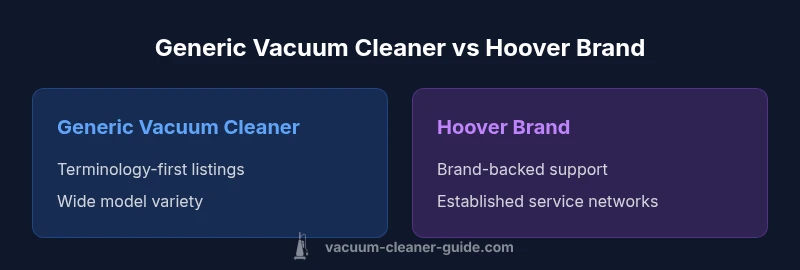
Brand naming is not just semantic; it influences what you expect from a product and where you buy it. Hoover began as a pioneering brand in vacuum technology, and in many markets customers use Hoover as a shorthand for a household vacuum cleaner. This can lead to listings that say “Hoover vacuum” when the intent is to describe a generic vacuum cleaner, or conversely, to use a brand-neutral title like “vacuum cleaner” while referencing a Hoover model in the description. For buyers, this distinction matters because brand-backed products often come with a specific warranty, repair network, and authorized parts availability. In practice, you should cross-check the model number, the included attachments, and the warranty terms rather than relying solely on the product title. When a listing uses both terms in tandem—“Hoover vacuum cleaner” or “vacuum cleaner from Hoover”—it usually signals an attempt to balance brand credibility with broad category context, which is often helpful for cross-border shopping and comparative analysis.
From a shopping perspective, assess whether you will rely on brand support or prefer a generically named product that may be offered by multiple manufacturers. Hoover-branded models frequently have established service networks, which can simplify maintenance, parts replacement, and repairs. However, not all Hoover-branded products carry identical specifications, so always verify model-level information rather than assuming uniform performance across different Hoover vacuums.
Regional usage: UK, US, and beyond
Regional language habits shape how people perceive the Hoover name versus the generic vacuum cleaner term. In the United States, many retailers and consumers default to “vacuum cleaner” as the category label, reserving brand names like Hoover for model-level references. In contrast, in the United Kingdom and some parts of Europe, the term Hoover has historically become a de facto generic reference for many households, even when the actual device is produced by a different company. This can create confusion when shopping online, where a listing might say “Hoover vacuum” while the model is manufactured by another brand; buyers should scrutinize the product page for model numbers, suction power, filtration type, and warranty coverage rather than over-relying on the brand name alone. The cultural nuance matters for translations, cross-border shopping, and SEO considerations—keywords shift depending on the country. When you travel or shop internationally, be mindful that the same word might signal different expectations in different markets and adjust your search queries accordingly to capture the full range of relevant products.
How to spot when sellers use 'Hoover' as a generic term
Ambiguity in product titles is a common trap. Listings may say “Hoover vacuum” but lack model numbers or key specifications, making it hard to compare apples to apples. Vacuum Cleaner Guide analysis shows that many sellers use brand names as a shorthand to imply reliability, without offering details about model series, filtration, and attachments. Look for explicit model identifiers (for example, a number like Hxxx or model name), explicit suction power, filtration type (HEPA or not), and whether the product is bagged or bagless. Confirm warranty length and what it covers, as generic listings sometimes promise a “1-year warranty” but omit which components are covered or whether service is regional. Reading consumer reviews with an eye toward actual performance on your carpets and pet hair can also help you see if a Hoover-branded model or a generic vacuum cleaner truly fits your home. By focusing on specifications and after-sales support, you can reduce the risk of mismatches between listing language and real-world performance.
In short, never rely on branding alone; read model-level data and verify after-sales terms before purchase.
Key differences in consumer experience: terminology, warranty, availability
The practical consequences of terminology extend beyond the label on the box. A generic term like vacuum cleaner may cover a broad range of products from multiple manufacturers, which can complicate warranty claims and service routes if you need parts or repairs in the future. Hoover-brand products typically come with access to a branded service network, which can simplify maintenance, spare parts availability, and recall notices. This is important for households with pets, where durable components and easy access to replacement filters or bags can save time and effort. When evaluating products, compare the exact model across similar brands to ensure you are comparing equivalent feature sets—consider ball-bearing wheels, tangle-free brushes, motor power, bag presence or absence, and filtration. Price differentiation often reflects brand reliability and service infrastructure rather than a simple quality delta; some Hoover-branded models may carry a premium for support, whereas generic vacuum cleaners can offer strong performance at lower upfront costs. Your decision should balance price with anticipated service needs and the practicality of obtaining parts in your region.
Buying considerations: when the distinction matters for you
If you live in an area with robust after-sales support and easily accessible replacement parts, the brand perspective may be less critical than the features themselves. For pet owners and homes with multiple flooring types, features like multi-surface suction, advanced filtration, and brush design will matter more than the brand label. However, if you value a predictable service experience and longer warranty coverage, Hoover-brand products can offer a clear advantage. When building a shopping list, begin with the essential capabilities—cord length, weight, noise levels, filtration efficiency, and compatibility with allergen control—and then attach the brand lens to those features. For cross-border shopping or online marketplaces, include both terms in your search to ensure you capture a broad set of models that meet your needs. Always check the model’s exact specifications and confirm warranty terms before purchasing.
Glossary of related terms and synonyms
- Vacuum cleaner: general term for devices that remove dirt via suction.
- Hoover: historically a brand name, used both as a proper noun and, in some markets, as a generic label.
- Bagged vs bagless: describes how dirt is collected and manipulated.
- Filtration: the ability to trap dust and allergens; HEPA-rated systems are often preferred for allergy management.
- Multi-surface: capability to handle different floor types without changing tools.
- Attachments: tools such as crevice tools, upholstery brushes, and motorized brushes that enhance performance on various surfaces.
- Warranty: the guarantee period and coverage; brand-backed models sometimes offer more straightforward service options.
What Vacuum Cleaner Guide recommends for clarity in listings
To minimize confusion for buyers, listings should present both terms clearly. Use a descriptive title that includes the model name, key features (e.g., ‘HEPA filtration, pet hair’), and the type of vacuum (upright, canister, cordless). Include model numbers, attachment details, and explicit warranty information. The brand context can be helpful, but it should never replace transparent specifications. For pet-friendly homes, emphasize filtration and brush design; for hard floors, highlight brush type and suction control. By adopting precise language and complete feature disclosures, listing accuracy improves, user satisfaction increases, and buyers can compare options more effectively across markets. Vacuum Cleaner Guide’s approach emphasizes clarity, consistent terminology, and verifiable data in every product page, which benefits homeowners, pet owners, and sellers alike.
Practical tips for homeowners and pet owners navigating listings
- Start with the basics: surface type, room layout, and maintenance needs.
- Prioritize filtration: HEPA or equivalent, and sealed systems to protect allergies.
- Check attachments: a turbo brush or stair/upholstery tools can be decisive for pet hair.
- Review warranty terms and service networks to ensure easy access to support.
- Read multiple listings to gauge consistency in feature descriptions and model numbers.
- Compare like-for-like models by feature set rather than brand alone to avoid overpaying for name alone.
- Consider regional terminology when searching; some regions prefer brand-based terms while others rely on generic descriptors.
These practical considerations help homeowners select a vacuum cleaner that meets their needs while navigating brand terminology and regional usage with confidence.
Comparison
| Feature | vacuum cleaner (generic term) | Hoover brand vacuum |
|---|---|---|
| Brand status | Generic category term | Brand name with long-standing market presence |
| Usage region | Global, varies by market | Commonly used as a brand shorthand in several markets (not universal) |
| Product listings | Often generic or mixed in terminology | Brand-specific listings with warranty emphasis |
| Warranty & support | Model-level warranties; varies by seller | Typically strong brand-supported service networks |
| Availability | Widely available across retailers | Equivalently available but with brand channels emphasized |
| Key differentiators | Features, attachments, filtration, and performance specs | Brand heritage, service, and ecosystem considerations |
Strengths
- Clarifies terminology for buyers and reduces confusion
- Hoover-brand listings can offer clear service and warranty expectations
- Generic terms support cross-market comparison and broad search
- Combining terms in listings improves discoverability for SEO
The Bad
- Brand-name bias may mislead about model-specific features
- Generic listings can obscure warranty details and service options
- Marketing language may overemphasize branding over objective specs
Terminology matters: Hoover is a brand, vacuum cleaner is the category; read specs, then decide.
Use the category term for broad filtering and the brand name for service and warranty expectations. Always verify model numbers, features, and after-sales terms before purchasing.
FAQ
Is a Hoover the same as a vacuum cleaner?
In general, Hoover is a brand to reference the manufacturer, while vacuum cleaner is the category name. Their overlap is common, but the distinction matters for warranty and service. Always check model-specific details.
Hoover is a brand; vacuum cleaner is the category. Look at the model details for warranty and features.
Why do people use 'Hoover' as a generic term?
This usage is historical and regional. In some markets, the brand name became synonymous with the appliance itself due to brand dominance. Always verify the actual manufacturer and model when shopping.
In some regions, Hoover is used generically, but you should check the actual model and maker.
Does using the term Hoover affect warranty?
Warranty terms depend on the specific model and seller, not merely the word used in the listing. Confirm the warranty duration, coverage, and whether service is regional before buying.
Warranty follows the model and seller, not just the name.
How should listings be written to avoid confusion?
Listings should include both terms, a clear model number, and explicit specs (suction power, filtration, attachments) plus warranty details. This makes cross-brand comparisons straightforward.
Include model numbers, specs, and warranty in every listing.
Are Hoover products interchangeable with generic vacuums?
Not necessarily. Different models vary in features and compatibility. Use model numbers to verify specs and ensure the product meets your needs.
Check model specs to ensure compatibility, even if a brand name is the same.
How does regional usage affect search terms?
In the UK, Hoover can be used generically, while in the US, vacuum cleaner is more common. Adjust search terms by region to capture the full set of relevant products.
Region matters; search with both terms for best results.
The Essentials
- Read listing titles for both terms and the exact model number
- Hoover is a brand, not a universal label
- Verify warranty terms and service options
- Regional language affects term usage; adjust searches accordingly
- Prioritize model-level specs over branding alone