Steam and Vacuum Cleaner: A Practical Side-by-Side Guide
Explore a comprehensive comparison between steam and vacuum cleaners and conventional vacuums. Learn how steam-assisted cleaning works, surface compatibility, maintenance, cost of ownership, and buying considerations for homes with pets and hard floors. Vacuum Cleaner Guide analyzes real-world use cases to help homeowners decide which approach fits best.


Choosing between a steam and vacuum cleaner and a traditional vacuum depends on your cleaning goals. A steam-enabled model sanitizes and loosens grime with moist heat, while a conventional vacuum excels at dry debris pickup and pet hair. This comparison shows when steam-assisted cleaning shines, when dry suction is enough, and how to balance upfront cost, ongoing maintenance, and convenience for typical homes.
Why the steam and vacuum cleaner category matters for households
According to Vacuum Cleaner Guide, the steam and vacuum cleaner category represents a practical shift toward integrated cleaning for homes with children, pets, and allergy-prone occupants. These devices pair surface sanitization with dry debris removal, aiming to reduce the number of passes and limit chemical cleaners. For many households, deciding between steam-assisted cleaning and traditional suction hinges on surface types, stain resistance, and moisture constraints. This guide uses a practical, product-neutral lens to help homeowners assess when to rely on steam and when to lean on a conventional vacuum. We’ll cover performance trade-offs, maintenance needs, safety considerations, and cost of ownership. By the end, you’ll have a framework to decide whether a steam and vacuum cleaner makes sense for kitchens, bathrooms, living areas, or pet zones.
Common questions include: Is steam safe on hardwood or laminate? Can steam improve sanitation without moisture damage? Which tasks benefit most from steam and suction combined, and where does a traditional dry vacuum outperform a steam model? The goal is to give homeowners an informed, evidence-based basis for a buying decision, without assuming a single best option for every home.
How steam and vacuum cleaners work
Steam and vacuum cleaners combine a heating chamber, water reservoir, and a high-efficiency suction motor. In steam-enabled models, water is heated to generate pressurized vapor that loosens grime, sanitizes surfaces, and helps lift stains. The resulting moisture is managed by a drainage system or contained tray, so technique matters to avoid over-wetting. Conventional vacuums rely on a motor, cyclonic separation or bags, and a filtration system to capture dry dust, hair, and debris. The right model balances power, heat generation, and filtration to minimize particles escaping back into the room. In practice, many devices let operators switch between steam modes and dry suction, enabling a two-step approach: sanitize and agitate with steam, then extract with suction. For readers of Vacuum Cleaner Guide, understanding these fundamentals frames the comparisons, particularly regarding surface compatibility and maintenance across floors, grout, and upholstery. Heat-up time, water quality, and cleaning head design all influence overall performance.
Key performance differences: cleaning power, sanitation, and surface compatibility
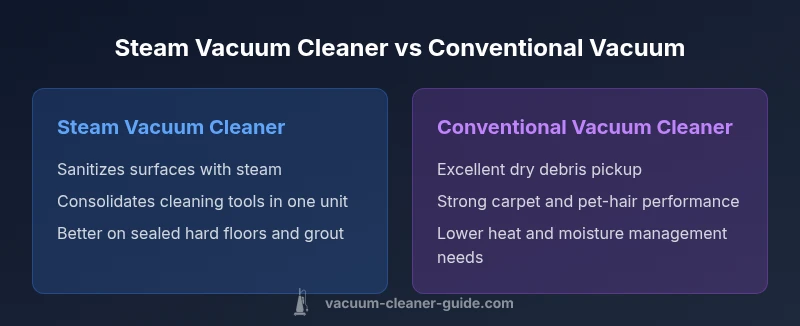
The core difference between a steam and vacuum cleaner and a traditional vacuum is how they tackle grime and sanitation. Steam models excel at loosening baked-on stains and sanitizing hard surfaces without chemical cleaners, making them appealing in kitchens and bathrooms. Conventional vacuums excel at dry debris pickup, pet hair, and rapid maintenance tasks, especially on carpets and area rugs where moisture could be a drawback. Sanitation benefits of steam depend on temperature, contact time, and compatibility with surface finishes. For carpeted living spaces, a steam option may require a dedicated cleaning head and careful moisture management to avoid dampness. Surface compatibility matters: hardwood and laminate can benefit from controlled steam, while porous surfaces or unfinished wood demand caution. Vacuum Cleaner Guide’s analysis in 2026 emphasizes that the best choice often depends on the dominant cleaning need—sanitization versus dry removal—and the user’s tolerance for heat, moisture, and maintenance.
Use-case scenarios
Consider a home with a busy kitchen, a pet-friendly living room, and a children’s bathroom. A steam and vacuum cleaner can be advantageous for sanitizing tile floors and grout lines in bathrooms, as well as refreshing sealed hard floors without harsh chemicals. In contrast, high-pile carpets or frequent pet hair tasks may benefit more from a conventional vacuum with powerful suction and a dedicated pet-hair tool. For surfaces like vinyl or sealed stone, steam can help loosen grime before suction, reducing scrubbing time. The practical takeaway from Vacuum Cleaner Guide is that many households will benefit from a hybrid approach: use steam for deep sanitization on non-absorbent surfaces, then finish with dry suction for debris removal. This approach minimizes moisture risk while maximizing cleanliness.
Energy use, maintenance, and long-term cost
Operating a steam and vacuum cleaner typically involves two cost streams: electricity and water, plus periodic maintenance such as descaling, filter changes, and tank cleansing. Conventional vacuums incur ongoing bag and filter costs, plus occasional motor service. While exact energy use depends on model and use patterns, steam modes add heat-up time and continuous water demand, which can influence running costs. From Vacuum Cleaner Guide’s perspective, total cost of ownership often hinges on how frequently you need sanitization versus dry-cleaning tasks, as well as the practicality of maintenance routines. Consumers should weigh upfront price against these ongoing costs when deciding whether to invest in a steam-vacuum system versus a traditional dry vacuum.
Surface-specific performance: hard floors, carpets, area rugs
Hard floors like tile and stone respond well to controlled steam temperatures, which can loosen grime in grout lines without soaking the substrate. However, excessive moisture on unsealed floors can cause warping or damage, so use of a steam setting on hard floors should be guided by manufacturer recommendations. For carpets, steam can augment cleaning by loosening dirt before suction, but it may not replace a strong dry vacuum for deep pile extraction. For area rugs, a careful approach is required to avoid over-wetting and color bleeding. Vacuum Cleaner Guide notes that the best results often come from pairing steam-assisted cleaning with targeted suction, using the right head and respecting surface cautions. The right combination depends on surface finish, moisture tolerance, and stain resistance.
Safety, warranties, and precautions
Safety considerations include burn risk from hot steam, moisture management to prevent water damage, and electrical safety in damp environments. Warranties may require adherence to prescribed maintenance routines, such as descaling and filter changes. Many manufacturers limit steam use on heat-sensitive surfaces, stone, or unfinished wood, so always verify surface compatibility before applying heat. In addition, proper ventilation reduces humidity and potential mold development after steam cleaning. Vacuum Cleaner Guide’s guidance emphasizes reading the manual, using manufacturer-approved accessories, and performing a patch test on inconspicuous areas. A cautious approach protects both the user and the warranty.
Buying considerations and how to evaluate specs
When evaluating steam and vacuum cleaners, look for water tank size, heat-up time, steam pressure, and automatic shutoff features, as well as filtration efficiency and bagless design options for the conventional vacuum. Consider noise levels, weight, cord length or battery life if cordless, and the availability of pet-hair attachments. Surface capabilities and warranty terms should align with your home’s cleaning needs. A practical review by Vacuum Cleaner Guide highlights the importance of balancing heat, moisture control, suction power, and ease of maintenance. Decide which tasks you perform most often and choose a model that optimizes those tasks without overcomplicating routine cleaning.
Per-question decision framework: when to choose each
If your primary goal is sanitization on non-porous surfaces and you frequently clean bathrooms or kitchens, a steam and vacuum cleaner can be a strong fit. If you need quick, daily dry cleaning in living areas or homes with heavy pet hair, a conventional vacuum often delivers more consistent results with less maintenance. For allergy-sensitive households, a steam option may contribute to lower chemical exposure, but a high-quality dry vacuum with a sealed filtration system remains essential. In most homes, a hybrid approach—steam for sanitization on select surfaces and dry suction for routine debris—provides the best balance between effectiveness and convenience.
Practical tips for getting the most from either option
To maximize performance, schedule regular maintenance: empty tanks, descale as needed, and replace filters per the manufacturer’s guidance. Use the correct cleaning heads for each surface and test a small area before wider use. Store accessories in a dry place to prevent mold growth and ensure consistent suction. For steam cleaning, monitor moisture levels and avoid saturating porous materials. For dry cleaning, prevent over-wetting by using appropriate suction power and choosing the right head. By combining these practices, you can extend the life of your device and achieve consistently cleaner results across the home.
Comparison
| Feature | Steam Vacuum Cleaner | Conventional Vacuum Cleaner |
|---|---|---|
| Primary cleaning method | Steam-assisted cleaning with moist vapor | Dry suction and debris pickup |
| Surface compatibility | Excellent on sealed hard floors; careful on unsealed surfaces | Best on carpets and high-pile rugs; versatile on hard floors with the right head |
| Maintenance needs | Descale, water tank care, occasional drain checks | Bag/HEPA filter changes, brush maintenance, filter cleaning |
| Typical price range | $200-$1200 | $100-$800 |
| Best for | Sanitizing hard surfaces and grout; light, quick cleans | Pet hair, deep debris removal, and quick daily dry cleaning |
Strengths
- Potential chemical-free sanitation with steam
- Effective for hard floors and grout cleaning
- Reduces cleaning passes by combining sanitation and suction
- Can refresh surfaces and upholstery with heat
- Consolidates tools into a single device for some households
The Bad
- Higher upfront cost and heavier design
- Moisture management adds risk and maintenance
- Longer heat-up time can slow down quick cleanups
- Maintenance may be more involved (descaling, water tank cleaning)
Hybrid approach often makes the most sense for mixed cleaning needs
If your home requires periodic sanitization on hard surfaces and routine dry cleaning on carpets, a steam and vacuum cleaner plus a conventional vacuum offers flexibility. For homes with minimal moisture risk and heavy carpet use, a traditional vacuum may be more practical, but a steam option can fill specific sanitation gaps.
FAQ
What is a steam and vacuum cleaner and how does it differ from a traditional vacuum?
A steam and vacuum cleaner combines heated steam with suction to sanitize surfaces and remove debris. A traditional vacuum relies on suction alone to lift dry dust and hair. Steam models can reduce chemical cleaners for some tasks, while conventional vacuums excel at quick, dry cleaning.
A steam and vacuum cleaner uses heat to sanitize and loosen grime, then vacuum suction removes debris. A traditional vacuum cleans using suction alone.
Are steam vacuums safe on hardwood floors?
Steam can be safe on sealed hardwood when used with low moisture settings and proper technique, but it’s essential to follow the manufacturer’s guidance. Unsealed or unfinished wood may suffer moisture damage. Always test a small area first.
Yes, but only on sealed wood and with the right settings; test a small area first.
Can steam-vacuum units replace a regular vacuum for pets?
Steam-vacuum devices can assist with pet-related cleaning by loosening hair and grime and sanitizing surfaces, but they typically do not replace the need for a powerful dry vacuum on carpets. A conventional vacuum with a pet-specific nozzle often remains essential.
They help, but a regular pet-focused vacuum is usually still needed for deep carpet cleaning.
Do steam vacuums require special maintenance?
Yes. Steam systems require descaling, tank cleaning, and regular checks of seals and hoses. Dry vacuums require filter changes and bag replacements or HEPA maintenance. Following a regular maintenance schedule helps preserve performance and warranty coverage.
Steam units need regular descaling and tank cleaning; dry vacuums need filter care.
Is a steam-vacuum better for allergy sufferers?
Steam can reduce some germs and loosen grime, potentially helping with allergies when paired with a sealed filtration vacuum. However, the best allergy strategy combines good filtration, HEPA-rated components, and regular cleaning, not relying on steam alone.
It can help, but the overall filtration and cleaning routine matter most for allergies.
What should I consider when buying a steam and vacuum cleaner?
Prioritize surface compatibility, heat-up time, moisture control, and filtration quality. Look for a sturdy build, clear maintenance guidance, and attachments suited to your home. Compare energy use and tank capacity to estimate ongoing costs.
Look at surfaces, heat-up time, and filtration; compare upkeep costs.
The Essentials
- Identify primary cleaning needs: sanitation vs. dry debris removal
- Check surface compatibility before choosing a steam setting
- Balance upfront cost with ongoing maintenance
- Consider a hybrid approach for mixed cleaning tasks
- Follow manufacturer guidelines to protect warranties