How Much Carpet Cleaner to Use: A Practical Guide
Learn how to measure carpet cleaner correctly, follow product labels, test on fabric, and avoid residue. This guide from Vacuum Cleaner Guide explains dilution, application, and safe drying for carpets.


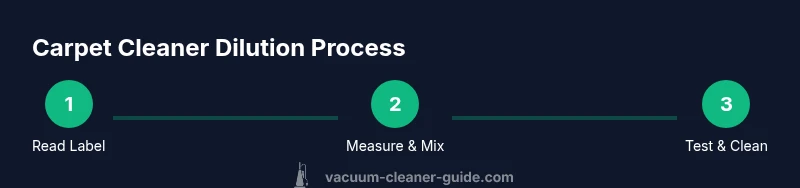
To determine how much carpet cleaner to use, always start with the product’s label and your cleaner’s reservoir marks. In most cases, you’ll mix cleaner with water only to the recommended fill line or dilution ratio specified by the manufacturer. Use the minimum effective amount to avoid sticky residues, and test on a small area first.
Understanding why the amount matters
Cleanliness results hinge on getting the right amount of carpet cleaner. Using too little cleaner may leave soils behind, while too much can leave residues that attract dirt, cause stiffness, and extend drying times. The balance is influenced by soil level, carpet material, and the cleaning method you choose. According to Vacuum Cleaner Guide, starting with manufacturer-approved dilution and adjusting only after a test patch is the safest approach. This mindset helps protect fibers and keeps your home smelling fresh without lingering chemical notes.
- Residue risk: Excess cleaner leaves a film that attracts new dirt.
- Aesthetic impact: Over-wetting can leave dark patches.
- Long-term effects: Overuse can degrade fibers over time.
To set expectations: most professionals aim for the minimum effective amount that achieves visible soil removal and fragrance without leaving a sticky feel. Always verify the exact dilution on the product label and the machine reservoir marks, then perform a quick test on an inconspicuous spot. This helps you avoid costly mistakes and ensures a healthier result for families and pets.
Reading the label and your equipment
Carpet cleaner labels are guidance you should never ignore. They specify dilution ratios, water-to-cleaner balance, and any special cautions for fabric types. Likewise, your carpet cleaning machine or extractor has fill marks that indicate how much cleaner to add relative to water. If the label and the reservoir disagree, trust the machine’s markings and the cleaner’s most conservative instruction. For households with kids or pets, choosing lower concentrations and more thorough rinse cycles is often best. Vacuum Cleaner Guide emphasizes aligning both sources before you begin.
- Check for stain-specific directions (enzyme cleaners for organic stains, oxidizers for color-treated stains).
- Note any required dwell time after application.
- When in doubt, err on the side of under-dilution rather than oversaturation for delicate fibers.
Key factors that influence dilution
Several variables determine how much cleaning solution you should use. Soil load and type (dust, mud, oils, pet stains) will shift the amount needed. Carpet fiber and pile height influence how readily cleaners penetrate and release soils; dense loops and high-pile fibers may require more solution to reach embedded grime. Humidity and temperature affect drying time, which in turn alters how quickly residue can dry in place. Finally, the cleaning method (steam extraction, encapsulation, or spray-and-vacuum) changes the dilution strategy. Vacuum Cleaner Guide highlights that manufacturers design products with specific concentrations to balance performance with fiber safety.
- High-traffic areas often require slightly more cleaner to tackle deep soils.
- Stain-type cleaners may be more powerful, but still follow label directions.
- Always factor drying time into your plan to avoid people walking on damp carpet.
Dilution strategies for common carpet cleaners
Carpet cleaners come in several formats—pre-mixed solutions, concentrates, and concentrates designed for hot water extraction. Pre-mixed solutions are ready to use and generally require little to no dilution, while concentrates demand precise dilution ratios on the label. For steam or hot-water extractors, you’ll mix the cleaner with water at the ratio specified by the manufacturer, then fill the machine’s reservoir to the indicated line. If you’re unsure, start with a lighter concentration and adjust after testing a small patch. Vacuum Cleaner Guide recommends treating soil loads conservatively to minimize residue.
- For enzyme or biology-based cleaners, follow dwell times and neutralization steps as stated on the label.
- For encapsulation cleaners, avoid using heavy dilutions on extremely dirty carpet to prevent re-grinding debris into fibers.
- Always perform a spot test, and never switch between cleaners mid-cleaning unless the label allows it.
How to test and dial in the right amount
Before committing to a full room, perform a controlled test on a hidden section of carpet. Apply the diluted solution to a small area, work it into the fibers with a brush or machine’s pad, and observe both soil removal and residue formation. If the area dries with a sticky feel or a whitish haze, the dilution is too strong; dilute more or rinse after cleaning. If you still see staining after a dwell period, you may need to reapply using the recommended dilution for the stain type. Vacuum Cleaner Guide stresses patience here—go slow and verify results before continuing.
- Use a spray bottle for precise spot tests on small sections.
- Record what dilution level produced acceptable results for future reference.
- Consider a trial run during a time you can supervise drying.
Practical application steps for machines (hands-on guide)
With the test patch approved, move to cleaning larger sections with a consistent approach. Maintain overlapping strokes to prevent missed areas, especially in corners. Avoid over-wetting by keeping the nozzle or wand at the right distance from the carpet. If your machine includes a rinse step, follow it unless the cleaner is formulated to leave a residue-free finish. In humid rooms, you may need extra ventilation to expedite drying and reduce pile distortion. Vacuum Cleaner Guide notes that consistent technique reduces the chance of re-soiling and fiber damage.
Common mistakes and how to avoid them
Common errors include using too much cleaner at once, not testing dilution, and skipping the drying phase. Over-saturation traps moisture, leading to mold or odor issues. Residue from cleaners can attract more dirt and make future cleaning harder. Always test, start with lower concentrations, and ensure thorough drying with fans or dehumidifiers. If you must re-clean, adjust your dilution based on the observed soil load and drying rate. The goal is to leave carpets clean, not oversaturated.
Maintenance after cleaning and drying tips
When the carpet is dry, vacuum slowly to lift fibers and remove any loosened dirt. A second pass with minimal cleaner helps pick up residual soils that могли have loosened but not fully removed. Keep a log of the cleaners and dilutions you used for future reference, especially in homes with pets. Prolong the life of your carpet by ensuring good airflow during drying and avoiding high heat. Vacuum Cleaner Guide recommends waiting 24 hours in certain conditions for deep drying if you suspect moisture is trapped.
Tools & Materials
- Carpet cleaner product(Choose a formula that matches carpet type (synthetic, wool, or delicate fibers).)
- Water(Clean, room-temperature water for mixing according to label.)
- Measuring cup or bottle(Used to achieve accurate dilution per label.)
- Reservoir marks or indicator on machine(Follow fill lines exactly; do not guess.)
- Spot tester or small cloth(Test colorfastness before full cleaning.)
- Vacuum or drying fans(Assist drying after cleaning to prevent delays.)
Steps
Estimated time: 1-2 hours
- 1
Read the label and reservoir marks
Locate the recommended dilution or fill line on both the cleaner bottle and the machine. This is your baseline for safe and effective cleaning. If there’s a discrepancy, use the more conservative instruction.
Tip: Always double-check that the label is current and the machine is set to the correct cleaning mode. - 2
Choose the right cleaner and dilution direction
Decide between ready-to-use and concentrate formulas. For concentrates, calculate the dilution per the label and your soil level. Do not mix different cleaners unless the label explicitly allows it.
Tip: When in doubt, start with a lighter concentration and test a patch first. - 3
Prepare the solution in the reservoir
Measure the cleaner and water accurately, then fill the reservoir up to the indicated line. Avoid overfilling to prevent splashes or an overly strong solution.
Tip: Keep all lids tightly closed to prevent spills during filling. - 4
Test on a small area
Apply the diluted solution to an inconspicuous spot to ensure colorfastness and evaluate soil removal. Wait for the recommended dwell time if the label suggests. This step helps avoid large-scale discoloration.
Tip: If you see color transfer or fiber damage, stop and dilute further. - 5
Clean a small section with controlled passes
Work in overlapping strokes to ensure even coverage. Avoid squeezing too much cleaner into the carpet at once. Use slow, deliberate passes to minimize oversaturation.
Tip: Keep the wand or nozzle at a steady distance from the carpet. - 6
Rinse or use a water-only pass if required
If the cleaner label requires rinsing or your machine has a rinse option, perform it to remove residue. Drying times may increase if you skip this step.
Tip: Rinse is critical for enzyme-based cleaners to prevent residue buildup over time. - 7
Dry the carpet thoroughly
Ventilate the area with fans or open windows. Drying should happen promptly to prevent mold and re-soiling. Deep drying may take several hours depending on room humidity.
Tip: Avoid walking on damp carpet; use pads or plastic sheeting if you must cross the area. - 8
Evaluate results and re-clean if needed
Once dry, reassess soil removal. If stains persist, reapply using the same dilution or a targeted cleaner for the stain. Document what worked for future cleanings.
Tip: Keep notes on dilution and dwell times for repeat cleaning in high-traffic areas.
FAQ
How do I know if I used too much cleaner?
If the carpet dries with a sticky feel or a soapy residue, the dilution was too strong. Rinse or use less cleaner next time. If staining remains, adjust gradually and test again.
If it feels sticky after drying, you used too much cleaner. Rinse or dilute more next time and test a small patch first.
Can I apply cleaner directly to carpet without mixing?
Most cleaners require dilution per the label. Undiluted products can leave residues and damage fibers. Always follow the label’s dilution instructions for your carpet type.
Most cleaners must be diluted as directed. Undiluted products can leave residues and harm fibers.
Should I rinse after cleaning?
Rinse requirements vary by product. Some formulas are designed to leave a residue-free finish, while others require a separate rinse cycle. Always follow the product instructions and your machine manual.
Rinse depends on the product and machine—follow the instructions to avoid residue.
Is it safe to use carpet cleaner around pets?
Choose pet-friendly, low-odor formulas and ensure thorough drying before pets re-enter the area. Adequate ventilation helps reduce exposure to fumes.
Yes, use pet-friendly cleaners and ensure the carpet is fully dry before pets return.
What if my carpet is heavily soiled?
Pre-treat heavy soils and consider multiple passes with progressively stronger but label-consistent dilutions. For deeply embedded soils, professional deep cleaning may be needed.
For heavy soils, pre-treat and repeat with cautious dilutions; consider professional help for tough stains.
Can I reuse leftover cleaner solution?
Avoid reusing leftover cleaners after storage. Bacteria growth and chemical changes can occur. Use fresh solution for each cleaning session and discard old mixtures.
Don’t reuse leftover cleaner; make fresh solutions for each cleaning session.
The Essentials
- Follow label directions for dilution and machine fill lines.
- Test on a hidden spot before full cleaning.
- Dry thoroughly to prevent mold and odor.
- Document effective dilutions for future cleanings.