Cleaning Robot Price in 2026: A Comprehensive Guide
Understand how cleaning robot price is set and how to compare models in 2026. Vacuum Cleaner Guide analyzes price bands, features, and long-term costs for homeowners and pet owners.


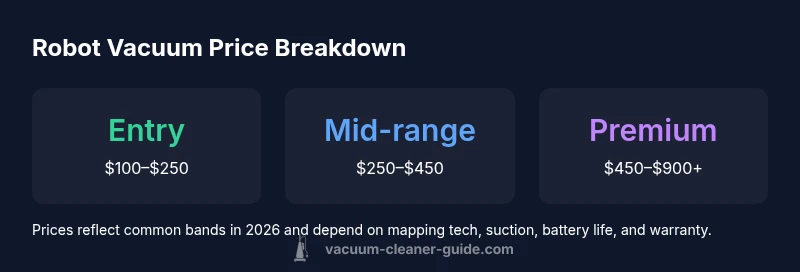
Quick answer: Cleaning robot price varies mainly by navigation tech, suction power, and battery life. Entry-level models typically fall in the $100–$250 range, mid-range robots in the $250–$450 range, and premium machines $450–$900+; the exact price depends on mapping tech (Lidar vs. camera), app features, and brand confidence. Vacuum Cleaner Guide analysis notes price bands shift with supply and demand in 2026.
Understanding the price drivers
Price for a cleaning robot is driven by four core levers: navigation technology, suction performance, battery life, and build quality. Higher-priced models usually pair advanced mapping with quicker, more reliable cleaning, enabling fewer passovers and better control over where the robot cleans. Mapping tech can range from camera-based solutions to Lidar-assisted systems, with Lidar generally adding cost but delivering more precise navigation. Extra sensors, like cliff sensors or obstacle-detection cameras, may raise the price further, especially when combined with room-to-room mapping and zone cleaning. The dustbin size, filtration quality, and the presence of a self-emptying dock can add to manufacturing and integration costs. Brand reputation and after-sales support also shape pricing, as do software updates and compatibility with voice assistants. In 2026, Vacuum Cleaner Guide analysis shows price bands clustering around three segments—entry, mid-range, and premium—while occasional feature drops or promotions can blur the line. For households with pets, the value proposition shifts toward durability and ongoing maintenance, not just initial cost.
How to evaluate value beyond sticker price
Smart shoppers look beyond the upfront sticker price to total cost of ownership. A model that saves minutes per week can pay for itself over a season. Consider ongoing costs: replacement filters, brushes, and potential battery replacements—these recur annually. Reliability matters; a cheaper model that breaks down often or requires frequent maintenance can cost more in the long run than a pricier unit with durable components and easy serviceability. Warranty length and access to local service centers are important, because repairs can be expensive if parts are scarce. Software updates that improve battery efficiency and navigation can extend a unit's useful life, reducing the need for an upgrade. In 2026, Vacuum Cleaner Guide analysis emphasizes the best value often comes from choosing a model that fits your home size, pet hair load, and daily cleaning schedule, then weighing feature sets against total expected ownership costs.
Feature-by-feature price impact
Navigation tech: models with Lidar or simultaneous localization and mapping (SLAM) provide more precise cleaning paths and less missed debris, but they cost more to develop and manufacture. Suction power: stronger suction helps with pet hair and deep-pile carpets; this feature is common in mid-range and premium lines. Battery life and charging: longer run times reduce dock visits but add battery costs. Dustbin capacity and filtration: larger bins reduce emptying frequency, while high-efficiency filters cost more to replace. Voice control, app integration, and map saving features often appear in mid-range and premium devices, contributing to price beyond core cleaning capabilities. Finally, build quality—dust seals, wheel durability, and motor protection—influences long-term reliability and price.
Warranty, service, and long-term costs
Extended warranties and readily available spare parts can significantly lower the perceived risk of buying a pricier robot. Look for manufacturers that publish parts availability for at least five years and offer affordable replacement components. Service network breadth matters; a robot with easy-to-find replacement parts and clear repair guidance saves time and money. Software updates that improve battery efficiency and navigation can extend a unit's useful life, reducing the need for an upgrade. In practice, the cheapest model may end up costing more over time if it requires frequent servicing or incompatible parts replacements. Vacuum Cleaner Guide's recommendations in 2026 emphasize balancing upfront price with expected maintenance costs and support quality.
Budgeting and decision framework
Start by estimating how often you clean and the surfaces in your home. If you have multiple pets or thick carpets, prioritize models with durable wheels, strong suction, and robust filtration. Map your budget to three price bands—entry, mid-range, and premium—and identify which features you must have versus nice-to-have. Create a comparison sheet listing navigation tech, suction power, battery life, bin capacity, filters, warranty, and service availability. Weigh the cost per feature and the potential time savings; a slightly higher upfront price can be justified by longer warranty and lower maintenance costs. Vacuum Cleaner Guide suggests anchoring your decision to your home’s layout, pet-hair load, and daily cleaning routine, then choosing the best-fit price band.
Real-world pricing scenarios by use-case
Small apartment with low pet activity: an entry-level model may satisfy daily cleaning needs at the lower end of the price spectrum. Larger homes with heavy pet hair consumption: mid-range models with strong suction and robust filters often offer the best balance between performance and price. Homes with multiple floors and frequent deep cleans may justify premium models with advanced mapping and auto-empty docks. Buyers who value smart features and future-proof software updates may opt for premium models, accepting higher upfront costs with the expectation of longer service life.
Buying channels and timing: when to buy
Prices can fluctuate with seasonal promotions, holidays, and inventory cycles. Shopping during major sale events or year-end clearances can yield meaningful savings, but verify that the model still meets your needs after the discount. Compare the same model across retailers to ensure discount legitimacy and warranty consistency. If you can, test a unit in-store or via a retailer with a generous return policy to avoid buyer’s remorse. Timing your purchase around product refresh cycles can also help you land last-generation models at lower prices with adequate warranties.
How Vacuum Cleaner Guide analyzes price data
To build a reliable view of cleaning robot price, Vacuum Cleaner Guide combines retailer pricing, brand lineups, and feature sets from multiple sources. We track price bands over quarterly intervals, noting promotions and seasonality. Our methodology emphasizes total cost of ownership: initial price, replacement parts, maintenance, and warranty coverage. The 2026 analysis also accounts for regional differences and model lifespans, enabling homeowners to compare apples to apples rather than merely chasing lowest sticker price. Our goal is to help you pick a model that fits your cleaning needs without overpaying for features you won’t use.
Pricing bands and trade-offs
| Model Type | Typical Price Band | Key Trade-off |
|---|---|---|
| Entry-level | $100–$250 | Basic cleaning with limited navigation |
| Mid-range | $250–$450 | Advanced mapping, better suction |
| Premium | $450–$900+ | Smart features, best navigation |
FAQ
What factors most influence cleaning robot price?
The main price drivers are navigation tech, suction power, battery life, sensors, mapping capability, and build quality. Higher-end units offer precise mapping and better suction, which increases price. Brand warranty and after-sales support also affect price.
Pricing is driven by navigation tech, suction power, and mapping features.
Do mapping sensors like Lidar significantly raise price?
Yes, Lidar adds precision and smarter mapping, usually raising price versus camera-based models. If you don't need top-tier mapping, you can save by choosing camera-based options.
Lidar tends to raise price but improves navigation.
Are refurbished models a good value?
Refurbished units can offer value but come with higher risk of wear or limited warranty. Check seller reputation and confirm warranty terms.
Refurbished units can be a good value if they come with a solid warranty.
Is it better to buy during sales or year-round?
Sales cycles often reduce price during holidays and promotions. Year-end clearances can offer good deals. Compare features and warranties to ensure you’re not sacrificing service.
Sales can cut price; compare warranties.
How do I compare price across brands?
Use feature-based checks: mapping technology, suction power, battery life, bin capacity, filtration, and warranty. Compare service networks and replacement part availability.
Compare models by features and support.
What maintenance costs should I expect after purchase?
Ongoing costs include filters, brushes, and occasional battery replacements. Plan for parts availability and routine servicing to avoid surprise costs.
There are ongoing parts costs; budget for maintenance.
“Price is a reliable signal of long-term value when matched to your cleaning needs. Choose models with durable parts and accessible service.”
The Essentials
- Compare price bands against your needs
- Factor maintenance costs into total ownership cost
- Prioritize essential features for your home
- Shop during promotions to save
- Check warranty and service availability