What to Do If You Drank Carpet Cleaner: Quick Guide
A practical, step-by-step guide for immediate action if carpet cleaner is ingested—what to do now, when to seek emergency care, and how to prevent future incidents.


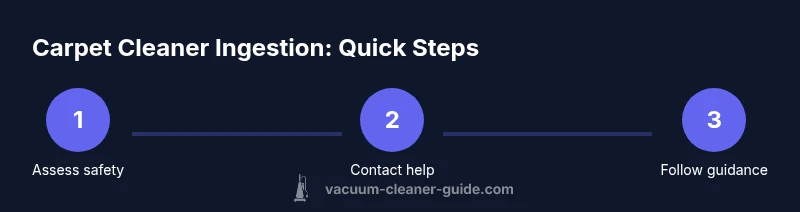
According to Vacuum Cleaner Guide, if you or someone else drank carpet cleaner, act quickly and calmly. Do not induce vomiting unless a poison-control expert tells you to. Immediately call your local poison control center or emergency services, provide product details from the container label, and follow their instructions. Seek medical evaluation if you develop symptoms such as trouble breathing, persistent vomiting, or chest pain.
What carpet cleaner is and why ingestion is dangerous
Carpet cleaners are formulated as multi-component mixtures designed to loosen stains and dissolve dirt. They often contain surfactants, solvents, fragrances, and sometimes caustic agents like alkaline compounds or bleach. Ingesting these substances can irritate the mouth, throat, and stomach, and some chemicals can burn tissues on contact. Even if you don’t notice immediate symptoms, the material can irritate the airway if accidentally breathed in or aspirated during vomiting. Children and older adults are particularly vulnerable because their airways and stomachs are more sensitive, and small amounts can cause disproportionate harm. Safe storage and clear labeling help reduce risk, but accidents still happen. If ingestion occurs, treat it seriously and respond promptly. Vacuum Cleaner Guide’s guidance emphasizes a quick, measured response to reduce injury and ensure proper medical evaluation when needed.
note
Tools & Materials
- Phone to call poison control or emergency services(Have the product label handy to report exact ingredients and concentrations.)
- Container label or product bottle(Used to identify active ingredients and warnings for clinicians.)
- Clean water for mouth rinse (if the person can swallow safely)(Offer small sips only; do not force fluids if there is vomiting or coughing.)
- Notepad and pen(Record time of ingestion and any symptoms to share with a clinician.)
- Access to the internet or phone(Useful for looking up product details or locating nearest emergency resources.)
Steps
Estimated time: up to 60 minutes for initial actions; monitor for symptoms over the next 24-48 hours
- 1
Stop and assess safety
Alert others, move the person away from any additional exposure, and take note of the product name and amount if possible. Do not panic; a calm, quick assessment helps you respond faster and more accurately.
Tip: If the person is conscious and breathing, avoid giving anything by mouth beyond small sips of water unless advised. - 2
Call poison control or emergency services
Report what happened, the product name, the approximate amount ingested, and the time of exposure. Follow the operator’s instructions precisely, including whether to seek immediate care.
Tip: Have the container label ready so the responder can identify exact ingredients. - 3
Check the product label for warnings
Read the label for any specific first-aid recommendations or cautions. Note whether the product contains bleach, alkali, solvents, or enzymes, as this informs medical guidance.
Tip: If contraindicated by the label or a clinician, do not attempt home remedies; rely on professional instructions. - 4
Do not induce vomiting unless told to do so
Vomiting can cause the liquid to re-enter the airway or cause further chemical injury. Only follow a professional’s instruction to induce vomiting if explicitly advised.
Tip: If vomiting begins naturally, help the person stay upright and monitor their breathing. - 5
Rinse mouth safely and monitor for symptoms
If allowed by a professional, offer small sips of water and allow the person to rinse their mouth to remove residue. Do not swallow large amounts and do not give anything else by mouth if the person is vomiting or unconscious.
Tip: Watch for coughing, choking, drooling, fever, or chest pain—these may indicate airway or digestive tract involvement. - 6
Follow medical instructions and seek urgent care if needed
A clinician may perform an evaluation, monitor for delayed symptoms, and provide supportive care. Do not delay if symptoms worsen or new signs appear.
Tip: Bring the product label and time of ingestion to the healthcare visit. - 7
Document and plan for follow-up
Record symptom progression, any treatments given, and when you contacted professionals. Schedule a follow-up with a healthcare provider if symptoms persist or new concerns arise.
Tip: If symptoms delay or worsen over the next 24-72 hours, seek medical attention promptly.
FAQ
What should I do immediately if I or someone else drank carpet cleaner?
Call poison control and emergency services right away. Do not induce vomiting unless told by a professional. Report the product name, amount if known, and time since ingestion. Follow their directions and seek medical evaluation if symptoms develop.
Call your local poison control and emergency services now. Do not induce vomiting unless advised; report the product details and follow professional instructions.
Is drinking water safe after exposure?
If the person can swallow safely, offer small sips of water to rinse the mouth and dilute the substance. Do not give water if there is vomiting, coughing, or altered consciousness.
If they can swallow safely, offer small sips of water; stop if vomiting or confusion occurs.
Should I go to the emergency department if there are no symptoms?
Yes, especially for strong cleaners or unknown ingredients. Call poison control for guidance; if advised, go to the ER or urgent care for evaluation.
If unsure or if symptoms may develop, contact poison control and consider going to the ER for a professional check.
Why should I read the product label?
Labels list active ingredients, warnings, and recommended first-aid steps. They guide what actions to take and help clinicians treat any exposure appropriately.
The label tells you what's in the product and the recommended first-aid steps, which helps responders.
What about children or pets?
Keep the affected person away from the product and seek immediate guidance from professionals. Do not assume small amounts are harmless for children or animals.
Get professional guidance promptly; children and pets are at higher risk and require careful management.
How can I prevent carpet cleaner ingestion in the future?
Store cleaners in a locked cabinet, never decant into other containers, and keep products out of reach of kids and pets. Read labels before use and follow directions closely.
Lock cleaners away, never repurpose bottles, and always read and follow the label directions.
Watch Video
The Essentials
- Act quickly but calmly after exposure.
- Do not induce vomiting unless advised by a professional.
- Have product label handy and report details to responders.
- Seek medical care for any symptoms or if unsure.
- Store cleaners safely to prevent future ingestion incidents.