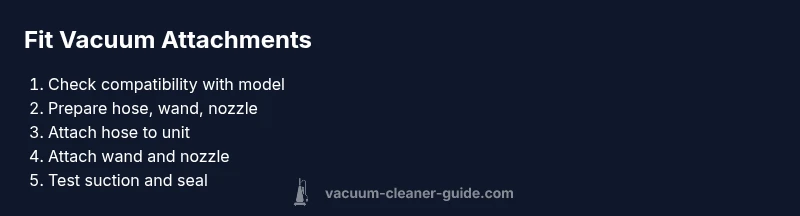
How to Fit a Vacuum Cleaner: A Step-by-Step Guide
Learn how to fit a vacuum cleaner with the right attachments, seals, and safety checks. This educational guide covers compatibility, attaching hoses and nozzles, troubleshooting, and maintenance for optimal performance in 2026.


By the end of this guide you will know how to fit a vacuum cleaner by verifying compatibility, connecting the hose, wand, and nozzle, and securing airtight seals. We'll cover common attachment types, step-by-step assembly, and quick troubleshooting to ensure safe, efficient cleaning on carpets and hard floors. Expect practical tips, safety notes, and maintenance pointers.
What 'fit' means for vacuums: compatibility and types
Fit means that the attachments—hose, wand, nozzle, crevice tool—are designed to work with your specific vacuum model. Models differ in intake sizes, lock mechanisms, and sealing surfaces, so a generic attachment can be loose, jammed, or ineffective. According to Vacuum Cleaner Guide, compatibility is the first gatekeeper for a successful fit. Start by checking your model’s manual, or the manufacturer’s website, for attached accessory lists and part numbers.
There are several common configurations:
- Standard uprights and canisters use a fixed hose connection and a wand that telescopes.
- Some bagless or central-vacuum units use quick-connect couplings or proprietary locking collars.
- Cordless stick vacuums often come with integrated attachments that slip onto a dedicated port.
Understand the difference between hoses that accept locking rings versus squeeze-style connections, and note whether you need a foam seal, O-ring, or gasket to seal joints. If you own multiple vacuum tools from different brands, you may need an adapter for a proper fit. Always confirm that the attachment bore matches your model’s inlet size.
Match the nozzle, wand, and hose: choosing the right attachments
Choosing the right attachments means matching their shapes and purposes to your cleaning needs. A crevice tool shines in tight gaps, while a wide floor nozzle covers larger areas efficiently. Upholstery and dusting brushes help with furniture and shelves, and a motorized brush head may improve carpet cleaning. For pet owners, a stiff brush or motorized head can help lift hair without tangling.
When evaluating compatibility, consider the attachment’s diameter, locking mechanism, and whether it relies on a simple friction fit or a locking tab. If you’re using a combination of brands, look for adapters or universal connectors that preserve suction and prevent leaks. Always keep your floors and surfaces in mind to choose attachments that minimize drag and maximize control.
How to physically fit: connecting hoses to main unit
Start by turning off the unit and unplugging it from the power source. Align the hose end with the main inlet and push firmly until you hear or feel a secure click. Some models require twisting the hose clockwise to engage a locking collar; others use a push-and-tull locking clip. Once the hose is connected, gently tug on it to ensure it’s secure before proceeding.
Next, slide the wand into the hose’s other end, ensuring any locking mechanism engages. If your wand is telescoping, extend to the desired length and lock in place. Attach the chosen floor nozzle or brush to the wand’s end, verifying there is no gap between parts. A snug, straight alignment reduces air leaks and maintains suction power.
Seals, gaskets, and clamps: ensuring airtight connections
A tight seal is essential for maximum suction. Inspect seals and gaskets at every joint for cracks, tears, or deformation. If a gasket is damaged, replace it with an OEM part or compatible alternative. For plastic joints, a quick wash with mild soap and water can reveal cracks—do not submerge motor components.
After reassembling, run a quick test by placing a tissue near each joint to detect air leaks. If you notice whistling or a decrease in suction at any joint, re-seat the components and re-check seals. Keep replacement seals handy so you can address wear before it impacts performance.
Cord management and safety: power cords and switches
Never force cords through tight spaces or wraps that could pinch. Use a cord wrap to prevent tangling and protect the plug and cord. If your model has a primary on/off switch, test it with the attachments in place to ensure no obstruction occurs when you power on. Always unplug before adjusting or removing parts to avoid electric shock or injury.
If you use a retractable cord feature, verify it retracts smoothly and does not snag attachments. Keep the cord away from hot surfaces and sharp edges to minimize wear. Regularly inspect the plug and cord for fraying and replace if needed.
Special cases: bag vs bagless, canister vs stick, pet-hair concerns
Bagless units rely on a chamber that may require different seals and filters compared with bagged models. Canister vacuums typically offer longer hoses and more attachment options, which can influence how you fit parts. Stick vacuums and cordless models often integrate attachments with a single point port—check the manual for exact connection methods.
Pet owners may benefit from a motorized brush head or a high-efficiency filter to handle hair and dander. If the vacuum’s intake becomes clogged due to long hair, pause to remove hair from the brush and cleaning path. Always ensure that the attachment’s airflow isn’t blocked by debris before continuing.
Maintenance after fitting: cleaning, checks, and troubleshooting
After fitting, perform a quick cleaning of the attachment paths to remove dust and hair that can hinder airflow. Periodically inspect hoses for cracks or wear, especially at joints where hoses connect to the wand and main unit. If performance declines, recheck seals, replace worn gaskets, and verify that the nozzle is appropriate for the surface.
Troubleshooting steps:
- If suction seems weak, check for blockages in the wand, hose, and nozzle.
- If noise or whistling occurs, reseat joints and inspect seals for gaps.
- If attachments won’t stay attached, verify compatibility and consider a dedicated adapter.
When to call a professional
If you’ve confirmed compatibility, replaced seals, and followed the fitting steps but still face persistent leaks, or if you notice electrical or motor issues, it’s wise to consult a professional technician. A specialist can diagnose worn internal gaskets, damaged hoses, or problematic power components and perform safe, compliant repairs.
Tips for different floor types and attachments usage
For carpeted surfaces, a motorized brush head can improve deep cleaning and hair removal, while a soft-bristled dusting tool protects delicate fabrics. For hard floors, use a wide, hard-floor nozzle to avoid scattering debris. When transitioning between floor types, keep the wand length appropriate for control and minimize the risk of head detachment or contact with furniture. Regularly rotate attachments to maintain even wear and extend overall lifespan.
Tools & Materials
- Owner's manual for your vacuum model(Helpful to confirm compatible attachments and part numbers)
- Attachment kit (hose, wand, nozzle) compatible with your unit(Ensure ends match the model’s inlet/outlet sizes)
- Screwdriver (Phillips #2)(In case you need to adjust clamps or release catches)
- Scissors or utility knife(Optional for trimming damaged seals or debris removal)
- Soft cloth for cleaning seals(Keep joints clean to improve seal integrity)
Steps
Estimated time: 20-30 minutes
- 1
Unpack and inspect components
Remove all parts from the box and lay them out on a clean surface. Check each piece against your model’s manual to confirm you have the correct hose, wand, and nozzle. Look for any visible damage or defects before starting.
Tip: Mark a quiet area where you won’t misplace small parts. - 2
Identify compatible connectors
Review the manual or manufacturer’s site to verify the correct connection types for your attachments. Note whether you need locking collars, squeeze fittings, or simple friction fits. This helps prevent forcing incompatible parts together.
Tip: If you’re unsure, contact customer support before forcing connections. - 3
Prepare workspace and safety
Power off and unplug the unit. Clear the area of obstructions, and lay out rags or towels to catch any debris. If you’re in a pinch, work on a non-slip mat to keep parts from rolling away.
Tip: Never handle power components with wet hands. - 4
Attach the hose to the main unit
Align the hose end with the main inlet and push firmly until you hear a click or feel the locking mechanism engage. If twisting is required, rotate until the collar locks in place.
Tip: Give a gentle tug to ensure the hose won’t detach during use. - 5
Attach wand and nozzle
Insert the wand into the hose end until secure, then attach your chosen nozzle or brush. For telescoping wands, set the desired length and lock. Check for straight alignment to keep suction efficient.
Tip: Avoid bending the wand beneath furniture to prevent kinks. - 6
Test suction and seal
Plug the unit in and power on. Hold your hand near joints to feel for leaks; inspect gaskets and replace if necessary. Make a quick pass on a small area to confirm airflow is steady.
Tip: If suction is weak, re-seat joints and inspect for clogs first.
FAQ
Do all vacuums use the same attachments?
No. Attachments vary by model, inlet size, and locking mechanism. Always verify compatibility in the manual or manufacturer site before purchasing or attempting to fit components.
Attachments vary by model, so always check compatibility in the manual before you buy or fit parts.
How do I know which nozzle to use on different floors?
Use a wide floor nozzle for hard floors and a motorized brush for carpets. Choose brushes designed for your vacuum’s airflow and surface type to maximize effectiveness.
For hard floors use a wide nozzle; for carpets, pick a motorized brush designed for your model.
What if attachments won’t fit after all this?
If parts won’t fit, re-check model compatibility and confirm part numbers. Consider a manufacturer-approved adapter or contacting support for a proper solution.
If they won’t fit, double-check compatibility and consider an approved adapter or support help.
Is it safe to fit a new hose while the unit is powered?
Never fit or adjust parts with the unit powered. Always unplug first to prevent electric shock or injury.
Never work on a powered vacuum. Unplug it first to stay safe.
Can I use non-OEM attachments safely?
Non-OEM parts can be usable but may affect performance or seals. If you choose them, ensure they match the model’s specifications and test for leaks.
Non-OEM parts can work if they match your model’s specs; test for leaks after fitting.
Watch Video
The Essentials
- Check compatibility before fitting
- Attach in the correct order from main unit outward
- Test suction and seal for best results
- Maintain seals and inspect for wear regularly