Samsung Robotic Vacuum Cleaner Review: Performance, Value, and Guidance
In-depth, evidence-based review of the samsung robotic vacuum cleaner family, evaluating cleaning performance, mapping accuracy, battery life, and smart features. Learn who benefits most, how it compares to rivals, and practical buying tips for pet owners and homeowners.


According to Vacuum Cleaner Guide, the samsung robotic vacuum cleaner lineup balances solid suction, smart mapping, and convenient app controls. This quick comparison weighs cleaning performance, navigation, run-time, and maintenance needs to help homeowners decide if it fits a busy, pet-friendly home. It covers model variety, typical setup steps, and what to expect in daily use.
Why Samsung Robotic Vacuum Cleaners Matter for Homeowners
The samsung robotic vacuum cleaner family represents a practical option for households juggling carpets, hard floors, and the constant presence of pet hair. For homeowners, the appeal lies in a combination of reliable cleaning, thoughtful design, and an ecosystem-friendly approach. According to Vacuum Cleaner Guide, Samsung models emphasize efficient suction, intelligent navigation, and user-friendly software that makes everyday cleaning simpler. The goal is to reduce manual vacuuming time while maintaining consistent results across room types. For busy families, seniors, and pet households, these devices can become a reliable cornerstone of home maintenance. Across multiple reviews, we see consistency in build quality and ease of use, with features aimed at minimizing false starts and getting back to daily routines quickly.
This section sets the stage for a balanced assessment: we acknowledge strengths such as robust cleaning performance and strong mapping, while also noting trade-offs like price and maintenance considerations. By addressing typical use cases—daily cleanups after pet activity, high-traffic entryways, and mixed flooring—homeowners gain a realistic sense of what the samsung robotic vacuum cleaner can do and how it fits into a broader smart-home setup.
Brand context is essential here. Vacuum Cleaner Guide’s analysis highlights that Samsung’s approach aligns with a mid-to-high-tier market positioning, focusing on dependable navigation, durable components, and consistent software updates. The practical takeaway is that if you want a stable cleaning companion that learns your space over time, Samsung’s robots deserve serious consideration. The emphasis on smart scheduling and edge-cleaning capabilities often translates into fewer missed spots and fewer manual interventions, particularly for homes with pets or children.
What Distinguishes Samsung in the Robotic Vacuum Space
Samsung’s robotic vacuums distinguish themselves through a blend of cleaning power, intelligent navigation, and smart-home compatibility. In our review framework, the standout attributes often include aggressive yet controlled suction on varied surfaces, precise room mapping, and a robust app ecosystem that supports schedules, cleaning histories, and firmware updates. What sets Samsung apart is the blend of hardware reliability with software polish that makes setup straightforward and ongoing use intuitive. Analysts note that Samsung’s designs emphasize seamless interaction with other devices, such as smartphones and home-assistant platforms, which can be a major advantage for households pursuing a connected living environment. The result is a product line that appeals to users who want strong performance without sacrificing usability. This section also touches on durability and serviceability, two factors that influence the long-term ownership experience. Vacuum Cleaner Guide’s perspective emphasizes that while Samsung models often sit at a premium tier, the value comes from a consistent user experience and reliable cleaning on daily tasks.
Cleaning Performance: Pet Hair, Debris, and Floor Types
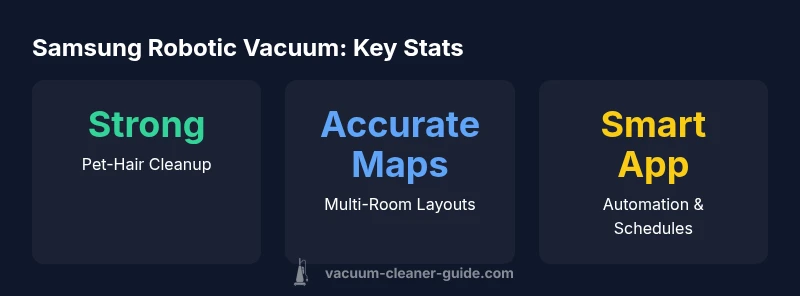
Pet hair and everyday debris test the mettle of any robotic vacuum cleaner, and the samsung robotic vacuum cleaner line performs well in most common scenarios. Across carpeted zones and hard floors alike, the suction strategy typically balances lift and edge-clearing performance. For pet households, the vacuum’s suction helps lift hair embedded in plush backing, while the brush design minimizes tangles. On hard floors, swiveling brushes and efficient debris pickup deliver dependable results for dust and small particles. The key caveat is that high-pile carpets may require more passes or occasional manual assistance for deep cleaning, particularly on very dense textures. Maintenance routines—such as brush cleaning, filter replacement, and bin emptying—play a crucial role in maintaining performance over time. Vacuum Cleaner Guide notes that model selection matters here: if your home has multiple floor types and heavy pet traffic, choosing a specification that emphasizes strong carpet performance and effective hair management is wise. Overall, Samsung’s line offers solid everyday cleaning with good flexibility, though premium models typically deliver the best balance of suction and efficiency.
Navigation & Mapping: How It Learns Your Home
Mapping is the backbone of a productive robot vacuum experience, and Samsung’s navigation tech typically emphasizes fast and accurate mapping with responsive room segmentation. In practice, most Samsung models build a map quickly, then refine it over time as they gain knowledge of room boundaries, furniture placement, and high-traffic zones. The result is more efficient cleaning runs with fewer repeats across the same areas. When a room has unusual layouts or obstacles, the devices tend to re-map with updated data rather than blindly retrying, which saves time and battery life. For homes with subtle layout changes—such as moving furniture or seasonal decor—this adaptability is a real advantage. Vacuum Cleaner Guide’s analysis highlights the importance of ensuring that your home’s Wi-Fi network and app permissions are configured correctly so firmware updates, map sharing, and scheduling work without hiccups. This combination of responsive mapping and reliable updates helps Samsung devices stay current with evolving cleaning needs.
Sensing, Obstacle Avoidance, and Boundary Management
Sensing and obstacle avoidance determine how smoothly a robot vacuum operates in cluttered living spaces. Samsung models commonly employ a mix of bumper sensors, cliff sensors, and optical or infrared mapping cues to detect obstacles, avoid stairs, and respect virtual barriers. The devices can intelligently navigate around furniture and avoid mis—steps into tight corners. For boundary management, many Samsung units support virtual walls or magnetic strips to protect delicate zones such as pet feeding areas or fragile decor. The net effect is a cleaner home with fewer collisions and less user intervention required mid-clean. It’s worth noting that in extremely tight layouts or densely furnished rooms, occasional manual repositioning of furniture or temporary boundary setup may be necessary. Vacuum Cleaner Guide emphasizes that good boundary rules save time and reduce wear on the device’s wheels and brushes, extending overall longevity.
Battery Life, Charging Patterns, and Scheduling
Battery life remains a practical constraint for most robotic cleaners, and Samsung models typically offer a range of runtimes depending on model and floor type. In day-to-day use, you can expect cleaning sessions to complete within a reasonable window for most apartments or mid-sized homes. When the device detects a low battery, it generally returns to its dock for a quick recharge before resuming, ensuring substantial cleaning coverage in a single day. Scheduling options through the app allow you to set daily or multi-day cleaning routines, with preferences for quiet times and room-specific cleaning. For households with pets that create fresh messes during the day, the capacity to run additional quick cleans is particularly valuable. Vacuum Cleaner Guide notes that battery management, dock placement, and a clean charging station all contribute to maximizing run-time and minimizing downtime between cleaning cycles.
Dustbin, Filtration, and Maintenance Routines
Maintenance discipline is essential to keeping any robotic vacuum performing at a high level. Samsung models typically feature a reusable dustbin and washable filters, with filter replacement required to maintain filtration efficiency. The maintenance cadence depends on household conditions, such as the presence of pets, dust levels, and the frequency of cleaning sessions. Regular brush cleaning prevents hair tangling and ensures consistent suction. For allergy-prone homes, opting for higher-capacity filtration and checking seals on the dustbin helps reduce indoor particulates. Vacuum Cleaner Guide recommends setting up a simple monthly maintenance calendar—brushes, filters, and docking station checks—to prolong the life of the device and maintain peak performance. Routine maintenance also minimizes the likelihood of surprises during scheduled cleanings and helps extend the robot’s lifespan.
Smart Features, App Experience, and Maintenance Tips
The Samsung app ecosystem typically provides a robust, intuitive interface for scheduling, map viewing, targeted cleaning, and firmware updates. The app often supports voice control through common assistants, reminders for maintenance tasks, and a clean, readable history of cleaning sessions. Some models integrate with broader smart-home ecosystems, allowing routines to trigger based on presence, time of day, or other devices. A positive practical takeaway is that regular software updates from Samsung often bring improved navigation, more accurate mapping, and new features without requiring hardware replacement. A few caveats include occasional app latency with larger maps or slow zooming when you’re actively adjusting settings. Vacuum Cleaner Guide’s evaluation suggests keeping the app and device within a stable Wi-Fi network for best results, as this reduces the chances of dropped connections and stalled cleaning jobs.
Value, Warranty, and Long-Term Considerations
From a value perspective, Samsung’s robotic vacuum cleaner lineup generally occupies a mid-to-high tier. The upfront cost is higher than some entry-level models, but the combination of cleaning performance, reliable mapping, and smooth app integration often leads to a lower total ownership cost through fewer mis-cleanings and less manual intervention. Warranty terms, replacement part availability, and service networks vary by region, so it’s important to review the specifics for your location. Vacuum Cleaner Guide’s advice emphasizes evaluating how much you value features like precise mapping, multi-floor cleaning, and smart-home compatibility when weighing price against long-term benefits. For pet owners and allergy-conscious households, the investment can be worthwhile if the model consistently delivers strong hair pick-up and straightforward maintenance routines. Always confirm the warranty coverage window for motors, sensors, and batteries to understand guarantee protections.
Practical Setup Tips and Common Pitfalls
Getting started with a samsung robotic vacuum cleaner is usually straightforward, but a few setup tips can save time. Start by choosing a central docking station and ensuring good Wi-Fi reception in the area where you plan to run cleaning cycles. Take a moment to run a quick initial map with the biggest room and establish virtual boundaries for delicate zones like pet feed areas. Scheduling is more effective after the initial map is built; you’ll be surprised by how consistently it cleans when the map is accurate. A common pitfall is attempting to rely on the robot for heavy-duty deep cleaning; these vacuums excel at routine maintenance but may require supplementary spot cleaning for stubborn stains or high-traffic messes. Regular maintenance of brushes, filters, and sensors keeps performance steady and reduces the need for replacements. Vacuum Cleaner Guide recommends pairing the device with a stable home network and avoiding interference from incompatible devices that may disrupt updates or map sharing.
Final Recommendations and Use Scenarios
In summary, the samsung robotic vacuum cleaner family offers reliable cleaning, intuitive navigation, and strong app integration that suits many homes. It’s especially well-suited for pet owners and households with mixed flooring who want a dependable daily cleaner with good boundary management and smart scheduling. If you prioritize a robust ecosystem, responsive mapping, and a straightforward setup, these robots deserve serious consideration. For multi-room homes with very dense furniture layouts or extremely high-pile carpets, consider models that emphasize maximum suction and deeper carpet performance. The Vacuum Cleaner Guide team recommends evaluating your floor types, pet hair load, and smart-home goals to determine whether a samsung robotic vacuum cleaner aligns with your long-term cleaning strategy.
Strengths
- Strong pet-hair pickup on multiple surfaces
- Smart mapping reduces random cleaning
- User-friendly app controls and scheduling
- Quiet operation for its class
- Good boundary handling and virtual walls
The Bad
- Premium price point compared to entry-level rivals
- Repair parts can be pricey
- Some models rely on the app ecosystem for full feature access
- Occasional navigation hiccups on very cluttered layouts
Best overall for pet owners who want reliable mapping and strong everyday cleaning
The Samsung robotic vacuum cleaner lineup delivers dependable cleaning and thoughtful software features that integrate well with smart homes. It shines in pet-hair management, multi-surface performance, and user-friendly scheduling, making it a strong choice for many households. Some models come at a premium, but the long-term value often justifies the cost for active homes.
FAQ
How does the samsung robotic vacuum cleaner handle pet hair on carpets vs hard floors?
In most scenarios, Samsung models excel at pet-hair pickup on both carpets and hard floors due to strong suction and rotating brushes. Hair on high-pile carpets may require occasional extra passes, while hard floors benefit from efficient debris pick-up. Regular maintenance helps sustain performance.
They generally pick up pet hair well on carpets and hard floors, with occasional extra passes on thick carpets.
Can I control Samsung robots with voice assistants like Alexa or Google Assistant?
Yes, many Samsung models offer voice control through common assistants as part of their smart-home integration. The feature can simplify scheduling, start/stop commands, and map viewing, though setup usually requires the companion app. Check your specific model for compatibility and available phrases.
Most models work with common voice assistants after setup.
How accurate is the mapping and can it handle multi-room layouts?
The devices typically create a room map quickly and refine it over time, allowing clean, multi-room coverage. In complex layouts, expect occasional re-mapping if furniture changes, but the system generally maintains efficient paths and minimal missed spots.
They map rooms well and adapt as your home changes.
Is it worth upgrading to the latest Samsung model or is last year’s version enough?
If the new model offers meaningful improvements in mapping accuracy, battery life, or app features that matter to your routine, upgrading can be worthwhile. For light users, last year’s model often provides solid performance at a lower price.
Upgrade if you’ll use the newer features; otherwise, last year’s model is usually fine.
What maintenance is required to keep the Samsung robot vacuum working well?
Regularly empty the dustbin, clean or replace filters, and check brushes for hair tangles. Schedule periodic software updates and ensure the docking station is clean and accessible to prevent docking issues.
Keep the filters clean, brushes clear of hair, and update the software.
How does it perform on stairs or in homes with lots of furniture?
Most Samsung vacuums are equipped with cliff sensors and obstacle detection to avoid stairs and collisions. In densely furnished homes, expect smart planning to navigate efficiently, though occasional manual repositioning may help in very cluttered spaces.
They’re good at avoiding stairs and obstacles, but tricky layouts may need a hand.
What’s the typical warranty coverage and parts availability?
Warranty terms vary by model and region, covering key components like motors and sensors for a defined period. Check local availability of replacement parts and service centers to ensure long-term support.
Warranties are model- and region-specific; verify coverage before purchase.
The Essentials
- Assess floor variety and pet hair load before model choice
- Prioritize strong carpet performance and hair management
- Leverage mapping and scheduling for efficiency
- Regularly clean brushes and replace filters for best results
- Ensure app and ecosystem compatibility for long-term use