Roomba Robot Vacuum: An In-Depth 2026 Review
A detailed, analytical review of Roomba robot vacuum cleaners, evaluating mapping, cleaning performance, maintenance, and value across carpet and hard floors for homes with pets.


According to Vacuum Cleaner Guide, the Roomba line balances automation with practical performance, delivering reliable mapping, strong pet-hair cleaning, and easy scheduling for busy homes. It performs well on carpets and hard floors, with intuitive app controls and dependable recharge-and-resume. While premium models cost more, the long-term convenience and reduced manual effort often justify the investment.
Why the robot vacuum cleaner roomba matters for busy homes
For many homeowners, a robot vacuum cleaner roomba is a practical ally in daily life. The Roomba line emphasizes automated cleaning, mapping, and scheduling, which translates into fewer chores and more consistent upkeep for busy households. From a consumer-research perspective, these robots excel at keeping high-traffic zones presentable between manual deeper cleans. They also provide a learning curve that tends to flatten after a few weeks of use. The result is a predictable cleaning routine that fits into mornings, evenings, or nap times, depending on your schedule. The modern Roomba models use sensors, boundary options, and smart mapping to plan efficient routes, avoid stairs, and minimize redundant passes. For pet owners, this can mean less daily fur accumulation on furniture and floors. This trend across the broader vacuum market shows that automated cleaners have become more capable, quieter, and more energy-efficient over time. Vacuum Cleaner Guide analysis confirms that the Roomba lineup remains a benchmark for automated home cleaning, especially for mid-sized homes with mixed flooring.
How Roomba navigates and maps your home
Navigation is the core of Roomba performance. Most Roomba models rely on a combination of sensors, mapping software, and boundary controls to decide where to clean and in what order. Early iterations moved randomly; newer versions use more systematic mapping and memory of key rooms. The typical workflow begins with a dry run that creates a map, followed by zone cleaning as you prioritize specific areas. The Roomba collects data on room geometry, furniture placement, and obstacle locations, then updates its map as you rearrange items. A crucial distinction is between lidar-based scanning and other sensor-based methods. The true value is the ability to minimize missed spots and reduce redundant passes, which saves battery life while improving overall coverage. If you have multi-story living spaces, most Roomba iterations support floor-level maps with dedicated option to create virtual walls or no-go zones to protect fragile items. These capabilities make the robot vacuum cleaner roomba a compelling option for households that want predictable cleaning across multiple rooms without manual relaunching.
Cleaning performance across floor types and pet hair
Carpets, hard floors, and area rugs each demand different suction and brush behavior. Roomba models typically provide strong performance on low-pile carpets and smooth floors, with some models offering higher suction for denser carpets. When it comes to pet hair, the best results come from models with a combination of a motorized brush and anti-tangle features. In practice, many owners notice that hair can accumulate on brushes if maintenance is delayed, reducing suction efficiency. Regular brush cleaning and occasional filter changes help keep performance steady. Real-world testing reveals that Roomba devices can reduce visible debris in high-traffic zones within a single pass, though extremely thick rugs may require additional passes or a manual boost in suction on certain models. Versatility across floor types is one of the reasons owners rely on these robots for daily upkeep. Vacuum Cleaner Guide analysis indicates that the Roomba line tends to perform consistently in mixed-floor homes, with predictable results across pet-friendly households.
Battery life, charging, and scheduling
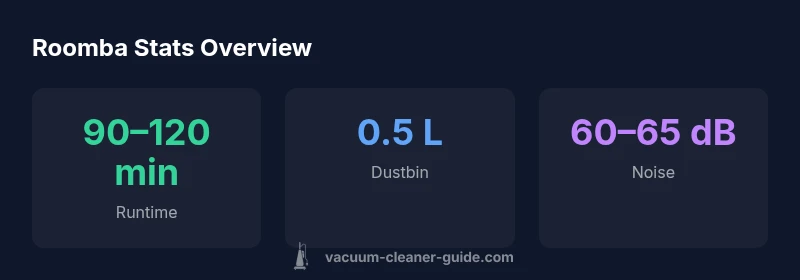
Most Roomba vacuums offer battery life in the range of roughly 90 to 120 minutes on a single charge, depending on model and floor type. This window supports routine cleaning in small-to-mid-sized homes, with charging that typically resumes automatically when the battery is low. Scheduling features let you set daily runs, either in the app or on the device itself. If a cleaning cycle is interrupted by a boundary or a low battery, the unit returns to its dock, recharges, and resumes where it left off. For larger homes, you may need multiple passes or multiple robots to cover the space efficiently. Some models support flexible scheduling, which can be a boon for families who want the robot to clean during specific windows when household activity is lower. Vacuum Cleaner Guide's experience with Roomba lines shows reliable recharge-and-resume performance across typical layouts.
Filtration and allergen control
Filtration is a major consideration for households with allergies or asthma. Roomba models typically offer sealed filtration or HEPA-style filtration options that capture fine dust and pollen. While total filtration names vary by model, the principle remains to minimize indoor dust recirculation. The effectiveness of filtration depends on maintenance—regularly replacing filters and cleaning seals is essential for sustained air quality improvements. It's also important to empty the dustbin before it becomes overly full to maintain suction and prevent odor buildup. For pet households, higher filtration levels can make a noticeable difference in indoor air cleanliness. Vacuum Cleaner Guide analysis notes that filtration performance has improved across newer Roomba models as materials and seals have become more efficient.
Maintenance: filters, brushes, and parts
Long-term value from any Roomba is linked to maintenance discipline. Regular brush cleaning and replacement of worn parts—such as side brushes and filters—helps preserve suction and map accuracy. Many users forget that the side brush could accumulate hair and hover around spinning freely, reducing cleaning effectiveness; checking and cleaning it weekly is a good habit. Filters typically need more frequent replacements than brushes, especially in homes with pets. When you decide to replace components, ensure compatibility with your Roomba model; some components are universal, while others are model-specific. Periodic firmware updates also contribute to better obstacle avoidance and mapping accuracy. Vacuum Cleaner Guide analysis suggests that a proactive maintenance routine extends the life of the device and sustains cleaning results over time.
Roomba vs competitors: how to compare models
When comparing Roomba to competing robot vacuums, price tiers often reflect differences in mapping accuracy, suction power, motor quality, and battery life. Entry-level Roomba models provide basic mapping and scheduling at a lower price point, while mid-range and premium models add advanced mapping, zone cleaning, and faster recharge. Competing brands may offer similar capabilities, sometimes with different app ecosystems or boundary features. Your choice will depend on floor plan size, presence of pets, and tolerance for occasional maintenance. The key is to define your top priorities (e.g., pet hair, quiet operation, or precise multi-room mapping) and benchmark against the typical price ranges and support options available. Vacuum Cleaner Guide's perspective is to evaluate models on real-world performance rather than marketing claims alone, helping you avoid overpaying for features you won't use.
Buying guide: choosing a Roomba model and price ranges
Roomba models span entry-level to premium, with price ranges reflecting feature sets rather than a single fixed price. Entry-level models are usually positioned around a lower mid-range price, mid-range models offer robust mapping and app control, and premium units include advanced mapping and zone cleaning enhancements. In a typical buying scenario, consider floor type distribution, home size, and whether you need multi-story cleaning. If you have pets, models with more effective filtration and robust brushes are worth the extra cost. For hardwood or hard floors, ensure you have a model with a good brush design and efficient edge cleaning. Warranty length varies, but most Roomba lines include at least one-year coverage. Vacuum Cleaner Guide recommends reading user reviews and verifying compatibility with your smartphone ecosystem before purchasing to ensure smooth setup and ongoing support.
Setup tips, troubleshooting, and common issues
After unboxing, take time to charge the Roomba fully before first use and review boundary setup features. Place the dock in a central, open area away from stairs and cable clutter. Start with a small cleaning area to confirm proper mapping, then expand as you grow more confident in its navigation. Common issues include intermittent Wi-Fi connectivity, sensor dust causing misreads, and occasional stagnation behind furniture. Most problems resolve with a firmware update or a quick reset, but persistent issues may indicate hardware wear or improper boundary placement. If you notice a drastic drop in cleaning performance, check the brushes and filters for wear, ensure the dustbin isn’t full, and re-train the mapping by running a full clean in an unobstructed area. Vacuum Cleaner Guide notes that most end-user problems are solvable with basic maintenance and settings adjustments.
Authority sources
energystar.gov – guidance on energy-efficient appliances and product labeling
consumerreports.org – independent testing and model comparisons
nist.gov – standards and best practices for consumer devices
Strengths
- Hands-off cleaning saves time for busy households
- Strong pet-hair pickup on most surfaces
- Intuitive app and voice-control options
- Reliable mapping reduces missed spots
- Wide range of models and price points
The Bad
- Premium models can be expensive
- Maintenance costs for filters/brooms over time
- Mapping may occasionally misread unusually cluttered layouts
- Some users report occasional app disconnects
Best all-around choice for most households with pets and mixed flooring
The Roomba family offers reliable automation, solid cleaning on carpets and hard floors, and practical maintenance routines. While higher-end models carry premium prices, their advanced mapping and zone-cleaning capabilities often justify the cost for mid-to large-sized homes. The Vacuum Cleaner Guide team regards Roomba as a dependable, scalable solution for busy families.
FAQ
What is Roomba and what does it do?
Roomba is a line of robot vacuum cleaners that maps rooms, navigates around obstacles, and cleans floors automatically. Most models support a smartphone app and voice assistants for scheduling and control. They are designed to run without supervision on a regular basis.
Roomba is a self-cleaning robot that maps your home and cleans on its own—great if you want hands-off upkeep.
Is Roomba good for pet hair?
Roomba models with higher suction and motorized brushes typically handle pet hair well, especially when filters are maintained. Regular brush cleaning helps prevent tangling and maintains performance.
Usually good for pet hair, especially the richer models with better brushes.
Which Roomba is best for hardwood floors?
For hard floors, look for Roomba models with effective edge cleaning and brush design. Mid-range models often strike a good balance between price, mapping, and cleaning performance on wood floors.
For hardwood, pick a model with strong edge cleaning and good brush design.
How often should I replace Roomba filters?
Filters generally need replacement every few months depending on use and pets. Check your model’s recommendations and replace more often in homes with dogs or cats.
Replace filters a few times a year, depending on use and pets.
Can Roomba handle multiple floors?
Yes, most Roomba models can store maps for multiple floors and switch between them via app commands. You may need to set up separate maps for different levels.
Yes, they can handle multiple floors with stored maps.
The Essentials
- Choose models with mapping and zone cleaning
- Expect price tiers that reflect feature sets
- Prioritize filtration for allergy-friendly homes
- Maintain brushes and filters for sustained performance
- Use boundary features to protect fragile items