How to Use Dyson Attachments: A Practical Guide
Learn how to use Dyson vacuum attachments—crevice tools, upholstery heads, and motorized brushes—across fabrics, floors, and stairs. Step-by-step guidance, model tips, maintenance, and common mistakes for pet owners and homeowners.


In this guide you will learn how to use the attachments on a Dyson vacuum cleaner to maximize efficiency and results. We cover attachment types, when to use them, how to connect and detach safely, and model-specific notes. By the end, you’ll confidently swap tools mid-clean and tackle pet hair, dust, upholstery, and tight corners.
Understanding Dyson Attachments: Why They Matter
If you’re wondering how do you use the attachments on a dyson vacuum cleaner, this guide starts by explaining what attachments do and why they matter. Dyson designs a line of tool heads that expand cleaning beyond the main floor nozzle—from crevice tools that reach tight gaps to motorized brushes that loosen pet hair. For homeowners and pet owners, choosing the right tool often determines how quickly a cleaning task gets done and how thorough it feels. According to Vacuum Cleaner Guide analysis, attachments expand a vacuum’s versatility, letting you tailor suction, airflow, and brush motion to the surface you’re cleaning. In this section, we’ll outline the core attachment families and how they fit into a typical cleaning routine. Understanding the logic behind each head helps you decide when to swap tools, rather than fighting with the machine.
Overview of Common Dyson Attachments
Dyson attachments include crevice tools, upholstery tools, dusting brushes, and floor-specific heads designed to fit a standard wand or compatible Dyson nozzle. The core set usually features a crevice tool for tight gaps, an upholstery tool for fabrics, a dusting brush for delicate surfaces, and a motorized brush for carpets—often with a soft alternative for hard floors. The Vacuum Cleaner Guide team notes that model compatibility varies; always check your vacuum’s connector type before purchasing extras. If you have a pet-friendly home, consider a motorized brush with anti-tangle tech. This section highlights how each head serves everyday tasks and where to store them when not in use.
Matching Attachments to Surfaces and Tasks
Choosing the right attachment speeds up cleaning and protects surfaces. Use a soft dusting brush on electronics and shelves to avoid scratches. Reserve the motorized brush for deep carpet piles and pet hair, but avoid using it on hard floors unless your floor tool is designed for it. Crevice tools excel in corners and between couch cushions. For stairs, the slim crevice or stair tool reduces awkward angles. The Vacuum Cleaner Guide analysis shows many homeowners rate attachment versatility as a top satisfaction driver, especially for homes with pets, kids, and multiple floor types.
How to Connect Attachments to a Dyson Vacuum
Connecting attachments is straightforward but requires attention to alignment and release mechanisms. Locate the wand’s end or the low-profile nozzle, then align the attachment’s neck with the connector. Push firmly until you hear a click, and gently tug to confirm it’s secure. To remove, press the release tab or button and pull the attachment away. Always ensure the vacuum is powered off during changes to prevent spinning brushes from causing injury or damage.
Model Variations: Cordless vs Upright vs Canister
Dyson’s cordless models typically use a simple press-release or click-in connection, while upright and canister designs may rely on a locking collar or bayonet-style mount. Cordless tools tend to be lighter and optimized for quick swaps, whereas larger models may require more deliberate alignment due to longer wand lengths. Always consult your model’s manual for compatibility charts and cleaning steps—these details vary by series and era. The goal is a snug fit that won’t detach during operation.
Maintenance and Cleaning of Attachments
Attachments accumulate dust, hair, and residue between cleanings. Rinse plastic parts under lukewarm water after use when allowed by your model, then air-dry completely before reattaching. Do not place attachments in dishwashers or heaters; heat can warp plastic. Wipe metal connectors with a microfiber cloth to prevent corrosion and keep metal edges smooth for easy snapping on and off. Regular maintenance helps preserve suction and prolongs attachment life.
Safe Use and Common Mistakes
Avoid using motorized heads on delicate surfaces unless the manufacturer explicitly allows it; misusing brushes can scratch floors or fabrics. Don’t force an attachment if it won’t click—recheck alignment and connector orientation. Never loosen a tool’s clip or release tab while cleaning, as loose parts can scatter debris or injure feet. Keep cords clear of attachments and store heads away from children and pets when not in use.
Practical Scenarios: Pet Hair, Dust, and Upholstery
Pet hair on furniture benefits from a motorized brush or a specialized pet-hair attachment. For dusty shelves or blinds, a soft dusting brush helps remove fine particles without scattering them. Upholstery and car interiors respond well to a slim crevice tool and a small upholstery head. In kitchens or entryways, a crevice tool reaches tight gaps where crumbs hide, while the main nozzle handles general surface cleaning. The goal is to pair the task with the tool that minimizes passes and maximizes surface contact.
Quick Start Checklist: Attachments in 10 Minutes
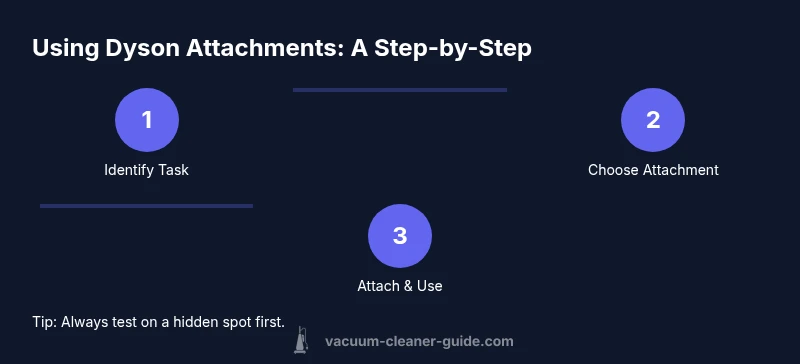
- Identify the task and surface to clean.
- Select the appropriate Dyson attachment from your model’s kit.
- Align and click the attachment onto the wand or nozzle.
- Test on a hidden area, then begin cleaning.
- At the end, detach, rinse if allowed, and store attachments in a bag or rack.
Tools & Materials
- Dyson vacuum attachments set (crevice tool, upholstery tool, motorized brush, dusting brush, stair tool)(Ensure compatibility with your Dyson model.)
- Soft microfiber cloth(For wiping attachments and surfaces.)
- Storage bag or wall rack for organized storage(Keeps attachments handy and dry.)
Steps
Estimated time: 15-25 minutes
- 1
Identify the task and the right attachment
Review the room and surface you’ll clean, then select the appropriate head from your Dyson kit. Check compatibility with your model and ensure the tool matches the wand or nozzle type.
Tip: Plan the swap before you start moving furniture. - 2
Prepare the vacuum for tool change
Power off and unplug or switch off the unit if cordless. If your model uses a trigger, release it before detaching a tool to avoid accidental operation.
Tip: Have a small storage area for the detached tool. - 3
Attach the tool securely
Align the attachment neck with the wand or nozzle, push until you hear a click, then give a light tug to confirm a secure fit.
Tip: Ensure the collar or release is fully engaged. - 4
Test before you clean
Power the vacuum briefly to confirm the attachment is stable and there’s no unusual vibration.
Tip: If vibration is off, stop and re-check alignment. - 5
Use the attachment for the task
Sweep or press the tool across the surface with steady motions for even pickup; adjust suction if your model allows.
Tip: Use multiple light passes rather than one heavy pass. - 6
Detach and store properly
Turn off the machine, release the attachment and store it in its designated spot after use.
Tip: Wipe connectors clean before storage.
FAQ
Which Dyson attachments are included with my model?
Most Dyson vacuums include a crevice tool, upholstery tool, and dusting brush. Check your model's manual for a complete list.
Most Dyson vacuums come with a crevice tool, upholstery tool, and dusting brush. Check your manual for specifics.
Can I use a motorized brush on hard floors without scratching?
Usually not; use the floor tool or a soft brush designed for hard surfaces, and reserve the motorized brush for carpets.
Motorized brushes can scratch hard floors; use a floor tool instead.
How do I attach tools to a Dyson cordless vacuum?
Press the release button, align the tool with the wand, and push until it clicks into place. Tug gently to confirm fit.
Press the release, align, click into place, and tug to confirm.
Do attachments affect suction?
Using the wrong attachment can reduce efficiency; ensure the nozzle fits snugly and is appropriate for the surface.
Right attachment helps maintain suction; wrong one can hinder it.
How should I clean and dry attachments after use?
Wipe with a microfiber cloth to remove dust, rinse only if your model allows, and air-dry completely before storage.
Wipe them clean and let them dry before storing.
Where should attachments be stored?
Keep them in a dedicated bag or wall rack near your docking station for quick access.
Store them in a bag or rack near the vacuum.
Watch Video
The Essentials
- Match attachments to task for efficiency
- Check model compatibility before swapping heads
- Keep attachments clean and dry after use
- Store tools together for quick access
- Test on a hidden area before full cleaning