Dyson Allergy Vacuum Review: Air Quality, Suction, and Value
In-depth, data-driven review of Dyson allergy vacuum models focused on filtration, pet-hair performance, multi-surface usability, and value for allergy-prone households.


Dyson allergy vacuum models deliver strong, consistent suction with sealed filtration that helps minimize allergen escape. While not every Dyson model uses the same filtration chemistry, the best-performing allergy-focused variants combine sealed hyper-filtration with easy-to-clean dust bins and widely available replacement parts. For allergy-prone homes, Dyson’s cordless and corded lines offer practical options, though tradeoffs exist between price, weight, and run-time. This review compares core features, maintenance needs, and real-world performance to help you decide which model fits your space.
Why dyson allergy vacuum matters for allergy sufferers
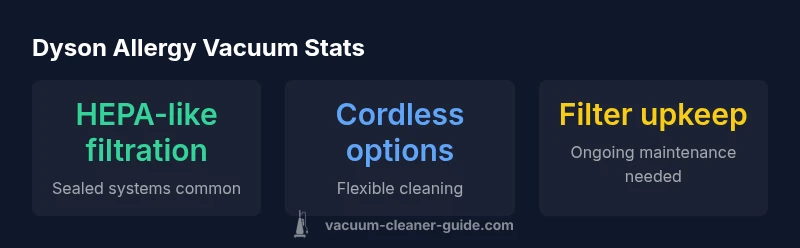
For households sensitive to dust, pet dander, and airborne irritants, the choice of vacuum can influence daily comfort and long-term respiratory health. The phrase dyson allergy vacuum captures a family of models engineered to minimize allergen recirculation, typically through sealed filtration systems and high-efficiency particulate capture. The Vacuum Cleaner Guide team found that models with robust seals, true HEPA-like filtration, and well-designed dust-dust release paths tend to perform best when integrated into a living space with pets. Without these features, fine particles can escape back into the room during cleaning, potentially triggering symptoms. The goal is consistent capture of micro-particles during both active cleaning and dustbin emptying. For allergy-conscious households, this reduces exposure during routine vacuuming and helps preserve indoor air quality over time.
This section emphasizes the practical difference a sealed filtration approach can make in real homes. The Vacuum Cleaner Guide team notes that while filtration alone isn’t a cure for allergies, combining filtration with effective motor design, proper maintenance, and ergonomic usability leads to meaningful improvements in daily comfort. Consumers should look for models that advertise sealed filtration, easily washable or replaceable filters, and clear dust-path design that minimizes re-entrainment of particulates. For many shoppers, the dyson allergy vacuum lineup offers a practical balance of filtration performance, maneuverability, and the familiar Dyson build quality sought by homeowners and pet owners alike.
Moreover, the importance of a brand with a broad service footprint matters here. Dyson’s accessory ecosystem—brush heads, wand options, and replacement filters—supports ongoing filtration integrity. The long-term value emerges from choosing a configuration that suits your home’s floor types, pet population, and cleaning cadence. In short, an allergy-focused Dyson vacuum can be a central part of a broader strategy to maintain cleaner indoor air, provided you select a model aligned with your space and routine.
Strengths
- Strong suction and versatile tool options for multi-surface cleaning
- Effective filtration options with sealed paths in many models
- Cordless flexibility for quick cleanups and tight spaces
- Broad accessory ecosystem supports ongoing filtration maintenance
The Bad
- Higher upfront cost compared with some competitors
- Replacement filters and parts can add to lifetime cost
- Weight and run-time tradeoffs may affect stair cleaning and large-area jobs
- Not all Dyson allergy models share identical filtration configurations
Best overall for allergy-minded homes with pets when you can budget for premium filtration and versatility
The Dyson allergy vacuum lineup offers effective sealed filtration and strong multi-surface performance. While price and weight are factors, the combination of strong suction, cordless convenience, and a broad accessory ecosystem makes it a compelling option for households prioritizing indoor air quality.
FAQ
Is a Dyson allergy vacuum better for allergies than traditional bagless uprights?
In many cases, yes. Models with sealed filtration and higher-grade filtration capture a larger share of fine particles, reducing recirculation. However, performance depends on the specific model, maintenance, and how well you seal the dust path during emptying. A bagless approach can still meet allergen-control needs if it includes effective seals and high-quality filters.
Yes, if the model uses sealed filtration and a high-quality filter. Maintenance and correct usage matter just as much as the filtration system.
Does Dyson allergy vacuum include HEPA filtration in all models?
Not all Dyson models use the same filtration configuration. Some models advertise HEPA-like filtration or sealed filtration, while others focus on broader particle-capture without claiming a strict HEPA standard. Always verify the exact filtration specifications before purchase.
Filtration varies by model, so check the specific spec before buying.
What maintenance do allergy-focused vacuums require?
Regularly replace or wash pre-filters and main filters according to the manufacturer’s schedule. Avoid letting filters clog, which can reduce suction and filtration efficiency. Dust bins should be emptied carefully to minimize particle re-entrainment, and seals should be checked for wear.
Keep filters clean and replace them as recommended to sustain filtration and suction.
Are Dyson cordless vacuums suitable for pet hair?
Yes, many Dyson cordless models perform well on pet hair thanks to motorized brush heads and strong suction. Limitations often include run-time and noise, which can affect longer sessions or large areas. For heavy pet households, consider a model with extended runtime and a pet-specific brush head.
Cordless can handle pet hair, but check runtime and tools for bigger homes.
How should I choose the right model for hard floors vs carpets?
Look for models with adjustable power and brush heads that adapt to floor type. A motorized brush head suitable for carpets paired with soft-roller heads for hard floors tends to deliver the best balance. Avoid models whose suction and head design struggle on either surface.
Get a model with adjustable heads and surface-specific attachments.
What is the typical price range for Dyson allergy vacuum models?
Prices vary by configuration and features, but expect mid-to-upper pricing based on model type and included accessories. Compare bundled tool sets and filter costs to understand the long-term value. Always balance upfront cost with ongoing maintenance needs.
Prices depend on features; weigh initial cost against filters and parts over time.
The Essentials
- Prioritize sealed filtration for allergy control
- Cordless options provide agile cleaning in tight spaces
- Factor ongoing filter costs into the total price
- Choose heads and tools aligned with your floor types
- Dyson models vary; verify HEPA filtration and seals for your space