Vacuum Cleaner and Washer in One: A Comprehensive Comparison
Compare integrated vacuum-washer combos with separate units. Learn performance, space savings, maintenance, and buying tips from Vacuum Cleaner Guide.


For most homes, a dedicated vacuum cleaner paired with a separate washing appliance remains the practical choice, but a true vacuum cleaner and washer in one can save space and simplify chores for small spaces or renters. Our analysis shows that combo units excel in compact footprints but often compromise on depth of cleaning and maintenance compared to separate devices.
The promise and limits of vacuum cleaner and washer in one
Integrated vacuum-cleaner-and washer devices offer a compact solution for small homes and rental spaces where floor space is at a premium. According to Vacuum Cleaner Guide, these multi-function units can consolidate two chores into a single footprint, reducing clutter and making routine cleaning feel simpler. However, the very idea of combining suction and washing in one chassis introduces trade-offs: performance may be dialed toward convenience rather than peak cleaning, maintenance can become more complex, and repair options may be less flexible than those for dedicated appliances. In this section we explore what this integration means for real-world usage, including the types of homes that tend to benefit most and the ways to set expectations accordingly.
Design choices you’ll encounter in vacuum-cleaner-and-washer-in-one products
There are two primary design philosophies. Some all-in-one units emphasize a fully integrated system where the suction head and washing mechanism share a single reservoir and powertrain. Others are more modular, offering dedicated heads or interchangeable modes that switch between dry vacuuming and wet washing. The key distinction matters because it affects maintenance, ease of use, and how well each mode performs on different surfaces. In practice, consumers should evaluate which format better aligns with their daily routines and storage constraints.
Space, energy, and cost considerations for all-in-one solutions
Space savings are the most compelling reason to consider a vacuum cleaner and washer in one. In tight apartments, a single unit can replace two devices, freeing closet space and reducing cord clutter. Energy use tends to scale with how aggressively the unit switches between modes; some models optimize for light, daily maintenance cleanups, while others run longer cycles for deeper refreshes. Cost varies widely by brand and feature set; expect a wide range and be prepared to compare two scenarios: one all-in-one unit vs. separate goods. The Vacuum Cleaner Guide analysis emphasizes evaluating total ownership cost over time rather than just the upfront price.
Surface performance: carpets, hard floors, and pet hair handling
Performance on carpets and hard floors can diverge between all-in-one units and separate devices. A strong suction motor paired with a capable brush roll may outperform a basic system on pet hair, while a built-in mopping or washing function adds value on hard floors that require more than dry cleaning. For households with mixed flooring, prioritize a model that has switchable brush settings, good filtration, and a reliable damp-mop option. Remember that true deep cleaning often benefits from a dedicated device, especially when dealing with embedded dirt or high-pile carpets.
Maintenance realities and lifecycle costs
Maintenance is a critical factor. All-in-one units can simplify storage but may complicate service when the system is not performing as expected. Filters, reservoirs, and seals require regular checks, and a failure in one function can impact the other. The availability of replacement parts and service networks varies by brand, so plan for possible downtime if you rely on a single unit for both jobs. In the long run, frequent repairs or clumsy maintenance routines can erode the perceived value of an all-in-one solution.
When to choose a combo unit and when to go separate
If your space is limited and your cleaning tasks are light to moderate, a compact all-in-one can be the right fit. If you prioritize high suction, deep cleaning, or a specialized washing function for delicate fabrics, separate devices can offer superior performance and greater longevity. The decision should hinge on your home size, pet presence, floor types, and willingness to manage maintenance complexity. A practical approach is to test a model with a return policy and a robust warranty.
How to read the spec sheet and what to prioritize
When evaluating a vacuum cleaner and washer in one, focus on: suction power (even if labeled as watts or Pa, look for real-world performance tests), reservoir capacity, wash cycle effectiveness on common messes, filtration efficiency (HEPA compatibility helps for allergy concerns), noise levels, and warranty terms. Look for models that clearly separate maintenance tasks (easy filter cleaning, simple refill), and choose one with readily available parts. Do not overlook service support and replacement-accessibility in your region.
Practical use-case scenarios for all-in-one designs
Scenario A: A small apartment with a single resident and a cat. Prioritize compact size, easy storage, and quick cleanups. Scenario B: A two-bedroom home with children and a dog. You’ll need solid suction plus a mop capability and a straightforward cleaning routine. Scenario C: A two-story home where the laundry area doubles as a cleaning hub. A space-efficient all-in-one can save time, but ensure the unit isn’t overwhelmed by concurrent tasks.
Common myths vs facts about all-in-one cleaning solutions
Myth: All-in-one units deliver equal performance to dedicated devices in every task. Fact: They often balance trade-offs, delivering good results but not always best-in-class in any single function. Myth: Maintenance is easier because there’s only one device. Fact: Combined systems can be more complex to service when one feature fails. Myth: They are always cheaper. Fact: Total ownership costs depend on usage patterns and longevity of the main unit.
Real-world expectations and brand perspective
In real homes, the appeal of a vacuum cleaner and washer in one lies in simplification and space savings. However, many households discover that occasional, specific tasks—like deep carpet cleaning or stubborn spills—still benefit from a dedicated vacuum or a separate washer. Vacuum Cleaner Guide’s team recommends evaluating your own space, routine, and willingness to trade flexibility for convenience before committing to a two-in-one device.
Authoritative sources and next steps
For further reading and credible benchmarks, consult external sources after you review this guide. This article integrates insights from established consumer guidance and appliance testing literature to inform your decision.
Comparison
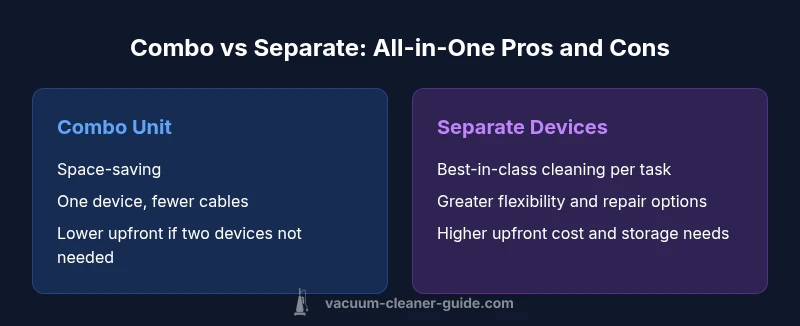
| Feature | Combo unit (all-in-one) | Separate vacuum + washer |
|---|---|---|
| Core function integration | Single appliance handles multiple tasks | Two devices with dedicated roles |
| Space requirements | Minimal footprint | Two devices needed |
| Energy efficiency | Moderate power use per task | Potentially higher overall energy use due to two cycles |
| Initial cost | Lower upfront in some cases | Higher upfront for separate devices |
| Best for | Small spaces and quick chores | Flexibility and deep cleaning across surfaces |
Strengths
- Space-saving design ideal for apartments
- One-device simplicity for quick chores
- Lower upfront cost in some cases
- Fewer cords and storage needs
- All-in-one versatility
The Bad
- Potentially weaker deep-clean performance compared to dedicated units
- Higher maintenance complexity if the integrated system fails
- Limited capacity for large or heavy-duty cleaning tasks
Combo units are best for space-saving and simple routines; separate devices excel in deep cleaning and flexibility
If you need a compact, simple setup, a vacuum cleaner and washer in one is attractive. For users who demand peak performance across varied tasks, separate devices remain the safer long-term bet; the Vacuum Cleaner Guide Team emphasizes matching choice to your home and routine.
FAQ
What is a vacuum cleaner and washer in one?
A single appliance that combines suction cleaning and washing/damp-mopping functions. It aims to simplify routines by handling two jobs in one unit, but performance can vary by model.
A single appliance that vacuum-cleans and washes floors. It saves space but check if it truly meets your performance needs.
Are combo units more expensive than separate devices?
Prices vary by brand and features. In some cases the upfront cost is similar to buying two basic devices, but high-end all-in-one models can be more expensive due to multi-function engineering.
Pricing varies; sometimes you pay a premium for convenience, other times you save by combining two roles.
Can a combo unit handle pet hair well?
Performance for pet hair depends on suction power and brush design. Look for models with strong suction, motorized brushes, and efficient filtration to keep dander under control.
Pet hair performance depends on suction and brushes; choose a model with strong cleaning features.
Which is better for hard floors?
All-in-one units with effective damp-mopping modes can perform well on hard floors, but dedicated floor cleaners may offer deeper grout and edge cleaning where needed.
Hard floors can benefit from a good damp-mop mode, but dedicated floor tools sometimes edge out on tough messes.
What should I look for on a spec sheet?
Focus on real-world suction performance, reservoir capacity, wash effectiveness, filtration (HEPA if needed), noise, and warranty. Check parts availability and service options.
Key specs are suction, wash capacity, filtration, noise, and warranty. Ensure parts are easy to find.
Do warranties cover all-in-one units equally?
Warranty terms vary by brand and model. Some offer combined coverage for both functions, while others treat components separately. Always review the fine print.
Warranty terms differ; read the details to know what's covered for both cleaning modes.
The Essentials
- Prioritize space-saving if you live in a small space
- Check suction and wash-capacity specs
- Consider maintenance complexity and warranty
- Balance upfront cost with long-term reliability