Vacuum Cleaner vs Broom in India: Is Vacuum Cleaner Better?
A comprehensive, evidence-based comparison of vacuum cleaners and brooms for Indian homes, focusing on cleaning performance, allergens, surfaces, energy use, and maintenance to guide your decision.


Across Indian homes, a vacuum cleaner usually outperforms a broom for everyday cleaning, especially with pets and mixed flooring. It removes dust and dander more completely and reduces allergen exposure, while a broom can be cheaper upfront and quicker for light sweeping. Your decision should weigh floor types, budget, power usage, and maintenance willingness.
India-Specific Cleaning Realities
According to Vacuum Cleaner Guide, Indian homes face a distinct mix of floors, dust, and daily rhythms that shape whether a vacuum cleaner or a broom is the better tool. In many apartments and family homes, you will find ceramic or vitrified tile, polished marble in living spaces, laminate or wood in bedrooms, and area rugs that complicate cleaning. Dust can travel on the roads, monsoon humidity adds to grime, and pet dander is common in households with cats or dogs. A broom is inexpensive and requires no power, but it often stirs dust and misses fine particles, especially on textured surfaces, under furniture, and in corners. The decision between a vacuum cleaner and a broom should account for floor types, home size, pet presence, storage space, power availability, and maintenance willingness. For pet-owning households and homes with mixed flooring, a dedicated vacuum cleaner generally delivers deeper cleaning, better air quality, and more consistent results, while a broom might still serve as a quick, zero-power option for light tidying. In this guide we examine the nuances of choosing the best tool for Indian homes.
How Vacuum Cleaners Work in Indian Homes
Vacuum cleaners create suction that pulls dirt into a collection chamber, while attachments help reach crevices, upholstery, and stairs. In Indian homes, where dust can be fine and surfaces vary from tiles to low-pile carpets, a model with strong filtration and reliable seals matters for air quality. Corded vacuums provide consistent power for longer cleaning sessions, while cordless stick vacuums offer portability and ease of use for quick spot-cleaning in kitchens and bedrooms. Dust control improves when you select models with cyclonic separation and airtight dirt containers. Look for HEPA or equivalent filtration to minimize indoor allergens, motorized pet tools for fur, and a versatile tool kit for gaps, upholstery, and high shelves. Maintenance matters: washable filters save recurring costs, and bagless designs should be cleaned regularly to prevent odor buildup. When evaluating options, consider energy use, running time, and charging convenience in multi-room homes. If you wonder is vacuum cleaner better than broom in india, this is where performance differences show up most clearly: the vacuum cleaner earns higher marks for thoroughness and allergen control.
Broom: Simplicity and Limitations
A broom is simple, silent in operation, and requires no electricity, maintenance, or specialized storage. It is inexpensive to purchase and easy to replace, making it appealing for quick tidying in kitchens and balconies. However, brooms push dust around rather than removing it, can miss hair and fine particles, and require more effort to reach corners, under furniture, and along baseboards. In homes with carpets or textured floor coverings, a broom often leaves behind dust that resuspends when people walk through a room. For households relying on quick daily sweeps or where storage space is limited, a broom offers practical advantages, but it trades off dust control, surface versatility, and overall cleanliness when compared with a purpose-built vacuum cleaner. If you value quiet operation and zero power dependence, a broom still has a role, particularly for tiny apartments or outdoor patios where a lightweight sweep suffices.
Key Differences: Cleaning Effectiveness, Allergen Control, and Maintenance
- Cleaning Effectiveness: A vacuum cleaner with a motorized tool and sealed filtration removes dust down to small particulates and pet hair more consistently than a broom. Brooms rely on manual agitation and sweeping motion, which can leave fine dust airborne.
- Allergen Control: HEPA-grade filtration helps capture microscopic particles; broom use can reintroduce dust into the air, especially with dry sweeping.
- Surface Versatility: Vacuums with adjustable suction and specialized tools handle carpets, hard floors, and upholstery; brooms mainly optimize hard floors and tile, with limited effectiveness on corners.
- Maintenance and Running Costs: Vacuum cleaners require periodic filter changes or bag replacements, plus occasional tool maintenance; brooms have negligible ongoing costs but limited lifespan and cleaning capabilities.
- Convenience and Storage: A compact broom takes less storage space and costs little, whereas vacuums add weight and require charging or cord management.
Surface-by-Surface Comparison: Carpets, Hard Floors, and Tiles
Carpets and rugs: A vacuum cleaner with a motorized brush tends to lift embedded dirt and hair more effectively, while a broom may leave hair tangled in fibers. Low-pile carpets are manageable with most sticks; high-pile or shag carpets benefit from a powered head and strong suction.
Hard floors and tiles: Brooms work reasonably well for dry dust, but fine dust and grit often cling to tile grout. A vacuum with hard-floor setting, tiled-friendly head, and sealed suction captures tiny grains and reduces streaks.
Stone and marble: Wet mops or damp sweeps are often necessary for larger spills; a vacuum with damp-cleaning capability should be used carefully. Always ensure surfaces are compatible with your vacuum’s nozzle to avoid scratches.
Cost of Ownership: Upfront Price vs Long-Term Value
Upfront price for a basic broom is significantly lower than a basic vacuum cleaner. Over time, ongoing costs for a vacuum include filters, bags, and occasional servicing, which should be weighed against improved cleanliness, reduced dust exposure, and potential allergy-related health benefits. Corded vacuums may have lower long-term running costs than cordless models due to no battery replacement needs, but they require access to power outlets and can be heavier. In India, feature-rich cleaners with HEPA filtration and durable components often provide the best long-term value for households with pets or people sensitive to dust. The total cost of ownership should consider floor area, frequency of cleaning, and storage constraints when choosing between tools.
Noise, Convenience, and Storage in Indian Homes
Vacuum cleaners typically produce higher noise levels than a broom, which may be a concern in shared living spaces or late-night cleaning. However, many modern models offer quieter operation and variable suction settings to balance performance and noise. Convenience factors include reach, cordless operation for stairs, and the availability of attachments for upholstery and corners. Storage considerations matter in Indian apartments where hallways are narrow; slimmer stick vacuums and compact canister units can store in a wardrobe or utility closet. For quick daily tidying, a broom is often convenient, silent, and requires no charging or hoses, but it sacrifices depth cleaning.
Eco-Friendliness and Energy Use
Vacuum cleaners consume electricity, and energy use varies by motor size, battery, and efficiency. Cordless models rely on battery packs that need periodic replacement, affecting long-term environmental impact and cost. Brooms use no electricity, offering minimal energy footprint but trades off deep cleaning and dust control. If you are concerned about energy use and indoor air quality, choose a vacuum with energy-efficient motors, good filtration, and a design that minimizes the need for frequent filter replacement. When considering sustainability, you should also factor in the life cycle of the devices, repairability, and the availability of replacement parts in India.
Recommendations by Use Case
- Pet owners with mixed flooring: a mid-range cordless stick vacuum with a motorized pet tool and HEPA filtration is ideal for daily maintenance and pet hair removal.
- Multi-room homes with tiles and hardwood: a corded or high-capacity canister vacuum with flexible hoses and robust filtration handles diverse surfaces.
- Tight budgets or small spaces: a compact broom might suffice for quick daily tidying, while planning for a future upgrade to a basic vacuum cleaner should be considered for improved air quality.
- Homes with moisture/humidity: choose a vacuum cleaner designed for humid environments with sealed filters and anti-mold components.
Common Mistakes and How to Avoid Them
Over-reliance on a single tool: mixing broom for quick tasks and vacuum for deeper cleaning is optimal. Skipping filter maintenance: clogged filters reduce suction and air quality. Ignoring surface compatibility: using the wrong head on delicate floors can scratch finishes. For Indian homes with power fluctuations, consider a model with a low wattage setting or battery backup. Neglecting regular vacuum maintenance: clean the brush roll, empty the canister, and replace bags or filters as recommended by the manufacturer.
Authority Sources and Data
To support this comparison, this guide references government and public health resources that contextualize filtration, energy use, and indoor air quality. The EPA provides guidance on filtration efficiency and HEPA standards, which informs consumer expectations about dust capture and air quality. The World Health Organization highlights the broader impact of indoor air on health, especially for households with pets and high dust exposure. Additional academic perspectives from NIH/NIEHS examine the durability, maintenance, and performance of consumer-grade vacuum cleaners in real homes.
Comparison
| Feature | Vacuum Cleaner | Broom |
|---|---|---|
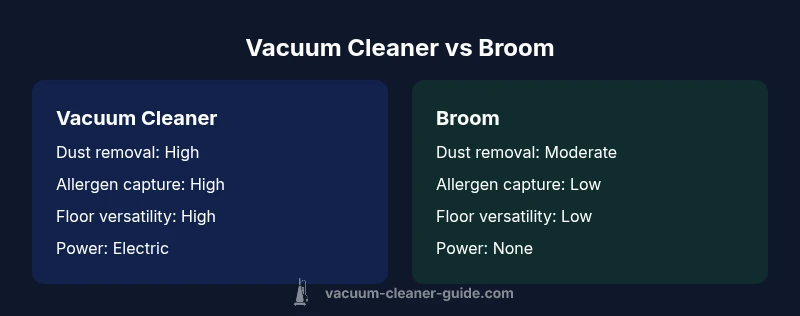
| Dust and allergen removal | High (HEPA-compatible sealed systems, cyclonic models) | Low (dust stirred, limited removal) |
| Surface versatility | Excellent on carpets, hard floors, upholstery with the right attachments | Limited to hard floors; poor reach on corners and under furniture |
| Maintenance cost | Medium to high (filters, bags, occasional service) | Low (no consumables; minimal maintenance) |
| Convenience | High (attachments, easy reach, multi-room use) | Medium (quick, simple use; no power needed) |
| Initial cost | Medium to high (entry-level to premium models) | Low (one-time bargain price) |
| Noise and disruption | Moderate to high depending on model | Low (silent operation during use) |
| Energy/power use | Electricity-powered; corded or battery-powered | None; no electricity required |
| Best for | Homes with pets, multiple floor types, allergy concerns | Quick tidying, small spaces, budget constraint |
Strengths
- Deeper cleaning and allergen removal for homes with pets
- Versatile performance across carpets and hard floors
- Improved overall air quality with sealed filtration
- Extensive attachment kit for corners and upholstery
- Higher long-term value in frequent-cleaning households
The Bad
- Higher upfront cost compared with brooms
- Ongoing maintenance costs (filters, bags, parts)
- Bulky designs can require storage space
- Battery life limitations for cordless models
Vacuum cleaner generally outperforms broom in Indian homes, especially for pets and mixed floors
For households with pets or multiple floor types, a vacuum cleaner is the better long-term choice. A broom remains a budget-friendly option for small, simple spaces or as a supplementary tool for quick spot-cleaning.
FAQ
Is a vacuum cleaner better for pet hair in India?
Yes. Vacuum cleaners with motorized pet tools and sealed filtration tend to remove pet hair more efficiently than a broom, reducing dander and improving air quality. Look for models with a dedicated pet tool and a HEPA-like filter for best results.
For pet hair, a vacuum with a motorized pet tool and a good filter is generally best. It picks up hair more effectively and helps with air quality.
Can I use a broom for hard floors only?
A broom can handle dry dust on hard floors, but it often leaves fine particles behind and can cause dust to resuspend. A vacuum designed for hard floors with a soft head offers better dust control and fewer streaks.
A broom works for quick dusting on hard floors, but a vacuum is usually better for thorough cleaning and less dust.
What about energy use with vacuums in India?
Vacuum cleaners do consume electricity, with power usage varying by motor size and battery. Cordless models save energy during short cleans but require charging, which may affect convenience.
Vacuum cleaners use electricity; cordless ones save energy for quick jobs but need charging.
Are cordless vacuums suitable for Indian homes?
Cordless vacuums are great for quick cleans, stairs, and small apartments, but their run time may limit deep cleaning in larger homes. For multi-room use, consider a model with longer runtime or a charging strategy.
Cordless vacuums are convenient for quick cleans, especially in small spaces, but watch for battery life in larger homes.
What maintenance is required for vacuums in humid climates?
Regularly clean filters and brush heads, dry components to prevent mold, and inspect seals. Humidity can promote mold growth if parts stay damp after use, so proper drying is essential.
Keep filters dry and clean; dry components after use to prevent mold in humid climates.
Which option is best for budgets?
Broom is the cheapest upfront, but a basic vacuum that fits your floor types often provides better value over time through reduced dust and improved health benefits.
Brooms are cheapest, but a budget vacuum can offer better long-term value and cleaner air.
The Essentials
- Choose a vacuum with good filtration for better air quality
- Prioritize attachments for hard-to-reach areas
- Balance upfront cost with long-term maintenance needs
- Consider storage space and power reliability in your home
- Healthy living favors sealed, easy-to-clean models