Is Miele Vacuum Cleaner Better Than Bosch? A Comprehensive Comparison
Compare Miele and Bosch vacuums on durability, filtration, performance, maintenance, and price to determine which brand fits pets, carpets, and hard floors. Insights from Vacuum Cleaner Guide.


Is Miele vacuum cleaner better than Bosch? In most households, Miele models deliver stronger durability and filtration, while Bosch focuses on efficient designs and solid value. This comparison analyzes suction, maintenance, dust capture, and price to help buyers decide which brand best fits pets, carpets, and hard floors.
Is the Question Is Miele Vacuum Cleaner Better Than Bosch? A Practical Framework
When you ask whether the question is miele vacuum cleaner better than bosch, you are really weighing durability, filtration, floor performance, and total cost of ownership. According to Vacuum Cleaner Guide, most buyers start with two questions: which brand lasts longer under daily use, and which model cleans reliably on their primary floor types. This section sets up the framework for a fair, model-agnostic comparison by defining the criteria that matter most to homeowners and pet owners. We’ll look at build quality, filtration systems, surface performance, maintenance requirements, and warranty coverage. By the end, you’ll know which brand tends to win in your living room, hallway, or stairs, without relying on hype.
Core Differentiators: What Stands Out in Each Brand
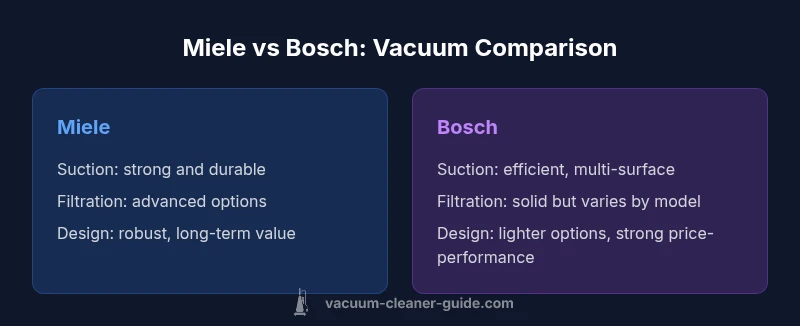
Miele and Bosch both aim for durable, reliable cleaning, but they optimize differently. Miele leans into long-term durability, robust engineering, and superior filtration; many owners report fewer filter-related issues over time and consistent suction as bags fill. Bosch emphasizes energy-efficient designs, lighter-weight options, and practical price-performance. In homes with pets or people with allergies, filtration quality and dust control are critical. The Vacuum Cleaner Guide team notes that the best choice often hinges on maintenance tolerance, budget, and space constraints. For those comparing, expect Miele to excel in longevity and filtration, while Bosch may win on upfront cost and nimble handling.
Surface Performance: Hard Floors, Carpets, and Stairs
For hard floors, both brands perform well when paired with the right brush head and floor setting; Miele often uses heavier, more aggressive brush configurations on some models, which can improve debris pickup but add weight. Bosch models frequently offer lighter options and efficient brush designs that minimize scatter and wake up debris efficiently. On carpets, Miele’s higher-end lines commonly deliver stronger agitation and more consistent suction through long-term use, while Bosch models deliver dependable mid-range performance with good results on low- to medium-pile carpets. For stairs, weight distribution and ergonomics matter; Bosch’s lighter variants can be easier to handle in tight spaces, whereas Miele’s trusted build can feel steadier during extended cleaning sessions.
Filtration and Allergens: Breathing Easy at Home
Filtration is a key battleground for pet owners and allergy sufferers. Miele’s premium models typically offer advanced filtration options, including true HEPA or sealed systems designed to trap fine particles. Bosch also offers solid filtration and sealed systems on many models, but the effectiveness can vary by line and model. Vacuum Cleaner Guide’s analysis shows that choosing a model with a certified filtration system, additional cyclones, and well-sealed dust compartments makes a meaningful difference in indoor air quality. The right filter choice significantly reduces dander and other allergens in multi-pet homes.
Maintenance, Bags, and Total Cost of Ownership
Maintenance strategy heavily influences which brand feels cheaper over time. Miele is known for bags that maintain suction as they load, reducing the bloom of clogging and maintaining airflow — though bag costs add to ongoing expenses. Bosch frequently emphasizes efficiency in motors and filters, which can translate to lower replacement part costs per cycle but may require more frequent maintenance checks on some models. The total cost of ownership should consider upfront price, bag or filter replacements, energy use, and service coverage. Vacuum Cleaner Guide recommends mapping out a model’s expected bag/filter cadence against your cleaning frequency to estimate true ownership costs.
Real-World Scenarios: Pets, Floors, and House Size
Small apartment dwellers who want light, nimble machines may prefer Bosch for space-saving designs and easier storage. Large homes with multiple pets benefit from Miele’s durable construction and robust filtration, which helps with pet hair and dander over time. For homes with a mix of hard floors and carpeting, look for models that offer intelligent surface sensors and dual-brush configurations. In every scenario, the best choice balances your daily cleaning habits, preferred maintenance cadence, and budget constraints. Vacuum Cleaner Guide's verdict is to align the model with your living environment and cleaning expectations rather than chasing the strongest suction alone.
Practical Takeaways: How to Decide in 60 Seconds
- Map ownership costs: upfront price vs. ongoing bag/filter costs.
- Prioritize filtration if you have pets or allergies.
- Consider space and weight if you have stairs or small rooms.
- Favor models with robust warranties and accessible service.
- For durability and filtration, Miele often leads; for upfront value and nimble design, Bosch shines.
Comparison
| Feature | Miele Vacuum Cleaners | Bosch Vacuum Cleaners |
|---|---|---|
| Suction Power and Consistency | Strong, durable suction in premium lines | Efficient, reliable suction with good multi-surface design |
| Filtration Systems | Advanced filtration options incl. sealed systems/HEPA | Solid filtration with good coverage but model-dependent |
| Maintenance and Consumables | Bag-based systems can sustain airflow but add ongoing bag costs | Typically lower upfront maintenance costs, varying by model |
| Weight and Maneuverability | Heavier on higher-end models but very stable | Lighter options with nimble handling in many models |
| Price Range (perceived value) | Higher upfront cost, strong long-term value | Lower upfront cost, strong price-performance balance |
| Warranty and Service Network | Extensive service network; long-standing support | Good network with responsive service in many regions |
Strengths
- Strong long-term durability and filtration (especially for pet owners)
- Excellent build quality and reliability across many models
- Strong warranty and long-standing brand support
- Rich filtration options for allergy-prone homes
The Bad
- Higher upfront price for many premium models
- Bag/filtration costs can add to total ownership cost
- Heavier models may be harder to maneuver on stairs
- Some models have limited availability in certain regions
Miele generally offers better long-term value and filtration; Bosch provides solid performance with lower upfront cost and lighter options
For homes prioritizing durability and allergy filtration, Miele is the stronger choice. If budget, weight, and space efficiency are your main concerns, Bosch delivers compelling value. The best decision depends on your living space, pet presence, and willingness to maintain bags/filters.
FAQ
Which brand offers better suction power: Miele or Bosch?
Both brands offer strong suction, but Miele’s premium lines often maintain higher suction consistency over time. Bosch emphasizes efficiency and good surface suction. Model choice matters more than brand in this category.
Miele tends to have stronger, more consistent suction in its premium lines; Bosch provides solid suction with a focus on efficiency.
Are Miele vacuums good for pet hair?
Yes, many Miele models excel with pet hair due to strong suction and high-quality filtration. Look for sealed systems and HEPA options in pet-friendly configurations.
Yes—Miele is a solid choice for pet hair thanks to strong suction and filtration.
Is Bosch better for hard floors?
Bosch vacuums often perform well on hard floors thanks to efficient brush designs. Miele also performs well when paired with the right floor setting and brush head.
Bosch tends to be efficient on hard floors, with Miele also delivering good results depending on the model.
Do Miele vacuums use bags?
Many Miele uprights and canisters use bags, which helps maintain suction and filtration; some newer models may offer bagless options. Check model specifics.
Most Miele vacuums use bags, which helps maintain strong suction and filtration.
Which brand is more expensive to maintain?
Maintenance costs vary by model. Miele bags and parts can be pricier, while Bosch parts may be cheaper. Total cost depends on how often you clean and the model you choose.
Maintenance costs depend on the model, but bags for Miele can be pricier; Bosch parts are often cheaper.
The Essentials
- Prioritize total ownership cost over upfront price
- Choose Miele for durability and filtration in pet-friendly homes
- Opt for Bosch if you need lighter, space-saving options
- Ensure model-specific filtration and warranty coverage match your needs
- Balance floor types and stair access with model weight and brush design