Is Central Vac Better Than A Dyson? An Analytical Comparison
An analytical comparison of central vacuum systems versus Dyson vacuums, focusing on installation, performance, noise, allergy relief, and long-term value for homes with pets.


Is this the right framing for comparing central vac vs Dyson?
When readers ask a straightforward question like is central vac better than a dyson, they’re really weighing two distinct cleaning philosophies: one built into the house and one portable enough to carry anywhere. According to Vacuum Cleaner Guide, the best approach is to define what you value most—coverage, air quality, or mobility—and then map those priorities to the two systems. The Vacuum Cleaner Guide team found that the decision rarely hinges on a single factor; it’s a trade-off between long-term value and daily convenience. By framing the comparison around your home profile—size, layout, occupancy, and cleanliness goals—you get a decision that feels precise rather than generic.
This article will stay focused on objective criteria: coverage, air quality, noise, costs, and flexibility. It avoids marketing hype and offers a practical framework you can apply whether you’re renovating, building a new home, or simply upgrading your current cleaning setup.
How central vacuum systems work
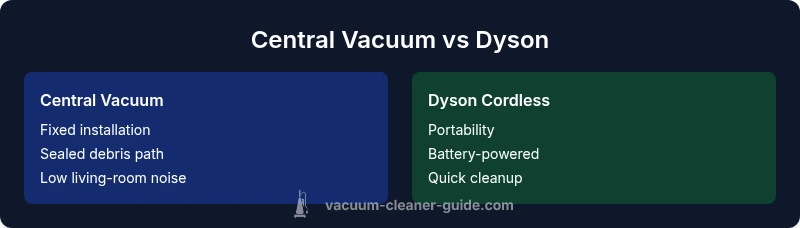
Central vacuum systems represent a fixed cleaning network installed in a home. A powered unit sits in a utility room or garage, and a network of PVC pipes carries the debris from in-wall inlets to a centralized canister. The suction at each inlet is delivered by the main unit, which can be oversized for multiple floors or extended for larger homes. Because the intake is fixed, users don’t drag a heavy machine around the house; instead, a lightweight hose and attachments do the work. Maintenance typically centers on periodic filter changes and tub cleaning of the canister, with some systems offering sealed bags or HEPA filtration. For homeowners evaluating the broad question of is central vac better than a dyson, the central system shines on long-term reliability and reduced indoor dust disturbance when properly installed.
How Dyson vacuums work
Dyson cordless vacuums operate on rechargeable batteries, using cyclone technology to separate dust and air. The design emphasizes mobility, quick pick-ups, and ease of use on stairs, upholstery, and cars. Battery life ranges by model and use, and many Dysons offer washable filters and cyclones that maintain suction with regular maintenance. Because Cordless Dyson models are not tied to a home’s piping, they score high on flexibility and ease of storage. However, their performance may dip during extended cleaning sessions as the battery discharges, and ongoing costs include battery replacement cycles and filter maintenance. When comparing to a central system, the Dyson’s value proposition rests on portability and immediate convenience rather than fixed-home efficiency.
Key use-cases for central vac vs Dyson
Large multi-story homes with pets, heavy traffic, and shared living spaces benefit from a central vacuum’s built-in suction and quiet operation, which translates into thorough debris removal with fewer recirculation issues. In contrast, a Dyson cordless vacuum excels for apartments, vacation homes, or households that require a handheld option for quick cleanups, car interiors, and upstairs rooms. For households with allergy concerns, the reduced dust disturbance and sealable debris path of many central vac systems can offer an advantage—especially when paired with HEPA filtration. The decision hinges on your daily routines: if most cleaning happens in a few rooms or you need rapid cleanup, the Dyson wins on flexibility; if you want consistent, ground-floor-to-attic cleaning with minimized dust escape, the central system often prevails.
Air quality, allergens, and hygiene implications
Indoor air quality is a major consideration when evaluating is central vac better than a dyson. Central vacs typically vent debris into a sealed canister, and if the system uses HEPA filtration, it can significantly reduce dust leakage into living spaces. This matters for households with allergies or asthma. Dyson vacuums, while portable and convenient, can recirculate fine dust if the filter maintenance is delayed, particularly for models with sealed cyclones that aren’t optimized for continuous heavy use. The key takeaway is not that one type inherently cleans better, but that sealing, filtration, and maintenance discipline strongly influence IAQ outcomes. Vacuum Cleaner Guide’s analysis emphasizes choosing a system with a well-sealed debris path and an accessible filter routine to minimize allergen exposure.
Installation, maintenance, and lifetime cost considerations
One of the most tangible dimensions when comparing central vac vs Dyson is installation cost and long-run maintenance. A central vacuum requires professional installation, trenching or wall-inlet placement, and a larger upfront investment. But the long-term operating cost can be lower if the system is reliable and requires minimal power use per cleaning cycle. Dyson vacuums, by comparison, demand lower initial spend and provide immediate usability; however, battery replacements and filter replacements over time can add up. For pet owners and families with regular cleaning needs, tallying total cost of ownership over 5–10 years helps clarify the choice. Vacuum Cleaner Guide’s analysis shows that homeowners often recover part of the upfront expense through efficiency and resale value when a central system is installed in a well-designed home.
Performance on surfaces: carpet, hard floors, and pet hair
Carpet cleaning efficiency often hinges on suction and nozzle design. Central vacuums with wide inlets and robust motors tend to pull debris from deep carpet fibers and lift dust from under furniture, especially when combined with a quality wand and floor nozzle. Dyson models excel on hard floors and above-floor cleaning, where maneuverability and edge-to-edge suction shine. For pet hair, both options can perform well with the right attachments: a central system benefits from powerful suction at fixed inlets and long hoses, while a Dyson’s motorized attachments excel at quick pickups on stairs and upholstery. The practical implication is simple: choose based on the surfaces you clean most, rather than assuming one system outperforms the other in every scenario.
Noise, vibration, and user experience
Noise is a practical consideration that often influences the perceived effectiveness of a cleaning system. Central vacuums are typically quieter in living spaces because the loud motor is located away from the living rooms, with the intake running through inlets rather than a handheld device. Dyson cords, while designed for low weight, can be noisier during peak suction and battery recharging cycles. Users also report less fatigue with central vacs for routine, high-coverage cleaning since they avoid dragging a heavy unit across rooms. The trade-off remains: central vacs require a one-time installation and space to house the main unit, while Dysons offer day-to-day portability and rapid responsiveness.
Space, layout, and home modernization: when to install
Deciding whether to install a central vacuum system often comes down to space and architectural flexibility. Homes with long-term plans for renovation, or new builds with planned wall-inlets, benefit from central vacs by spreading suction across the square footage without bulky hoses. In retrofit situations, homeowners must assess wall inlet routing, garage access, and the feasibility of trenching or ducting. Dyson vacuums win in existing homes where installation would be invasive or where there is frequent need for portable cleaning. Vacuum Cleaner Guide recommends a careful cost-benefit analysis that weighs your home’s size, renovation plans, and lifestyle needs before committing to a major installation.