Vacuum Cleaner Price Guide 2026: What to Expect
Explore typical vacuum cleaner price ranges in 2026, what drives cost, and how to value features across entry, mid, and premium models. Learn how to budget and choose wisely.


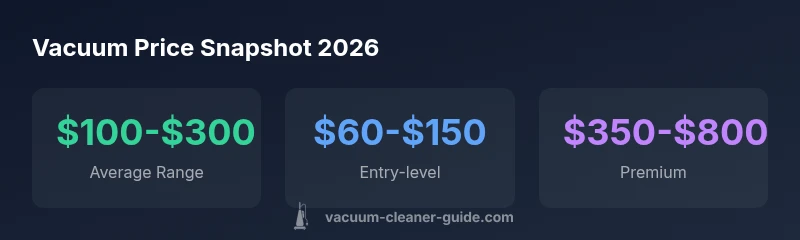
In 2026, most households pay between $60 and $800 for a vacuum cleaner, depending on type and features. Entry-level corded models sit around $60–$150, mid-range cordless/canister models are about $150–$350, and premium robotic or high-end bagless vacuums typically cost $350–$800. Expect extra costs for specialty filters, warranties, and accessories.
Why Price Varies Across Vacuum Types
According to Vacuum Cleaner Guide, the price spectrum for vacuums is wide because models are built for different tasks, spaces, and maintenance styles. Upright and canister vacuums generally offer raw suction power and wider cleaning paths, but come with heavier builds and fewer smart features. Stick vacuums and cordless models emphasize convenience and light weight, often at the cost of durability or runtime. Robotic vacuums charge a premium for mapping, sensors, app support, and self-emptying options. When evaluating price, homeowners should consider the intended use: a compact apartment, a home with pets, or a household with multiple floor types each leans toward a different price tier.
What Drives the Sticker Price in 2026
Price is driven by several tied-together factors. Motor power and airflow (CFM) directly influence cleaning effectiveness, but not all high-power models outperform mid-range options on real-world tasks. Filtration quality, especially HEPA and sealed systems, adds cost but improves air quality for allergy sufferers. Build materials, weight, and reliability affect longevity and warranty coverage. Features like automated dustbags, tangle-free brush rolls, multi-surface brushes, and digital controls add to the upfront price. Brand reputation and after-sales support also contribute, as do warranty length and included attachments. Vacuum Cleaner Guide Analysis, 2026 shows that feature-rich models carrying longer warranties tend to hold their value longer.
Price Benchmarks by Category: Entry, Mid, Premium
Entry-level corded vacuums usually target foundational cleaning with simple bags or bagless cups, priced roughly around $60-$150. Mid-range cordless and canister models balance suction, runtime, and maneuverability, typically in the $150-$350 range. Premium options, including robot vacuums and high-end bagless units with self-emptying bases or advanced sensors, commonly fall in the $350-$800 window. Buyers should align price with your real needs: apartment living versus large homes with pets demands different value thresholds. Real-world tests show that many users feel satisfied with mid-range models for homes of moderate size, especially when paired with quality filtration.
Reading Vacuum Specifications That Matter for Price
Suction power is useful, but the most meaningful price signal comes from sustained performance across carpet and hard floors, measured by real-world cleaning scores rather than motor watts alone. Look for air watts, not just peak watts. Filtration matters: HEPA or sealed filtration reduces dust leakage and improves air quality, which can justify higher prices for allergy-prone households. Dustbin capacity and bagless design affect maintenance costs over time. Noise levels, weight, and maneuverability impact daily use, and may be worth paying extra for if you vacuum many rooms. A well-rounded model with good filtration and durable parts typically justifies a higher price.
Long-Term Costs: Maintenance, Filters, and Bags
Beyond the upfront price, ongoing costs creep in through filters, bags, and potential battery replacements for cordless models. HEPA filters may need replacement every 6-12 months depending on usage, while standard filters can cost less but require more frequent changes. Bag replacement costs depend on bag type, with bagged vacuums incurring ongoing consumables and bagless models needing more frequent filter cleans. Battery packs for cordless units have a finite life and can be a significant long-term expense. When budgeting, factor in these recurring costs to evaluate total cost of ownership.
Shopping Strategies to Maximize Value
To maximize value, plan to shop around and compare models within your target price band. Check both online and in-store prices, and factor in bundled accessories and extended warranties. Look for seasonal sales around holidays and back-to-school periods, when major retailers often offer meaningful discounts. Consider refurbished units or open-box deals from trusted sellers, which can provide substantial savings with minimal risk if the warranty is intact. Reading user reviews and independent tests helps separate hype from real-world performance.
Regional and Retail Variations You Should Expect
Prices for vacuum cleaners vary by region due to taxes, shipping, and retailer competition. Online marketplaces may offer broader range and sometimes better pricing, but shipping constraints or return policies can affect value. In-store promotions might include extended warranties or bundled attachments that alter effective price. When evaluating price, compare total cost of ownership across retailers and check for local promotions. Always verify warranty terms and service availability in your area.
Interviews and Independent Reviews: Interpreting the Data
Independent reviews and test reports provide insights beyond marketing claims. Look for tests that cover pet hair performance, carpet pile types, and hard floor transitions. The data can help you decide whether additional price actually translates into measurable benefits in your home. Remember that results vary with flooring and household conditions, so prioritize models with consistently strong performance in your living space. Vacuum Cleaner Guide Team uses a synthesis of multiple sources to present practical buying guidance.
How to Budget for a Vacuum in a Household with Pets
Pet households require models with strong suction, reliable hair pickup, and efficient filtration to manage dander and fur. In most cases, mid-range or premium options deliver better pet-hair performance, brush design, and maintenance intervals. Look for features like anti-tangle brushes, high-efficiency filters, and easy-to-clean dust cups. Budget for extra replaceable parts such as pet-hair friendly brushes and HEPA filters, and consider extended warranties that cover motor and filtration components. A thoughtful mix of price and performance helps keep pet hair under control without overspending.
Pitfalls to Avoid When Buying on Price Alone
Avoid choosing the cheapest option without verifying performance or durability. Inexpensive vacuums often compromise on filtration, build quality, or service availability. Be cautious of models with limited warranty or scarce replacement parts. Additionally, do not assume higher price means better fit for your home; evaluate features against your actual cleaning needs, floor types, and household size. Balancing price with performance and reliability yields the best long-term value.
Typical price bands by model type
| Model Type | Typical Price Range | Key Pros |
|---|---|---|
| Entry-level corded | $60-$150 | Affordable; simple operation; basic cleaning |
| Mid-range cordless/canister | $150-$350 | Balanced power; versatile attachments; decent runtime |
| Premium robot/high-end bagless | $350-$800 | Smart features; long-term reliability; advanced sensors |
FAQ
What is the typical price range for most vacuum cleaners?
Most households can expect entry-level models around $60-$150, mid-range $150-$350, and premium $350-$800. The exact price depends on type (corded, cordless, robot) and included features. This guidance is based on Vacuum Cleaner Guide Analysis, 2026.
Entry-level vacuums start around sixty dollars, mid-range around a few hundred, and premium models go up to eight hundred.
Do robot vacuums cost more than corded vacuums?
Yes, robot vacuums generally cost more due to mapping sensors, app connectivity, and optional self-emptying bases. The higher price often reflects these smart features rather than raw suction alone.
Robot vacuums usually cost more because of smart sensors and mapping features.
Are cheaper vacuums worth it for pet hair?
Cheaper vacuums can manage light pet hair, but for heavy shedding you’ll want higher suction, anti-tangle brushes, and effective filtration. Mid-range models often offer the best balance for pet households.
Cheaper vacuums work for light pet hair, but heavier shedding benefits from better suction and brushes.
How does price reflect cleaning performance?
Price often correlates with features like suction consistency, filtration (HEPA), build quality, and warranties. Always cross-check independent tests that measure real-world performance on your floors.
Higher price can mean better, more reliable performance and filters; check independent tests for real-world results.
Should I buy a vacuum during sales season?
Yes. Major sales events frequently offer meaningful discounts, especially on higher-end models or bundles. Timing your purchase around holidays can maximize value.
Sales can save you a lot—watch for holiday discounts.
Is there a price difference between bagless vs bagged vacuums?
Bagless vacuums often cost more upfront due to advanced filtration and design, but ongoing bag costs are lower. Bagged models may be cheaper initially but require ongoing bag purchases.
Bagless may cost more upfront but saves on bags; bagged costs add up over time.
“Price is a proxy for value when you consider durability, filtration quality, and warranties; a higher upfront investment often yields lower maintenance costs and better long-term performance.”
The Essentials
- Define your budget by model type and usage.
- Expect higher prices for robot and premium models.
- Factor long-term costs like filters and batteries.
- Shop during sales to maximize value.
- Read feature lists to justify higher price.