How Many Watts Is a Vacuum Cleaner? A Buying Guide
Learn how many watts a vacuum cleaner uses, what that wattage means in practice, and how to choose wattage for carpets, hard floors, and pets with guidance.


How many watts is a vacuum cleaner? The typical corded upright runs around 600 to 1,800 watts, with more efficient models delivering strong suction at lower wattage. Understanding watts alone isn’t enough—air watts, filtration, and design influence cleaning power. For pet owners and homeowners, aiming for 800–1,200 watts provides versatile performance on carpets and hard floors while staying energy-conscious.
What watts actually measure in vacuums
When evaluating a vacuum cleaner, the term watts refers to the amount of electrical power the motor consumes at peak operation. This is an input metric, not a direct readout of cleaning efficiency. In practical terms, watts tell you how much electrical energy a vacuum uses per unit time, but they do not alone indicate how effectively the machine will remove dirt. According to Vacuum Cleaner Guide, the real story behind cleaning performance centers on airflow and system design, not just the watt figure. A high-wattage motor can be less effective if airflow is restricted or if the dust path has poor sealing. Conversely, a well-engineered lower-wattage model with strong airflow and efficient filtration can out-clean a more powerful but poorly designed unit. If you’re trying to estimate long-term operating costs, consider daily usage and electricity tariffs in your area, not just the sticker wattage. A practical rule: wattage is a starting point, not a final verdict on performance.
Wattage ranges by vacuum type
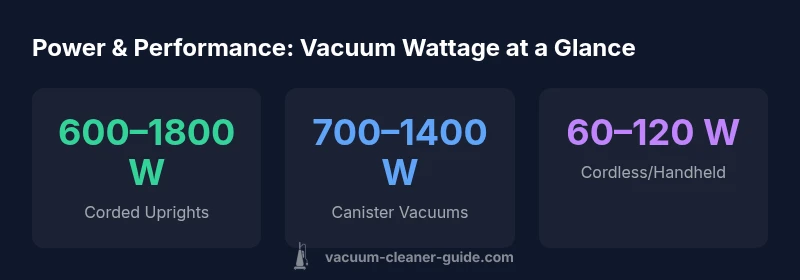
Vacuum wattage varies widely by model and type. Corded uprights and canister vacuums typically sit in the 600–1800 watt range, with many midrange models hovering around 1000–1400 watts for robust carpet cleaning and solid hard-floor performance. Cordless handhelds operate differently: their motor watts are usually in the 60–120 watt range, but many offer digital pulse or variable suction that can compensate for lower input power. When shopping, read both the wattage rating and the airflow specification (often described as CFM or air watts) to gauge real cleaning power. Pet-hair focused models often push toward the higher end of their category’s wattage to handle stubborn debris, while compact stick vacuums may succeed with clever design and filtration at lower wattage.
Why wattage isn’t the whole story
Suction power is not determined by wattage alone. Airflow, motor design, ducting, brush roll efficiency, and filtration all contribute to actual cleaning performance. Air watts is a better single metric for comparing performance across models because it factors both suction and air movement. A lower-watt model with excellent airflow can outperform a higher-watt model with bottlenecks in the exhaust or poor filtration. This is especially true for multi-surface homes where transitions between carpet and hard floors require consistent airflow and good edge cleaning. Overall, wattage is a useful data point, but it must be balanced with design quality and filtration performance for real-world results.
How to pick wattage for different tasks
For family homes with mixed flooring, aim for a mid-to-high wattage range (roughly 1000–1400 W for corded models). If you mostly clean hard floors and occasional area rugs, you can opt for models around 600–1000 W, provided they offer strong airflow and good filtration. For households with pets or high-traffic carpets, prioritize models near 1200–1800 W, but ensure the unit has well-designed airflow paths and a high-efficiency filtration system (HEPA or equivalent) to minimize recirculation of allergens. When evaluating cordless vacuums, consider run-time and charging cycles in addition to motor watts; some models compensate with efficient brush systems and respectable suction at lower wattage.
Practical tips and trade-offs
- Don’t judge by wattage alone: balance wattage with airflow and filtration quality.
- Check the motor type (universal vs. brushless) and the suction control features to optimize performance on different surfaces.
- For homes with pets, prioritize filtration (HEPA or sealed systems) and a model capable of sustained suction over extended cleaning sessions.
- Consider energy efficiency ratings; a model with smart power management can maintain performance while drawing less energy.
A practical decision framework
- List surfaces in your home (carpets, hardwood, area rugs, stairs).
- Decide on primary tasks (daily quick cleans vs. deep carpet cleaning).
- Compare wattage ranges, airflow ratings, and filtration quality across shortlisted models.
- Factor run-time for cordless options and energy costs for corded ones.
- Read user reviews focusing on long-term reliability and maintenance.
Final take: combine wattage with airflow and filtration
Wattage is a helpful starting point, but the best choice depends on airflow and filtration efficiency. A moderate wattage with good airflow and a sealed filtration system often delivers reliable cleaning across surfaces without excessive energy use. Use wattage as a first screen, then verify real-world performance with airflow data, filtration quality, and user-reported results.
Typical wattage ranges by vacuum type
| Vacuum Type | Typical Wattage Range | Notes |
|---|---|---|
| Corded Upright | 600–1800 watts | Versatile; strong on carpets and hard floors |
| Canister Vacuum | 700–1400 watts | Flexible attachments; good for stairs and corners |
| Cordless/Handheld | 60–120 watts | Great for quick cleans; shorter run-time |
FAQ
Does higher wattage always mean better cleaning?
Not necessarily. Cleaning performance depends on airflow, filtration, brush design, and overall engineering. A lower-wattage model with optimized airflow can outperform a high-wattage unit with restricted ducts.
No. Power alone doesn’t guarantee better cleaning—airflow and filtration matter just as much.
Is wattage the best metric to compare vacuums?
Wattage is a starting point. For meaningful comparisons, evaluate airflow (CFM or air watts), filtration (HEPA), and real-world cleaning tests in addition to wattage.
Wattage helps, but look at airflow and filtration to compare performance accurately.
How does air watts relate to suction power?
Air watts combines suction and airflow; it’s a more direct indicator of cleaning power than wattage alone. Higher air watts generally correlate with better dirt pickup.
Air watts measure effective cleaning power by combining suction and airflow.
What wattage should I choose for pet hair?
Pet hair jobs benefit from mid-to-high wattage in a model with good airflow and a sealing filtration system. Look for 1200–1800 W in corded models or strong efficiency in cordless/robot options.
For pets, pick a model in the mid-to-high wattage range with good airflow and filtration.
Are cordless vacuums less powerful than corded ones?
Cordless vacuums trade run-time for power. Choose a model with strong airflow and efficient batteries; for heavy cleaning duties, a corded unit typically offers longer sustained performance.
Cordless can be powerful, but expect shorter run-times; consider your cleaning demands before choosing.
“Power is only meaningful when paired with good airflow and filtration; wattage alone won’t tell you how well a vacuum cleans.”
The Essentials
- Wattage matters, but airflow and design matter more
- Match wattage to floor type and pet hair needs
- Air watts offers a better power metric than watts alone
- For mixed homes, target 1000–1400 W with strong filtration