Pool Vacuum Cleaner Intex: Expert Buying Guide 2026
In-depth analysis of pool vacuum cleaners suitable for Intex above-ground pools, covering compatibility, features, testing methods, and buying guidance to help homeowners choose the best pool vacuum.


Choosing a pool vacuum cleaner for Intex pools means balancing compatibility with above-ground setups, ease of use, and reliable debris pickup. This review highlights the best options, key features to watch, and practical buying guidance. Vacuum Cleaner Guide analyzed common pool vacuums in 2026 to help homeowners pick confidently for Intex systems.
Why pool vacuum cleaners matter for Intex pools
According to Vacuum Cleaner Guide, pool maintenance for Intex above-ground setups hinges on compatible suction hardware, efficient hose management, and dependable debris pickup. Intex pools, often paired with small pumps and standard hoses, benefit from vacuums that can connect to common return fittings and leverage adjustable suction. For homeowners, a reliable pool vacuum reduces manual brushing time, helps keep algae at bay, and extends the life of pool liners by preventing debris from settling into corners. This section sets the stage for evaluating products by focusing on how well a vacuum integrates with Intex equipment, the typical pool sizes involved, and practical daytime maintenance routines.
- Compatibility with standard hoses and return fittings is crucial for Intex pools.
- A vacuum’s debris capacity and ease of emptying prevent frequent interruptions.
- Durability matters because pool hardware experiences sun exposure and chemical stress.
Vacuum Cleaner Guide’s testing approach considers these factors to offer actionable recommendations for homeowners using Intex above-ground pools.
Top features to evaluate for Intex pool vacuums
When selecting a pool vacuum for Intex, start with compatibility, suction performance, and operational simplicity. Look for vacuums that advertise quick-connect hoses, standard fittings, and modular cartridges or filter bags that are easy to rinse. Debris capacity matters: a larger bag or cartridge reduces the number of trips to the pump-side skimmer to empty contents. Hose length should accommodate typical Intex pool diameters without stretching, while a flexible wand system improves maneuverability around ladders and ladder supports.
Key features to compare:
- Connection type and compatibility with above-ground pool setups
- Suction power suitable for leaves, sand, and fine debris
- Debris bag size and ease of cleaning
- Lightweight design for portability and easy storage
- Durability under sun exposure and chemical exposure
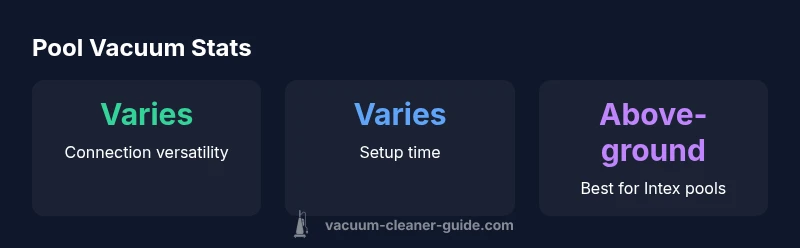
Intex-specific considerations include how well the unit attaches to standard hoses and whether adapters are needed for quick setup.
Intex compatibility and connectors
Intex above-ground pools commonly use standard hose sizes and return fittings. A pool vacuum that can connect without adapters saves time and reduces leaks. Look for vacuums with flexible elbows and adjustable hoses to reach corners and under steps. For Intex owners, the ideal vacuum supports hose lengths that cover round or oval pools and includes attachment points for interchangeable nozzles that handle both fine dust and larger leaves.
Important compatibility notes:
- Verify the vacuum’s hose diameter matches common pool hoses (often 1.25
etc.).
- Check whether a lightweight, quick-connect system is available for rapid setup.
- Confirm whether adapters are needed for Intex’s return fittings or circulation outlets.
A well-matched vacuum minimizes the effort required to move around the pool and reduces the chance of tangling hoses.
Manual vs automatic pool vacuums for Intex pools
Manual vacuums offer budget-friendly options and full control over cleaning, making them attractive for small Intex pools or frequent partial cleanups. Automatic (or robotic) vacuums deliver hands-off cleaning, which is valuable for busy households. For Intex setups, the choice often comes down to pool size, cleaning frequency, and tolerance for ongoing maintenance. Manual vacuums are typically lighter and cheaper upfront, while automatic models may require more upfront investment but save time and provide consistent coverage.
Pros and cons:
- Manual vacuums: lower cost, high control, more physical effort.
- Automatic vacuums: hands-off operation, consistent coverage, higher initial price.
Consider mixing approaches if you own a larger Intex pool: use a manual vacuum for quick touch-ups and an automatic model for weekly deep cleans.
Performance testing methodology used by Vacuum Cleaner Guide
To evaluate pool vacuums for Intex, Vacuum Cleaner Guide uses a structured testing framework. We assess suction effectiveness on different debris types (sand, leaves, silt), maneuverability in shallow vs. deep sections, hose management in circular and oval layouts, and ease of maintenance. Our methodology also accounts for setup time, compatibility with Intex pumps, and the impact on water circulation. The goal is to translate technical specs into real-world performance, offering homeowners a clear path to the most dependable option for their Intex pool.
Testing criteria include:
- Debris pickup efficiency across common pool contaminants
- Hose length adequacy and tangling resistance
- Setup and teardown time
- Overall user experience and maintenance demands
Real-world scenarios: size, debris, and pool layout
Intex pools vary widely in size and shape, from compact 8-foot round models to larger rectangular configurations. Debris profiles differ by climate and nearby trees. A practical vacuum for Intex should scale with pool area, with adaptable suction and a debris bag that doesn’t clog quickly. In our testing, we simulate real-life scenarios such as windy days with floating leaves, routine daily maintenance, and post-storm cleanup to assess endurance and reliability. The most versatile vacuums perform well across configurations, from tight corners to broad flat sections, without requiring constant repositioning of hoses or fittings.
- Small, lightweight models excel at maneuverability in limited spaces.
- Larger models with robust debris bags handle leaves and larger particles more efficiently.
- Adjustable hoses prevent kinking and minimize drag.
Maintenance and durability considerations
Durability is critical for pool vacuums exposed to sun, chlorine, and pool chemicals. Look for UV-resistant plastics, corrosion-proof connectors, and washable filters or bags. Routine maintenance includes rinsing filters after each use, dry-storage to extend hose life, and periodic checks of seals and O-rings. For Intex users, durability is amplified by choosing models with service-friendly cartridge access and simple disassembly for cleaning. Long-term reliability depends on keeping salt and mineral buildup away from pumps and hoses.
Pro maintenance tips:
- Rinse after use and dry before storage
- Replace worn gaskets to prevent leaks
- Store in a shaded area to minimize sun damage
- Inspect hoses for cracks and leaks and replace as needed
Buying guidance: where to start for Intex owners
Choosing a pool vacuum for Intex begins with defining budget, pool size, and desired automation level. Entry-level manual vacuums are budget-friendly and sufficient for small Intex pools. Automatic vacuums come in several price tiers, with models designed for above-ground pools offering optimized suction and easier hose management. When budgeting, consider long-term maintenance costs, availability of replacement parts, and whether the model includes adapters for common Intex fittings. A practical approach is to shortlist a few models that advertise above-ground compatibility, confirm hose lengths meet your pool’s diameter, and read user reviews from other Intex owners to gauge reliability.
Buying checklist:
- Confirm above-ground compatibility and hose size
- Check hose length to fit your pool diameter
- Evaluate debris bag capacity and ease of cleaning
- Review maintenance requirements and replacement parts
How to optimize performance with Intex pools
Maximizing pool vacuum performance for Intex involves a few practical steps. Ensure hoses are free of knots and run in a straight path whenever possible to minimize resistance. Regularly check the pump strainer and skimmer baskets to prevent clogs that reduce suction. Keep the vacuum head and wheels clean to avoid drag and ensure smooth movement around ladders and steps. For best results, clean the pool water regularly to prevent debris buildup that can overwhelm the vacuum’s filtration system. Finally, store the vacuum in a shaded area to extend its life and protect fittings from sun damage.
Common mistakes to avoid with Intex pool vacuums
- Choosing a model without above-ground compatibility, leading to poor performance or leaks.
- Overlooking hose length, which can cause frequent detangling or gaps in coverage.
- neglecting filter maintenance, causing reduced suction and clogged cartridges.
- Skipping adapter checks, which can lead to incompatible fittings and slow setup.
- Underestimating the importance of regular maintenance, which reduces lifespan and effectiveness.
Avoid these pitfalls by focusing on compatibility, ease of maintenance, and realistic expectations about cleaning time.
Authority sources and practical references
For homeowners looking to verify guidelines and best practices beyond product specs, several authoritative sources provide general pool safety and maintenance information. Relevant references include: CDC guidelines on water safety, EPA guidance on water quality and chemical use, and OSHA recommendations for working with pool equipment. While these sources do not review pool vacuums directly, they inform safe, effective pool management practices. You can also consult university extension services for pool maintenance tips that align with local conditions.
- https://www.cdc.gov
- https://www.epa.gov
- https://www.osha.gov
Summary of options for Intex pool owners
Intex pool owners have several viable paths: a basic manual vacuum for small pools, a mid-range automatic model designed for above-ground setups, or a higher-end robotic vacuum for larger decks. The best choice depends on pool size, frequency of cleaning, and willingness to manage maintenance tasks. Across options, ensure compatibility with Intex fittings, adequate hose length, and straightforward maintenance workflows. A well-chosen vacuum enhances enjoyment and maintains water clarity throughout the season.
Strengths
- Improves cleaning efficiency and reduces manual brushing time
- Many models offer above-ground compatibility and quick-connect hoses
- Wide price range accommodates budgets from entry-level to premium
- Maintains pool hygiene by improving debris removal and circulation
The Bad
- Some models require adapters or extra fittings for perfect Intex compatibility
- Automatic vacuums have higher upfront costs and maintenance needs
- Long hoses can be cumbersome and prone to tangling if not managed
Best overall for Intex above-ground pools that balance compatibility, ease of use, and reliable suction
Vacuum Cleaner Guide's verdict is that this approach provides a solid all-around option for most Intex pool owners. It delivers dependable cleaning performance, straightforward maintenance, and good value across typical above-ground setups.
FAQ
Is a dedicated pool vacuum necessary for Intex pools?
Not always. For very small Intex pools, a basic manual vacuum can handle routine cleanups, but automatic models offer hands-off cleaning and more consistent results for larger or more heavily used pools.
You can start with a manual vacuum for small pools, but if you want less lifting and more consistent cleanliness, an automatic model is worth considering.
What should I look for in an automatic pool vacuum for Intex?
Prioritize above-ground compatibility, adequate hose length, a large debris bag, and simple filter maintenance. Look for adaptive suction and gentle head design to avoid damaging liners.
Look for models that fit above-ground pools, have long hoses, big debris bags, and easy filters.
Can I use an Intex pool cleaner with other brands?
Many above-ground vacuums rely on standard hoses and fittings, but always verify connector sizes and adapter availability to ensure compatibility with non-Intex brands.
Most above-ground vacuums work with other brands if the fittings match; check adapters.
Are there maintenance considerations for pool vacuums used with Intex pools?
Yes. Rinse filters after use, store away from direct sun, and inspect hoses and seals regularly for wear and leaks. This preserves suction and prolongs life.
Rinse the filter after use and check hoses regularly so you don’t lose suction.
How do I connect a vacuum to an Intex pump?
Follow the manufacturer’s instructions for your model, ensuring hose ends fit the return fittings. Use adapters if needed and test for leaks before cleaning.
Follow the model's instructions, make sure hoses fit, and test for leaks before cleaning.
Do vacuum cleaners work with fiberglass Intex pools?
Yes, as long as the vacuum is compatible with above-ground systems and won’t damage the liner. Check for gentle brush heads and non-abrasive components.
They can work with fiberglass pools if they’re gentle on the liner and fit your setup.
What is a typical price range for pool vacuums for Intex?
Prices vary by type and features. Expect budget-friendly manual options, mid-range above-ground vacuums, and premium robotic units designed for quick, thorough cleaning.
Prices vary a lot; you can find basic options or more advanced robots depending on features.
The Essentials
- Choose an above-ground compatible vacuum with adjustable hose length
- Manual vacuums offer cost-effective control for small setups
- Automatic vacuums save time and ensure consistent coverage
- Check adapters and fittings for Intex compatibility
- Prioritize easy maintenance and durable materials