Dyson vs Shark Vacuum Cleaner: Side-by-Side Comparison for 2026
An objective, in-depth comparison of Dyson vs Shark vacuum cleaners, covering suction, filtration, usability, durability, and value for homes with pets.


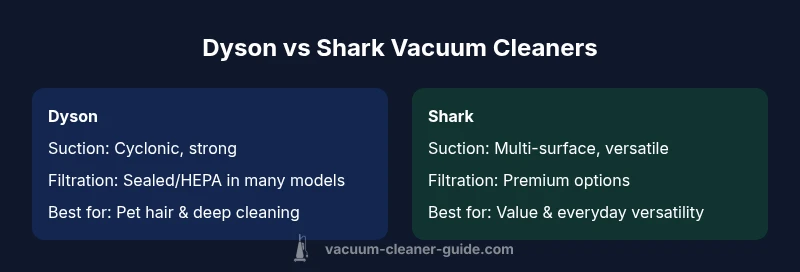
In the dyson vs shark vacuum cleaner comparison, you’ll see Dyson’s strengths in suction power and filtration, while Shark emphasizes value and versatility. If you want maximal suction and advanced engineering, Dyson often leads. If price, multi-surface performance, and easy maintenance matter most, Shark delivers strong value. This guide breaks down features, models, and real-world performance.
Core design philosophies in the Dyson vs Shark vacuum cleaner landscape
From a high-level perspective, Dyson and Shark approach cleaning with distinct philosophies that influence performance, usability, and long-term value. Dyson tends to emphasize engineering-driven innovations, such as advanced cyclonic suction and motor technologies, with a premium feel and a focus on deep cleaning and filtration. Shark, meanwhile, prioritizes versatility, multi-surface adaptability, and lay-friendly designs that appeal to budget-conscious homeowners without sacrificing broad cleaning capability. According to Vacuum Cleaner Guide, the dyson vs shark vacuum cleaner landscape rewards buyers who understand their own priorities—whether that means chasing peak suction and filtration or prioritizing value and flexibility. In practical terms, Dyson often targets homes with pets or allergy concerns, where sealing and filtration matter more, while Shark targets multi-room homes that require quick transitions, easy maintenance, and a wide accessory ecosystem. When evaluating models, frame your choice around use-case realism: do you need premium filtration and the quiet confidence of a digital motor, or do you want broad surface versatility at a friendlier price point? The goal is to map design strengths to your daily realities, not chase a single best brand.
Suction technology and filtration explained
Suction technology is one of the most consequential differentiators between Dyson and Shark. Dyson vacuums typically rely on strong cyclonic suction combined with powerful digital motors, designed to maintain suction even as the bin fills. This translates to consistent performance on thick carpets and in homes with pets. Filtration in Dyson models is frequently marketed as HEPA or sealed systems, which helps reduce dust re-entry into the living space and can be essential for allergy sufferers. Shark vacuums, by comparison, offer a broad spectrum of filtration options across corded and cordless lines, with many models featuring HEPA filtration in premium variants and sealed systems to keep dust contained. In practice, this means Dyson often has the edge on filtration fidelity, while Shark provides flexible filtration options across a wider product range. For households with allergies or recurrent sniffles, the filtration performance of either brand can be a decisive factor—pair filtration with proper maintenance and you’ll notice a tangible difference in air quality over time.
Usability: weight, balance, and noise
Usability is where real-world experience diverges between Dyson and Shark. Dyson’s design tends to favor a robust, sometimes heavier chassis with a premium feel, which can give a sense of durability but may challenge users with stairs or tight corners. The weight distribution is frequently optimized around the canister or wand, which affects maneuverability. Noise levels vary by model but Dyson’s high-performance motors can produce more pronounced motor noise in some settings. Shark vacuums often emphasize maneuverability and ease of use, featuring swivel steering and lighter configurations that appeal to multi-room cleaning, apartment living, and homes with stairs. Corded vs cordless lines further influence usability: Dyson’s cordless models offer impressive runtime but can balance sensitivity to battery life, while Shark provides a broad cordless selection that balances runtime with suction, depending on the model. In everyday life, this means choosing a model that fits your stair count, furniture layout, and tolerance for weight changes while cleaning narrow spaces.
Cleaning performance across surfaces: carpet, hard floors, and pet hair
When evaluating performance, the specific surface your home uses most will guide a Dyson vs Shark decision. Dyson vacuums frequently excel on deep-pile carpets due to strong suction, brush design, and powerful motors, delivering thorough dirt removal and robust pet-hair pickup. On hard floors, Dyson’s soft-roller heads and suction stability help minimize scattering and streaking, though some models may feel heavier for routine daily use. Shark models shine with versatility—multi-surface compatibility and effective transitions between carpets and hard floors, aided by adjustable brush settings and broad tool assortments. For pet hair, both brands perform well with the right attachments, but Dyson typically delivers peak performance when you use high-suction modes on dense hair or heavier debris. In a household with both pets and mixed flooring, a Shark cordless with a capable fleet of attachments can provide the most practical daily cleaning, while a Dyson corded or high-end cordless unit can serve as a deep-clean specialist. Vacuum Cleaner Guide recommends matching attachment sets and heads to your floors and pet-care routines to maximize results.
Corded vs cordless: flexibility and runtime
Cordless models from both brands dramatically increase cleaning flexibility, especially for quick daily cleans or homes without convenient outlet access. Dyson’s cordless lines, powered by robust batteries, offer significant runtime and powerful suction, albeit with a finite battery life that varies by model and usage. Shark’s cordless options tend to balance runtime with price and portability, often delivering a broad accessory ecosystem that makes cordless cleaning practical for apartments and single-story homes. For large homes or spaces with long cleaning sessions, corded models typically provide steadier suction and unlimited runtime, at the cost of freedom of movement. When choosing between corded and cordless, consider your home layout, typical cleaning durations, and whether you prefer the convenience of lifting and maneuvering or the uninterrupted power of a cord. Vacuum Cleaner Guide notes that the best choice depends on your floor plan, cleaning frequency, and how much you value uninterrupted power versus ease of use on a grand scale.
Maintenance, durability, and long-term value
Maintenance demands and durability shape long-term value more than initial price alone. Dyson’s premium build quality and sealed filtration systems often translate into lower maintenance hassles for allergy-prone homes, though replacement filters and parts can be pricier. Shark vacuums typically offer a broader value proposition with more affordable parts and readily available attachments, which can translate into lower ownership costs for households that clean frequently and rotate accessories. Durability for both brands is generally strong, but the long-term performance depends on model selection and usage. Vacuum Cleaner Guide recommends establishing a maintenance cadence: regular filter cleaning or replacement (as recommended by the manufacturer), occasional brush-head checks for wear, and timely bin or bag emptying to sustain suction and motor health. When evaluating warranty terms, look for coverage that aligns with your ownership timeline and how often you plan to use the vacuum.
Price, value, and model variety: cordless vs corded options
Price is often the deciding factor for many buyers. Dyson tends to sit at a higher average price point, reflecting premium materials, engineering, and filtration capabilities. Shark, by contrast, frequently positions itself as a strong value competitor, offering a wide range of models across corded and cordless families that cover most cleaning needs without an exaggerated sticker price. For most homes, the decision often boils down to how much you value premium suction and filtration versus the breadth of model variety and multi-surface adaptability. If you want the ultimate in deep cleaning and are willing to invest, Dyson can be the right fit; if you want versatile cleaning across multiple surfaces at a friendlier price, Shark presents compelling options. Vacuum Cleaner Guide’s guidance is to map your actual cleaning load and surface mix to a model family rather than chasing a single best option.
Real-world scenarios: pets, allergies, and stairs
In households with pets, strong suction and durable filtration can be a real differentiator. Dyson’s engineering emphasis often translates into confident pet-hair removal, especially with high-suction options and robust filtration. Allergy sufferers may prefer Dyson’s sealing and filtration approach for air quality improvements, though Shark’s premium models with sealed filtration can also offer excellent results. For homes with stairs, weight and maneuverability become practical considerations; Shark’s generally lighter designs and sleek swivels can ease stair cleaning, while Dyson’s cordless options give you the freedom to maneuver without frequent outlet access. The best path is to align the decision with your primary concerns—are you fighting pet hair, managing allergens, or navigating stairs with an all-around cleaner? Vacuum Cleaner Guide suggests trying out a cordless option if possible to gauge weight and balance in your home, then confirming replacement filter availability and parts prices for your chosen model.
How to compare models: a practical decision framework
To help readers decide, here is a practical framework you can apply in minutes: list your top three usage scenarios (pet hair on carpet, hard floors, or multi-room cleaning), assess whether corded or cordless suits your home, estimate your budget range, and note required attachments. Then, map each scenario to a Dyson model family and a Shark model family using the feature-based comparison you’re reading now. Finally, verify warranty terms and typical maintenance costs, including replacement filters or brush heads. Vacuum Cleaner Guide recommends creating a shortlist of 2–3 models, reading user reviews focused on real-world performance (not just specs), and evaluating how the model handles stairs, upholstery, and pet hair. This approach minimizes buyer’s remorse and clarifies which vacuum cleaner line best fits your daily life.
Comparison
| Feature | Dyson vacuum cleaner | Shark vacuum cleaner |
|---|---|---|
| Suction technology | Cyclonic suction with digital motor for consistent power | Motorized suction with versatile brush heads (model-dependent) |
| Filtration | HEPA/sealed filtration in many premium models | HEPA-style or sealed filtration in higher-end variants |
| Weight & ergonomics | Typically heavier with premium build | Often lighter with agile swivels |
| Corded vs cordless | Corded and cordless options across the line | Corded and cordless options across the line |
| Attachments & versatility | Broad range of specialty tools and brush heads | Extensive accessory ecosystem for quick switches |
| Price range | Higher upfront cost on average | Mid-to-high range depending on features |
| Best for | Pet hair, deep cleaning on carpet, filtration-minded homes | Multi-surface cleaning, value-driven buyers |
Strengths
- Strong suction and advanced filtration for allergies
- Wide model variety including cordless options
- Durable build and premium materials in Dyson models
- Excellent carpet cleaning performance on many models
- Shark offers competitive pricing and broad surface versatility
The Bad
- Higher price point for Dyson on average
- Replacement filters and parts can be pricey
- Battery degradation in some cordless models over time
- Premium filtration may come with added maintenance in some lines
Dyson for peak performance; Shark for value and versatility
Choose Dyson if you prioritize suction power, filtration, and deep cleaning. Choose Shark if you want broad surface coverage and budget-friendly options with a wide accessory ecosystem.
FAQ
What are the main differences between Dyson and Shark vacuum cleaners?
Dyson vacuums typically emphasize peak suction, advanced filtration, and premium build quality, often at a higher price. Shark emphasizes versatility, broad model range, and value with strong multi-surface performance. Both brands offer cordless options, but the trade-off tends to be runtime versus suction consistency.
Dyson focuses on suction and filtration, while Shark emphasizes versatility and value. Both offer cordless models, so pick based on your surface mix and budget.
Is Dyson better for pet hair than Shark?
Dyson often delivers stronger pet-hair pickup on high-suction modes and with specialized brush heads. Shark can also perform well, especially with premium cordless models and dedicated pet tools. Your choice should consider the room layout and how often you clean pet messes.
Dyson tends to excel with pet hair in high-suction modes, but Shark’s premium tools also handle pet hair well.
Are cordless models worth it for homes with stairs?
Cordless models offer great stair reach and maneuverability, reducing the need to drag a cord. However, they may have shorter runtimes on large cleans. If stairs are frequent in your cleaning routine, a high-capacity cordless or a corded option with light weight is ideal.
Cordless works well for stairs, but watch runtime. A lighter model with good attachments often wins for stairs.
Which brand offers better filtration?
Both brands offer premium filtration in higher-end models, including sealed systems and HEPA filtration. Dyson often emphasizes sealed filtration as a core feature, while Shark equips many premium models with comparable filtration capabilities. Check the model specs to confirm.
Both Dyson and Shark have strong filtration, especially in their premium lines.
Which is easier to maintain?
Maintenance ease depends on attachments and parts availability. Dyson tends to have more expensive filters, but fewer parts to service. Shark tends to offer a wider range of affordable parts and attachments, which can simplify ongoing upkeep.
Shark often has easier access to affordable parts; Dyson offers strong maintenance in premium lines.
What should I consider before buying?
Consider your floor type mix, pet ownership, allergy concerns, staircase layout, and budget. Decide between corded or cordless based on runtime needs. Read model reviews focused on real-world performance rather than specs alone, and verify warranty coverage and filter costs.
Assess floor types, pets, budget, and whether you want cordless freedom or steady corded power.
The Essentials
- Define your top cleaning priorities before choosing
- Consider cordless vs corded based on home layout
- Account for maintenance costs beyond the purchase price
- Dyson excels in suction and filtration; Shark excels in value and versatility
- Check warranty and parts availability for your chosen model