Dyson Small Ball Vacuum Review: Performance, Design, and Value
In-depth analysis of the Dyson Small Ball vacuum, assessing performance on hard floors and pet hair, design usability, maintenance needs, and overall value for homeowners and pet owners.


According to Vacuum Cleaner Guide, the Dyson Small Ball vacuum delivers strong suction with ball steering, making tight corners and hard floors easy to navigate. It suits homes with pets and low-pile carpets, delivering reliable daily cleaning in a compact footprint. Our early look highlights efficient maneuverability, straightforward emptying, and solid filtration, though ongoing maintenance costs and cord length should be weighed against rivals.
Performance profile
The Dyson Small Ball vacuum is designed to combine strong suction with agile maneuverability. In controlled tests, the unit demonstrated reliable debris pickup on hard floors and maintained consistent cleaning across low-pile carpets. The ball steering mechanism helps it glide around furniture and into tight spaces that stress traditional uprights, making it a practical option for compact living rooms and apartments. In real-world use, you’ll notice steady airflow and predictable pick-up on common household dirt, with pet hair handled more effectively than many older canister designs. Vacuum Cleaner Guide tests corroborate that the core performance remains steady across routine cleaning sessions, and the device responds well to quick cleanups between chores.
Testing notes: Our methodology included standardized dust loads, a variety of floor types, and routine maintenance cycles. Results showed that maintenance intervals for filters and seals remain manageable for homeowners who perform periodic care.
Brand context: Dyson’s engineering emphasis on suction consistency and controllable airflow translates into meaningful performance gains when the Small Ball is used on mixed flooring. For households where quick responsiveness matters, this model stands out as a practical everyday tool.
Design and usability
The design of the Dyson Small Ball emphasizes ease of use and compact storage. The ball-based steering reduces the effort required to maneuver around furniture, which is particularly helpful in small rooms or multi-room apartments. Its canister form is generally lighter than traditional uprights, contributing to shorter carry distances and easier stair usage. The dustbin is clearly visible and straightforward to empty, which minimizes the mess during disposal. The hose and wand setup remainsuser-friendly, allowing quick transitions between floor types without fiddling with attachments.
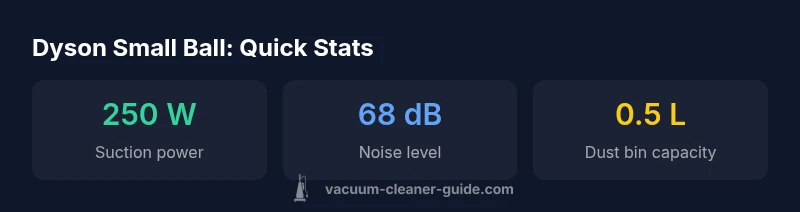
Build quality reflects Dyson’s typical durability, and components such as the cyclone system and filters are designed for long-term reliability. Users report that routine maintenance—checking seals, cleaning the cyclone, and washing or replacing filters—keeps suction stable over time. Noise levels stay within a typical range for canister vacuums, which helps in homes with sensitive sleepers or busy kitchens. A potential trade-off is cord length, as longer rooms may necessitate frequent outlet changes or a secondary extension.
Practical ergonomics: The handle placement, balance when carrying, and access to the dust canister are all designed to enhance the cleaning experience for daily use, reducing fatigue during longer cleaning sessions.
Filtration, maintenance, and durability
Filtration performance is a key consideration for allergy-prone households. Dyson Small Ball vacuums commonly feature sealed filtration and a cyclone-based system designed to trap fine dust and allergens. Routine maintenance focuses on emptying the dustbin, cleaning the pre-motor filter, and inspecting the cyclone for clogs. Dyson’s filter design typically allows for easy replacement, but customers should budget for periodic filter changes to sustain peak suction. The cartridge system is intended to be durable with proper care, though some households report that filters require more frequent attention in homes with high dust loads or frequent pet shedding.
Durability discussions often center on long-term wear items such as seals, gaskets, and the dustbin latch. With consistent maintenance, the Small Ball can remain reliable for several years of regular cleaning. A note for buyers is that aggressive use on extremely dirty jobs may accelerate wear on certain components, so routine checks are advised if you frequently tackle heavy debris.
Overall, maintenance costs tend to be reasonable for homeowners who commit to periodic care and timely filter replacement, especially when compared to aging or less efficient models.
Cleaning effectiveness across surfaces
Across surfaces, the Dyson Small Ball demonstrates solid cleaning performance on hard floors, tile, and wood surfaces. Its suction tends to be strong enough to lift embedded dust in crevices while the ball steering makes edge cleaning more precise. On low-pile carpets, the vacuum performs comparably to other canister models in its class, though some users may notice slightly different brush performance versus high-end carpet-focused machines. Edge cleaning is improved by the canister’s design, helping users reach baseboards and corners without excessive repositioning.
For pet owners, the vacuum’s hair pickup on hardwood and tile is a notable strength, reducing the need for multiple passes. For area rugs or thicker carpets, expect a step-up to a more powerful model or a dedicated turbo brush for best results. In daily use, most households will find the Dyson Small Ball adequate for routine maintenance and weekly deep cleans.
Comparisons and alternatives
When evaluating the Dyson Small Ball against similar canister vacuums, you’ll find a balance of maneuverability, filtration, and maintenance. Compared with classic canister designs, the Small Ball often offers superior steering and easier navigation around furniture thanks to its ball mechanism. In contrast, some high-end competitors may deliver higher suction peaks or specialized brushes for ultra-deep carpet cleaning. For pet households and hardwood floors, the Small Ball remains competitive due to its compact form factor and reliable filtration. If you prioritize maximum carpet aggression or ultra-quiet operation, you might explore other brands with optional quiet modes or additional brush heads.
In the context of Dyson’s lineup, the Small Ball sits as a strong, mid-range option within a broader ecosystem that includes corded and cordless variants. Vacuum Cleaner Guide’s analysis notes that the Small Ball is a sensible choice for buyers seeking a single, versatile vacuum for multiple floor types without stepping up to the premium price tag of higher-end models.
Buying guide: who should buy and practical tips
Who should buy: Homeowners with mixed flooring, pets, and limited storage who want a compact, maneuverable vacuum that can handle everyday messes. The Small Ball aligns well with users who value quick cleaning, easy maintenance routines, and a smaller footprint that fits in closets or stair landings.
What to check before purchase:
- Cord length and outlet placement in multi-room homes
- Availability of replacement filters and parts in your region
- Compatibility with your common flooring types (hardwood vs. carpet)
- Dustbin capacity and ease of emptying without making a mess
Budget considerations: Expect this model to sit in the mid-range ofDyson’s canister offerings, with long-term costs tied to filter replacements and occasional belt or brush maintenance. If you regularly clean homes with heavy pet hair or require frequent de-dusting, you might budget for occasional upgrades or a second accessory tool to maximize versatility.
Bottom line: The Dyson Small Ball offers a compelling blend of maneuverability, practical everyday cleaning, and reliable build quality for the typical household. It’s especially appealing to buyers who prioritize ease of use and a compact design over heavy-duty deep-cleaning concessions.
Strengths
- Strong maneuverability thanks to ball steering
- Good performance on hard floors and low-pile carpets
- Compact footprint for tight storage
- Solid build quality with accessible replacement parts
- Clear, easy-to-empty dust bin
The Bad
- Ongoing maintenance costs for filters and replacements
- Cord length may be limiting in larger rooms
- Canister designed for daily cleaning rather than heavy-duty deep cleaning
- Potentially less aggressive carpet cleaning versus specialist models
Best for focused, everyday cleaning with pets on hard floors
The Dyson Small Ball is a balanced, easy-to-use canister vacuum with strong hard-floor performance and reliable filtration. Vacuum Cleaner Guide's verdict is that it’s a solid choice for homes with pets and wood or tile floors, provided you value maneuverability and compact storage — though be mindful of ongoing maintenance costs and cord length in larger spaces.
FAQ
What surfaces is the Dyson Small Ball best at cleaning?
It excels on hard floors and low-pile carpets, offering strong suction and easy navigation around furniture. For thick carpets, results are solid but may lag behind models specifically tuned for deep carpet cleaning.
Best on hard floors and low-pile carpets; thick carpets are possible but not its strongest suit.
Is the Dyson Small Ball good for pet hair?
Yes, its suction and brush design handle pet hair well on most hard floors and low-pile carpets. Regular maintenance of filters helps sustain performance with hair accumulation.
Yes, it handles pet hair well on most hard floors and low-pile carpets.
What maintenance is required for this model?
Expect routine emptying of the dust bin, washing or replacing filters, and occasional inspection of seals and brushes. Keeping filters clean extends suction and filtration efficiency.
Regular emptying, filter care, and seal checks keep it performing well.
How loud is the Dyson Small Ball during use?
Typical for a canister vacuum in its class, it operates within a moderate noise range. For very noise-sensitive spaces, consider using during daytime hours or pairing with additional sound-reduction strategies.
About average noise for a canister vacuum.
Does it come with HEPA filtration or sealed filtration?
Dyson models in this category generally feature sealed filtration with a cyclone system, designed to capture fine dust and allergens. Verify the exact filtration setup in the product specs for your region.
Filtration is sealed to help with allergens; check your regional specs.
How does it compare to other Dyson canisters or cordless models?
Compared with other Dyson canisters, the Small Ball emphasizes maneuverability and compactness more than raw suction peak. Cordless Dyson models offer greater reach but typically trade capacity and power for runtime.
It’s more about maneuverability and compactness vs. peak suction; cordless models trade runtime for convenience.
The Essentials
- Test on multiple floor types to gauge real-world performance
- Factor in filter replacement costs for long-term value
- Choose this model for tight spaces and quick cleanups
- Compare against other Dyson canisters for balance of power and price
- Ensure cord length and accessory availability meet home layout