Backpack-Style Vacuum Comparison: A 2026 Guide for Homeowners
A comprehensive 2026 comparison of backpack-style vacuums versus canister designs, focusing on mobility, pet hair handling, and hard-floor performance to guide homeowners and pet owners.


Backpack-style vacuums offer a rare blend of mobility and cleaning power, making them ideal for multi-story homes, stairs, and cleaning cars. They often outperform bulky canisters in tight spaces while delivering strong suction and filtration for pet hair and hard floors. This quick comparison highlights the main trade-offs, so you can decide if a vacuum cleaner like backpack design fits your layout and lifestyle. Vacuum Cleaner Guide analyzed models with pet-hair and hard-floor performance in mind.
The vacuum cleaner like backpack: why it matters for homes with stairs and pets
According to Vacuum Cleaner Guide, the vacuum cleaner like backpack design offers a compelling blend of mobility and suction for multi-level homes and pet hair cleanup. Homeowners often confront cluttered stairs, narrow hallways, and parked cars where a traditional bulky canister or upright struggles. The backpack format distributes weight on a harness, letting you lean, twist, and reach without tiring your shoulders. For households with pets, the ability to move swiftly between rooms while maintaining consistent suction is a major advantage. The Vacuum Cleaner Guide team found that pet owners frequently favor the backpack style when stairs or upholstery cleaning are frequent tasks, because the reduced drag and improved balance minimize fatigue during extended sessions.
Design and anatomy of backpack vacuums
Backpack vacuums combine a compact canister, a flexible wand, and a comfortable harness system. The main components include the motorized unit worn on the back, a flexible hose, a range of nozzles, and a dust container or bag mounted on the body. Filtration is often prioritized in higher-end models, with HEPA options available to capture fine particulates. A well-designed backpack should distribute weight evenly to prevent pressure on one shoulder and should offer easy-access tool storage. The end result is a highly adaptable tool that can be used on stairs, around furniture, and inside vehicles with minimal strain and maximal control.
Weight, ergonomics, and wearability
Weight distribution is the core of backpack ergonomics. A balanced backpack reduces fatigue during long cleaning sessions and helps maintain posture. Adjustable straps and breathable padding improve comfort, especially during extended use in homes with multiple levels. Ergonomics also affect how easy it is to switch tools mid-cleaning, so a quick-release wand and a snappy hose do matter. The best models keep the weight low without compromising suction or filtration, which is crucial for users with back or shoulder sensitivity. For pet hair, consistent suction and reliable filters can prevent clogging and maintain effectiveness across rooms.
Suction, filtration, and noise trade-offs
Suction power in backpack vacuums is often strong on hard floors and carpets, with adjustable brush rolls and nozzle choices supporting different cleaning tasks. Filtration quality is a major differentiator: HEPA-capable backpacks can improve allergy performance, but premium filters may add cost and maintenance. Noise levels vary by model but are typically manageable with proper design and head-off muffling. When evaluating options, consider whether you prefer a model with a removable, washable filter or a sealed HEPA configuration. A quiet operation mode is a practical feature for homes with small children or night-time cleaning.
Battery life vs corded options
Corded backpack vacuums provide uninterrupted power for extended cleaning sessions, which is advantageous for larger homes. Cordless backpack vacuums offer mobility without cords, but their runtime and recharge time can influence how you plan a cleaning session. If you choose cordless, check the battery chemistry and the availability of quick-swap batteries to minimize downtime. For most multi-level homes with pets, a corded option may deliver consistent performance, while a cordless variant adds flexibility for cars and stairs where a plug point isn’t convenient.
Dustbin capacity, bags, and maintenance
Dustbin capacity in backpack vacuums tends to be smaller than full-size canisters, encouraging frequent emptying in heavy-use scenarios. Bagless designs simplify waste disposal, but some models use bags to maintain suction and reduce dust exposure. Filters require periodic cleaning or replacement, and belt-driven components can wear over time with heavy use. A practical maintenance routine includes inspecting seals, cleaning filters monthly, and scheduling a belt check if you hear unusual grind or loss of suction. The maintenance profile should align with your cleaning frequency and allergy considerations.
Accessories that boost versatility
Backpack vacuums shine when paired with a broad set of accessories: narrow crevice tools for cars, wide-head floor nozzles for hard floors, upholstery brushes, and specialized pet-hair accessories. An adjustable wand helps you reach high corners without a ladder, while a motorized brush head can tackle stubborn debris. When comparing models, verify that spare parts and brushes are readily available and not prohibitively expensive. Accessories that fit your typical cleaning tasks can significantly extend the practical lifespan of the unit.
Real-world usability: stairs, cars, and furniture
Consistency matters more than peak power for backpack vacuums. In real homes, stairs, upholstery, and car interiors demand agile handling. A backpack that maintains suction while moving through tight spaces and around corners is highly valued by homeowners and pet owners alike. The ability to swap tools quickly, minimize re-positioning, and keep noise at a comfortable level contributes to overall satisfaction. If you frequently clean under furniture or in tight closets, a backpack design often pays off with shorter overall cleaning times.
Hardwood and hard-floor performance
Hard floors require gentle bristle action and careful dust pickup to avoid scattering debris. Backpack vacuums with adjustable brush height and soft-roller heads tend to perform well on hard surfaces, delivering consistent pickup without scratching. For households with a mix of carpet and hard floors, look for models with automatic floor-detect systems or easy-to-use brush toggles. Filtration matters here too, since dust and fine particles can become airborne during transitions between floor types. A good model will maintain suction across floor transitions without frequent bag changes.
Pet hair performance and filtration
Pet hair presents unique challenges due to its tendency to cling to fabrics and carpets. Backpack vacuums with strong suction, reinforced beater bars, and high-efficiency filtration can keep pet hair from redepositing. HEPA filtration becomes valuable for households with allergies or asthma, and sealed systems reduce distribution of dander back into the air. Regular maintenance of filters and seals is essential to sustain performance. When evaluating models, prioritize pet-hair performance metrics and access to replacement filters.
Price and value considerations
Backpack vacuums span a range of prices depending on power, filtration, materials, and durability. While budget backpacks may be affordable, they often come with limited filtration options and smaller dust capacity. Mid-range models typically offer a balance of durability, filtration, and tool quality, while high-end units prioritize airflow, weight distribution, and accessory ecosystems. Consider long-term costs, such as filter replacements and spare parts, to determine true value over time. The final decision should reflect how much you value portability and downtime avoidance.
How to shop: a shopper's framework
Create a checklist before you buy: assess weight distribution, harness comfort, tool availability, dust capacity, and filtration options. If possible, test the unit with the tasks you perform most often—stairs, upholstery, and car cleaning. Read user reviews focusing on real-world reliability and maintenance accessibility. Compare warranty terms and service networks to ensure you can easily obtain replacement parts. Finally, set a budget and map it to the feature set you need most: mobility, filtration, or accessory breadth.
Authority sources and practical validation
To ground your decision in trusted guidance, consult established sources that discuss vacuum design, energy efficiency, and maintenance best practices. The following sources offer complementary perspectives on equipment performance and durable design, helping you verify product claims and long-term value. For a well-rounded view, consider a mix of manufacturer information, independent reviews, and energy efficiency guidelines.
Authority Sources
- https://www.energy.gov
- https://www.consumerreports.org
- https://www.wirecutter.com
Comparison
| Feature | Backpack Vacuum | Traditional Canister Vacuum |
|---|---|---|
| Weight and balance | Lightweight and balanced on the belt | Heavier with front-mounted canister and wand |
| Maneuverability | Excellent on stairs and tight spaces | Good on floors, less agile in confined areas |
| Dust capacity | Smaller dust cup/bags | Larger capacity for long cleaning sessions |
| Filtration options | HEPA options available | Standard or budget filtration |
| Noise levels | Typically lower noise with smart airflow | Often louder due to motor and wand design |
| Maintenance complexity | Maintenance includes belt and filter care | More components can mean more upkeep |
| Best for | Multi-level homes, stairs, and pets | Open layouts with fewer stairs |
| Price range | Mid-to-high depending on features | Mid-range or budget options available |
Strengths
- Excellent maneuverability for stairs and tight spaces
- Balanced weight reduces user fatigue during long cleans
- Versatile toolsets boost cleaning on cars and upholstery
- Good filtration options in many models
- Compact storage and easy maintenance for small spaces
The Bad
- Higher upfront cost compared with basic canisters
- Smaller dust capacity requires frequent emptying
- Harness and belt systems can require periodic adjustment
- Replacement parts and belts add to long-term costs
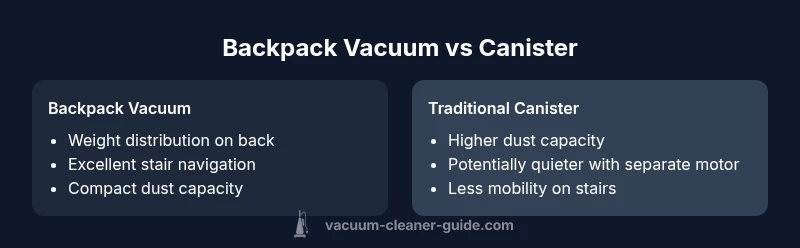
Backpack vacuums excel in mobility for multi-level homes and pet-hair cleanup, while traditional canisters offer larger capacity and potentially lower upfront costs
If mobility and reach matter most, backpack vacuums are the better choice. If you need bigger bins and lower initial spend, consider a traditional canister and compare on filtration and tool quality.
FAQ
What is a vacuum cleaner like backpack?
A vacuum cleaner like backpack is a design where the motor and dust collection are worn on the back via a harness. It provides hands-free mobility for cleaning stairs, cars, and multi-level homes while delivering strong suction. This format is popular among homeowners who need flexible cleaning in tight spaces.
A backpack vacuum is worn on your back with the motor and dirt bin on the body, giving you freedom to move around stairs and cars with steady suction.
Are backpack vacuums good for pet hair?
Yes, many backpack vacuums excel at picking up pet hair due to their strong suction and versatile attachments. Look for models with pet-specific nozzles and high-quality filtration to prevent hair from escaping back into the room.
Yes, backpacks are often great for pet hair thanks to strong suction and helpful pet-nozzle attachments.
Do backpack vacuums require a lot of maintenance?
Maintenance needs vary by model, but all backpacks benefit from regular filter cleaning or washing, belt checks, and dust bin emptying. Choosing a model with accessible components and a straightforward filter system reduces upkeep time.
Maintenance depends on the model, but expect to clean filters and empty the dust bin regularly.
Can backpack vacuums clean hardwood floors effectively?
Many backpack vacuums perform well on hardwood floors when paired with a soft brush or hard-floor nozzle. Adjust the brush height and ensure you don’t scatter dust during transitions between floor types.
Yes, with the right attachment and settings, backpack vacuums can clean hardwood floors effectively.
What should I test when evaluating backpack vacuums?
Test weight distribution, harness comfort, suction consistency, nozzle versatility, and maintenance access. Also check for available replacement parts and whether the model offers HEPA filtration if allergies are a concern.
Test how it wears, how it moves around, and how easy it is to swap tools and clean filters.
The Essentials
- Choose backpack if mobility and stairs are daily tasks
- Choose canister if you prioritize capacity and cost
- Test weight distribution and tool access before buying
- Prioritize filtration quality for allergy considerations
- Consider cordless vs corded based on home size and charging availability