Vacuum Cleaner Handheld: An Analytical Comparison
A rigorous, objective comparison of handheld vacuum cleaners versus full-size models, focusing on suction, runtime, portability, and best use cases for homes with pets. Designed for homeowners seeking practical buying guidance.


For homeowners who value speed and convenience, a vacuum cleaner handheld is ideal for quick spot-cleaning, stairs, and car interiors. It excels at portability and targeted tasks, while full-size vacuums perform better for deep cleaning and large-area coverage. This comparison highlights where handheld models shine and where they fall short, helping you choose the right tool for your home.
Understanding the vacuum cleaner handheld category
A vacuum cleaner handheld is a compact, portable cleaning tool designed for quick pickups and tight spaces. These devices are typically lightweight, cordless, and offer a range of nozzles to access car interiors, upholstery, stairs, and above-floor surfaces. The term covers a spectrum from bare-minimum pocket vacuums to more capable sticks with removable batteries. In practice, a handheld vacuum shines when you need speed and reach rather than sheer suction power. According to Vacuum Cleaner Guide, these models are especially valuable in homes with pets, where frequent small messes occur in cars and on furniture. The handheld format complements larger, full-size vacuums rather than replacing them, creating a two-tier cleaning strategy that keeps daily messes under control without lugging out a heavier machine. This section lays out where handhelds fit in a typical household toolkit and how to balance convenience with cleaning effectiveness.
Key design features that matter for handheld models
Choosing a vacuum cleaner handheld depends on a few core design elements. Weight and ergonomics determine how long you’ll actually use the tool without fatigue. Battery type and capacity drive runtime and charging speed, while nozzle variety affects how well you can tackle stairs, crevices, or upholstery. Filtration quality matters for allergy-prone households, with HEPA or high-efficiency filters catching fine particles. A well-rounded handheld generally includes a flexible wand or nozzle, a motorized brush for pet hair, and a washable filter to minimize ongoing costs. For pet owners, consider a model with a dedicated pet tool that loosens hair before suction. Finally, maintenance simplicity—how easy it is to empty the bin and clean filters—directly impacts long-term satisfaction and total cost of ownership. As you compare options, map these features to your usual messes and spaces.
Battery life, charging, and usage patterns
Powering a handheld vacuum reliably hinges on battery technology and capacity. Cordless handhelds typically rely on rechargeable lithium-based cells that balance weight and runtime. In real-world use, expect shorter runtimes for high-suction modes and longer durations when you switch to gentler settings. Charging times vary by model, with some units designed to quick-charge between brief cleanups and others capable of full-day battery maintenance. Because most homes don’t clean continuously for long sessions with a handheld, it’s common to alternate between quick top-offs and partial recharges. For pet owners and families with frequent messes, having a spare battery or a fast-charging option can dramatically improve overall cleaning efficiency. The right charge routine keeps your handheld ready for the next unexpected spill, spillover, or pet hair avalanche.
Suction power and filtration: what to look for
While handheld vacuums are not designed to rival full-size machines on sheer power, several models offer surprisingly strong suction for their size. Look for a motor with adequate amperage or wattage (described in product specs) and a well-designed air path that minimizes losses. Filtration matters: HEPA or multi-stage filtration helps reduce allergens released back into the room, which is particularly important for households with pets and allergy concerns. A sealed system that minimizes dust escape is a strong plus. Pay attention to the nozzle set; a motorized brush can be a game-changer for pet hair and embedded debris on fabrics, while crevice tools excel at cracks and edges. Maintenance should be straightforward: cleanable dustbins, washable filters, and easily accessible brushes minimize downtime and extend device life.
Cleaning scenarios: stairs, cars, and upholstery
Handheld vacuums excel in targeted cleaning tasks. Stairs benefit from compact form factors and precise nozzles that reach between steps. Car interiors demand slim profiles, long crevice tools, and noise levels that won’t startle passengers. Upholstery responds well to motorized brushes and soft dusting tools that lift hair without damaging fabric. In each scenario, the handheld’s virtue is its immediacy: you can grab it, snap on the right tool, and finish the job without dragging a larger appliance into the room. For most households, a handheld serves as a first responder to messes that would otherwise linger, while the primary cleaning work is handled by a full-size vacuum on a less frequent basis.
Maintenance and parts: filters, brushes, and dustbins
Low-maintenance operation is a major selling point for handheld vacuums. Regular tasks include emptying the bin, washing or replacing filters, and removing hair from brushes. A washable filter reduces ongoing cost while preserving suction. Some models use disposable filters that must be replaced periodically; others rely on reusable prefilters that extend usage between cleanings. Brushes can become entangled with hair, so routine detangling is essential to prevent performance drop. Spare parts availability—filters, brushes, and replacement batteries—varies by brand and model, so it’s wise to select a unit with a robust aftermarket supply. This upkeep becomes part of your lifecycle cost, so factor it into your overall value assessment when comparing handheld options.
Handheld vs full-size vs stick vs robot: where handheld fits
The handheld form factor sits at the intersection of convenience and capability. Compared with full-size uprights or canisters, handhelds deliver unmatched portability and rapid response for small messes. Against stick vacuum cleaners, they often offer similar portability but with a different balance of runtime and suction; some sticks are designed to be easily converted into handhelds, while others are purpose-built for handheld-only use. Robot vacuums and corded vacuums address other cleaning needs, but they rarely replace the specialized action of a handheld on stairs or in a car. The practical takeaway is that handheld vacuums are best used as quick-clean specialists that pair with larger machines for comprehensive floor care. Depending on your floor plan, pets, and daily mess patterns, you may benefit from both approaches.
How to choose: decision criteria by user profile
Different households demand different handheld capabilities. Pet owners should prioritize strong hair pick-up, an efficient filtration system, and durable pet tools. Families with children may need easy-empty bins and straightforward maintenance. Busy homeowners often favor quick-charge options and lightweight designs that minimize cleanup time. If you frequently clean cars or upholstery, look for a slim profile, versatile nozzles, and a flexible wand. For allergy-prone homes, prioritize sealed filtration and washable components. Finally, consider overall value: price, life cycle costs, and warranty coverage. The best path is to map your typical mess types to the features described above and choose a handheld that aligns with your most common use cases.
Durability and warranty: buying for pets and households
Durability matters when pets are involved, as claws, fur, and spills can push a handheld to its limits. A sturdy construction, reinforced housings, and reliable hinge points contribute to longevity. Warranty length is a practical indicator of confidence from the manufacturer; longer warranties usually reflect better build quality and support. For pet-friendly homes, confirm that replacement parts—the filters, motors, and brushes—are readily available and affordable. Reading customer reviews that focus on long-term reliability can help you gauge how a model performs after months of daily use. In short, a handheld that feels light and flimsy may still work for occasional cleaning, but for ongoing pet-related messes, prioritize durability and a robust service network.
Real-world testing paradigms: pet owners and heavy messes
In real-world tests, handheld vacuums should be evaluated across multiple everyday scenarios: quick kitchen spills, pet hair on furniture, car interiors, and stairway debris. Hands-on trials reveal how quickly a unit picks up hair, dust, and grit, how easy it is to switch nozzles, and how comfortable it is to hold during longer cleaning sessions. For pet owners, stress tests with hair meant to cling to fabrics provide insight into filtration effectiveness and brush design. In consumer reports and independent reviews, the best-performing handhelds deliver consistent suction with minimal clogging, remain comfortable over long periods, and offer dependable charging and bin-emptying experiences. These practical tests help translate specifications into real-world performance.
Price, value, and lifecycle costs
Handheld vacuums cover a broad price range, and value often depends on your expected use. In the short term, lower upfront costs may be attractive, but ongoing maintenance—filters, brushes, and potential battery replacements—adds to total cost of ownership. Mid-range handhelds typically balance cost and capability, offering decent suction and good filtration without the premium price tag. Premium models may deliver stronger motor performance, longer runtimes, and more durable construction, but they come at a higher price and potentially greater parts costs. For homes with pets or children, investing in a model with robust filtration and easily replaceable parts can reduce long-term irritation and maintenance headaches. When in doubt, align your choice with the expected frequency of use, the spaces you clean most often, and your tolerance for maintenance chores.
What Vacuum Cleaner Guide recommends after testing handhelds
Based on Vacuum Cleaner Guide Analysis, 2026, our team emphasizes pairing a handheld vacuum with a capable full-size model for complete home coverage. For quick spot cleaning, stairs, and cars, a handheld is an excellent first line of defense. We recommend focusing on models with strong filtration, a diverse nozzle set, and practical maintenance routines. When evaluating candidates, look for a balance between portability and performance, and consider how replacement parts and battery life will influence long-term value. The verdict is guided by real-world testing, user needs, and the practical realities of everyday cleaning. See our detailed comparison table for a side-by-side view of handhelds versus full-size vacuums.
Comparison
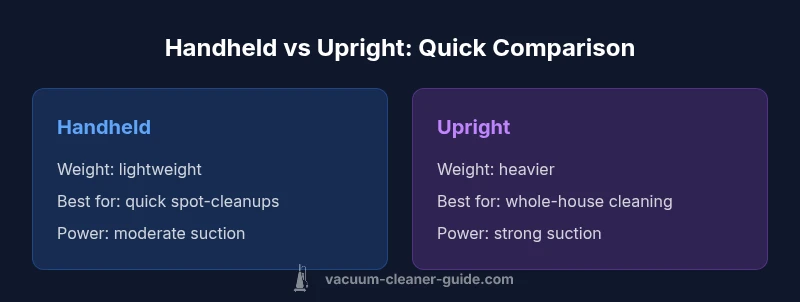
| Feature | vacuum cleaner handheld | upright vacuum (full-size) |
|---|---|---|
| Suction and cleaning power | moderate | high |
| Run time / power source | cordless, battery-powered | corded, continuous power |
| Weight & portability | lightweight, highly portable | heavier, more stable in large spaces |
| Best use-case | spot-cleaning, stairs, cars | whole-house cleaning and deep carpet/pile work |
| Maintenance costs | regular filter maintenance and occasional battery care | generally lower per-use maintenance but higher upfront cost |
Strengths
- Extreme portability enables quick cleanup anywhere
- No cords to manage, ideal for stairs and cars
- Wide nozzle assortment improves versatility
- Easy storage with small footprint
- Typically easier to service and upgrade parts
The Bad
- Suction and runtime are generally lower than full-size vacuums
- Battery quality degrades over time affecting performance
- Dust capacity is smaller, requiring more frequent emptying
- Fewer deep-cleaning capabilities for dense carpets
Handheld vacuums excel at quick, targeted cleaning; full-size vacuums win for overall deep cleaning.
Choose a handheld for quick spots and tight spaces. Add a full-size vacuum for regular, thorough cleaning to cover all floors and heavy messes.
FAQ
What is the main advantage of a vacuum cleaner handheld?
The primary benefit is portability. Handheld vacuums provide instant access to spills, stairs, and car interiors without dragging a larger machine around the house.
The main advantage is portability, giving you instant access to spills and tight spaces without dragging a big vacuum around.
Can handheld vacuums handle pet hair well?
Many handheld models perform well on pet hair with motorized brushes and good filtration. For heavy shedding, pairing with a full-size vacuum often yields the best results.
Many handhelds handle pet hair well with the right nozzle, but for heavy shedding a full-size vacuum works better.
Are handheld vacuums cordless?
Most handheld vacuums are cordless, relying on rechargeable batteries. Some models exist as corded variants, but cordless options are far more common for portability.
Most handhelds are cordless and battery-powered, though there are some corded options.
Is a handheld vacuum worth it if I already own an upright?
Yes, as a quick responder tool for spills and tight spots. It complements an upright by handling tasks the larger machine isn’t convenient for.
Absolutely—handhelds shine for quick spill cleanups and tight spots that uprights can’t reach.
How should I maintain my handheld vacuum?
Empty the dustbin regularly, wash or replace filters as recommended, and remove hair from brushes. Keeping seals intact helps preserve suction.
Empty the bin, clean filters, and clear hair from brushes regularly.
What features matter most for allergy-prone homes?
A sealed filtration system (HEPA or equivalent) and washable filters help minimize dust and allergens recirculating into the room.
Look for sealed filtration and washable parts to minimize allergens.
The Essentials
- Prioritize quick-clean tasks when selecting handhelds
- Balance portability with filtration quality
- Pair handhelds with a full-size vacuum for complete coverage
- Consider battery life and parts availability
- Choose models with versatile nozzle tools for pet hair and upholstery