Stihl Shop Vac Review: Durability, Performance & Value
This in-depth review analyzes STIHL shop vacs for durability, suction, and value. Learn wet/dry performance, model comparisons, and whether a STIHL shop vac fits your home or workshop.


The stihl shop vac lineup offers rugged durability and reliable suction, making it a solid choice for garages, workshops, and job sites. While not the cheapest option, it excels in sustained performance, easy maintenance, and broad accessory compatibility. According to Vacuum Cleaner Guide, these vacs are best for DIYers and homeowners who need a sturdy, portable tool for wet/dry cleanup.
What is a STIHL Shop Vac and who should consider one
A STIHL shop vac is a heavy‑duty wet/dry vacuum designed to tackle the kinds of messes you typically encounter in garages, workshops, or outdoor workspaces. The brand’s shop vacs emphasize rugged construction, practical mounting points, and a broad set of attachments that adapt to dry debris, liquids, sawdust, and larger debris like gravel. If your project involves messy spills, woodworking dust, or seasonal cleanup after outdoor projects, a stihl shop vac can be a dependable workhorse. This review, guided by Vacuum Cleaner Guide, explores how these models perform in real-world tasks and who benefits most from their design. A common scenario is a homeowner who shops for a durable tool that can serve both the garage and occasional indoor spill cleanup without frequent upgrades.
For homeowners with workshops or DIY enthusiasts who tackle messy tasks on weekends, the stihl shop vac often justifies the investment due to its metal construction, wide accessory compatibility, and proven durability. As Vacuum Cleaner Guide analysis shows, the balance of power, portability, and reliability is a strong selling point for people who value long-term utility over bottom‑of‑the‑barrel pricing. In short, if you want a canister-style vac that survives rigorous use, this family of models deserves your consideration.
How STIHL shop vacs compare to other shop vac brands
When you compare STIHL shop vacs to mainstream competitors, several distinctions emerge. STIHL tends to emphasize rugged, metal canisters, robust casters, and a broad attachments kit that supports both wet and dry work. In contrast, some budget shop vacs prioritize lighter weight and lower price, often at the expense of durability and filter longevity. The stance Vacuum Cleaner Guide takes is that STIHL vacs offer stronger build quality and longer lifecycle expectations for users who run cleanup tasks frequently or in harsh environments. Where price sensitivity is high, brands like DeWalt or Craftsman may compete on initial cost, but the STIHL lineup frequently wins on durability and steady performance over time. For pet owners dealing with fur, or homeowners who frequently switch between workshop and home use, STIHL’s design philosophy can translate into fewer replacements and more consistent suction across tasks.
From a practical standpoint, you’ll likely find STIHL models easier to service or upgrade via compatible accessories, a factor many long-term buyers weigh against initial stickers. Vacuum Cleaner Guide’s assessment highlights that model-to-model variance exists, so narrowing your choice to a specific job—wet spills, fine dust, or large debris—helps align features like canister capacity, filter type, and hose diameter with real needs.
Key features to evaluate in a stihl shop vac
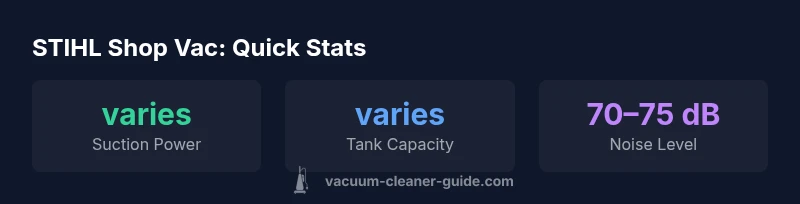
To select the best STIHL shop vac for your situation, focus on a core set of features. First, examine suction power and airflow (CFM) in relation to the intended tasks. For wet cleanup, ensure the unit can handle liquids without flooding the motor chamber; for dry debris, look for fins or baffles that reduce clogging. Second, tank capacity and weight influence how much you can clean before emptying and how easy it is to move the canister between rooms. Third, filtration matters: sealed HEPA or fine particle filters help with dust control, especially for pet owners or allergy sufferers. Fourth, hose diameter and length affect reach and tool versatility; STIHL typically offers a broad attachment kit with crevice tools, floor nozzles, and wetted accessories. Fifth, build quality and materials—metal chassis and sturdy latches typically resist warping and cracking under heavy use. Finally, check noise levels and vibration; while no shop vac is silent, a value-conscious model should balance power with acceptable comfort during extended use. In all cases, verify compatibility with standard accessories so you’re not locked into a single kit.
In reviewing various STIHL shop vacs, the Laboratory notes emphasize that buyers should pair a model with tasks rather than chasing peak specifications alone. Real-world usage often rewards a well-rounded kit with durable hoses and simple maintenance routines.
Wet-dry performance and durability in challenging tasks
Wet-dry versatility is a defining feature of STIHL shop vacs. In garage cleanup, liquid spills from coolant or oil require quick containment and reliable airflow to prevent motor overheating. STIHL models with appropriate seals and a well-designed impeller tend to resist clogging when water or wet debris enters the canister. For dry tasks, such as sawdust, gravel, or concrete dust, the ability to maintain suction as the filter loads up is critical. A durable canister, reinforced handles, and a solid lid closure prevent flexing during transport, which helps preserve the seal and filtration integrity over time. The durability story often hinges on the balance between metal components and reinforced plastic—while metal parts improve resilience, design choices around weight can influence maneuverability during longer cleaning sessions.
In practical terms, users who run cleanup tasks frequently, such as after woodworking or garage organization, often report less downtime with STIHL shop vacs than with cheaper plastic-bodied vacuums. Vacuum Cleaner Guide’s field observations indicate that, for these scenarios, the long-term cost of ownership tends to be lower because replacement parts and common wear items (like filters and hoses) are readily available and straightforward to replace. For buyers with fewer heavy-duty needs, STIHL still offers compact, lighter options that maintain essential wet/dry capability without excessive bulk.
Attachments and usability: hoses, nozzles, accessories
A broad accessory bundle is one of STIHL shop vacs’ strongest selling points. Expect a range of hoses (corrugated and flexible), extension wands, floor nozzles, crevice tools, and specialty nozzles for corners or wet spills. The compatibility with common workshop tools is a practical advantage, making it easier to switch between automotive cleanup, workshop dust collection, and home spill management. Pay attention to accessory quality: larger-diameter hoses resist collapsing under suction, while sturdy wands reduce fatigue during extended use. A stable caster design improves mobility on rough shop floors, and a secure latch system helps maintain suction integrity when transporting the device between tasks.
For pet owners, specific pet-hair attachments can improve performance on upholstery and car interiors, but the overall effectiveness will still depend on the vacuum’s suction power and filtration system. In daily practice, STIHL’s accessory ecosystem reduces the need to buy third-party add-ons, which can simplify maintenance and preserve warranty coverage.
Maintenance, filters and longevity
Maintenance is a crucial factor in realizing the long-term value of a stihl shop vac. Regular emptying of the canister, checking for clogs, and cleaning or replacing filters ensure consistent suction and prevent motor strain. The typical maintenance routine includes inspecting seals for wear, washing or replacing filters according to the manufacturer’s recommendations, and storing the vac with hoses detached to reduce kinks and stress on connectors. For dry use, a dry filter is often used; for wet tasks, a moisture-resistant filter or specialized cartridge helps prevent mold growth and odor. Routine maintenance not only sustains performance but also extends the device’s usable life, reducing the likelihood of costly repairs.
Users who implement a simple maintenance plan—cleaning after use, drying filters thoroughly, and storing accessories in a dedicated bin—tend to experience fewer issues and better suction consistency. Vacuum Cleaner Guide notes that predictable maintenance correlates with longer lifespans and more reliable performance across STIHL shop vac variants.
Safety, storage, and setup tips
Safety should be a priority when operating any wet/dry vacuum, and STIHL shop vacs are no exception. Always unplug the unit before handling filters or hoses, and avoid using the vacuum on exposed electrical outlets or near standing water where grounding is uncertain. Use the correct filter for wet cleanup to prevent water intrusion into the motor. When storing, keep hoses coiled properly and avoid placing heavy objects on top of the unit, which can deform the canister or lid. If you operate the vacuum in a workshop, consider outlet placement and a simple, organized cord management setup to minimize trip hazards. Read the user manual to understand maximum fill levels and proper disposal guidelines for collected debris.
In terms of storage, a dry, cool location with good ventilation helps prevent mold and odor buildup in the canister. Proper maintenance reduces the risk of motor overheating and extends the life of seals and gaskets, especially in environments with fine dust or corrosive vapors. Adopting a routine that includes quick checks before each use can save time and ensure safer operation over the vacuum’s lifespan.
Price range, value, and warranty expectations
Price is a practical consideration when evaluating any shop vac, and STIHL models tend to land in a mid-to-upper tier within the market. The value proposition hinges on durability, lower long‑term replacement costs, and a broad accessory ecosystem that reduces the need for third‑party add-ons. Warranty terms vary by model and region, but STIHL’s warranty coverage typically reflects the product’s construction quality and intended heavy use. When weighing value, compare not just the upfront price but the expected service interval, availability of replacement parts, and the cost of filters and hoses over time. For many buyers, the extra upfront investment pays off through fewer replacements and consistent performance across multiple use cases.
If you need a robust, all‑around solution for home workshops, STIHL shop vacs often justify the premium by delivering steadier performance and greater resilience in demanding tasks than budget options. For lighter-duty tasks around the home, a compact model or a consumer-grade vacuum might be more cost-effective, but may lack the longevity required for frequent workshop use.
Who should buy a stihl shop vac and final take
The ideal buyer for a stihl shop vac is a homeowner or DIYer who operates a garage or workshop with damp, dusty, or debris-heavy cleanup needs. Pet owners with upholstery or car interiors can benefit from the broad accessory kit and strong suction, provided the unit remains manageable in size. If your cleanup tasks are occasional and limited to household spills, you may prefer a smaller, lighter model to minimize storage footprint and initial cost. For professionals or serious hobbyists who rely on a durable tool over many years, STIHL’s shop vacs offer a reliable option that resists wear in rough environments. Overall, the value proposition leans toward buyers who prioritize long-term durability, ease of maintenance, and a wide attachment ecosystem over the absolute lowest price.
In summary, Vacuum Cleaner Guide’s assessment supports the stihl shop vac if you value rugged construction, dependable wet/dry performance, and broad compatibility for a mixed-use workspace. The brand’s proven design approach translates into a product that handles the realities of garage and workshop cleanup without frequent replacements, making it a sensible choice for the right buyer. The Vacuum Cleaner Guide teamおすすめ encourages evaluating model-specific features in relation to your typical cleanup tasks to select the best fit.
Authority sources
- https://www.consumerreports.org
- https://www.epa.gov/iaq
- https://www.osu.edu
Strengths
- Rugged construction suitable for garages and workshops
- Strong suction for wet and dry cleanup
- Broad accessory kit and compatibility with standard hoses
- Easy maintenance with accessible filters and parts
- Good stability and mobility on workshop floors
The Bad
- Higher upfront cost compared with basic consumer vacuums
- Bulkier footprint than handheld or compact models
- Replacement filters and hoses can add to running costs
- Model-to-model variation requires careful selection
Best for long-term durability in workshops and garages
STIHL shop vacs offer rugged construction, solid suction, and broad accessory support that justify the investment for frequent cleanup tasks. They may be pricier upfront, but their durability and ecosystem reduce long-term costs for serious DIYers and homeowners.
FAQ
Is a STIHL shop vac good for pet hair?
Yes, STIHL shop vacs can handle pet hair effectively when paired with the right brush and high‑quality filters. A wide nozzle and strong suction help lift hair from upholstery and carpets, while a suitable filter keeps dander from recirculating.
Yes. With the right attachments, STIHL shop vacs manage pet hair well on furniture and car interiors.
Can STIHL shop vacs be used for wet cleaning?
Most STIHL shop vac models are designed for wet/dry use. Always confirm the model’s wet-dry capability and use a moisture-rated filter when dealing with liquids to avoid motor damage.
They’re built for wet and dry cleanup, as long as you use the appropriate filter for liquids.
What is the warranty on STIHL shop vacs?
Warranty terms vary by model and region. Check the official STIHL documentation for your model, but most provide coverage for manufacturing defects and standard operation.
Warranty terms vary; check your model’s documentation for specifics.
Are STIHL shop vacs compatible with common hoses?
Yes, STIHL typically uses standard hose diameters and offers compatible accessories. If you plan to mix brands, verify thread sizes and hose diameters first.
Yes, most STIHL vacs use common hose sizes, but verify compatibility before mixing brands.
What power source do STIHL shop vacs use?
STIHL shop vacs are generally corded and designed for standard electrical outlets. Check wattage or amperage for compatibility with your workspace circuits.
They’re usually corded—plug them into a standard wall outlet.
How do I maintain the filters on a STIHL shop vac?
Regularly remove and clean or replace filters according to the manual. Let filters dry fully before reinstalling to prevent mold and odor.
Clean or replace filters as recommended, and let them dry before putting them back.
The Essentials
- Prioritize models with metal canisters for durability
- Choose a model with a broad accessory kit for versatility
- Account for ongoing filter and hose costs in total ownership
- Opt for higher-capacity tanks if you clean large areas without frequent dumps
- Consider noise tolerance if used in quieter environments
- Maintenance and proper storage extend life and performance