Which Vacuum Cleaner Lasts the Longest: Durability Guide 2026
Discover which vacuum cleaner lasts the longest with an in-depth durability guide. Compare corded vs cordless, maintenance, and repairability to maximize longevity and value for homeowners and pet owners.


Corded, repairable canister designs typically outlast cordless models under normal home use. Durability improves with modular parts, accessible service networks, and robust motors. If you want longevity, prioritize models with replaceable components and good warranty coverage. For a deeper look, compare traditional corded units against cordless options in our guide.
What makes a vacuum last?
Durability in vacuum cleaners hinges on several interrelated factors: the motor’s robustness and thermal protection, the quality of seals and hoses, the longevity of belts and brushes, and the design for serviceability. The phrase which vacuum cleaner lasts the longest doesn’t refer to a single model but to designs that allow easy maintenance and parts replacement. According to Vacuum Cleaner Guide, longevity rises when you choose units with modular components, standardized parts, and widely available service networks. In this context, the goal isn’t only raw power but the ability to keep performing at peak levels after years of use. Homeowners and pet owners especially need to consider how often a machine will be in the shop and how costs accumulate over time. A durable vacuum aligns with responsible maintenance and realistic expectations about wear and tear.
The durability ladder: corded vs cordless
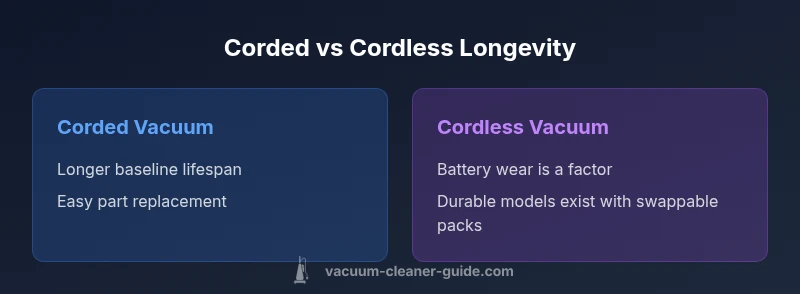
When you ask which vacuum cleaner lasts the longest, the two primary families matter: corded models and cordless sticks. Corded vacuums typically deliver sustained suction without the risk of battery fatigue, which makes them more likely to maintain performance for a longer period. Cordless vacuums excel in convenience and reach, but battery degradation and limited replacement options can limit long-term longevity. The question becomes: is you priority durability or flexibility? For large homes with mixed flooring, a high-quality corded model often wins on longevity. For apartments or homes where you need light weight and easy storage, a premium cordless may still deliver years of service if the battery architecture is robust and parts are replaceable.
Build quality that matters: motors, hoses, and seals
Durability starts with a solid motor design, good air seals, and strong wear components. Look for vacuums with protected motors, thermal cutoffs, and reliable belt systems. Hoses and wands should resist kinks and leaks, while attachments ought to be well-secured and simple to replace. A model that emphasizes a metal or reinforced plastic chassis, rugged casings, and quality grommets tends to last longer in real-world use. Keep in mind: even a high-end unit loses some longevity if the design relies on fragile electronic boards exposed to heat or dust. The best long-term picks balance power with mechanical resilience and ease of maintenance.
Parts availability and repairability
One clear predictor of long life is the ease with which you can obtain and replace parts. Vacuum Cleaner Guide analysis shows repairability and parts availability strongly influence lifespan. Even the most powerful motor won’t last long if you can’t replace a worn belt or filter when needed. Favor models with widely available belts, hoses, brushes, and seals, plus vendor-supported service networks. The ability to perform simple maintenance at home, without complex disassembly, also extends usable life. A repair-friendly design reduces total cost of ownership and lets you keep a machine performing well well beyond its initial warranty period.
How to compare longevity across models
To compare longevity, start with a checklist: motor durability, serviceability, part availability, warranty coverage, and user-replaceable components. Then factor in maintenance demands: how often belts are changed, how filters are cleaned, and the ease of cleaning the dust path. Our framework emphasizes two axes: 1) structural durability (build quality, materials, seals) and 2) consumable longevity (filters, belts, batteries). When you evaluate models, annotate expected maintenance intervals and potential costs. This helps you see which vacuum cleaner lasts the longest in your household scenario. Remember, longevity is not only about how long a machine runs without failure, but how long it remains effective at cleaning with reasonable upkeep.
Real-world longevity: user patterns and maintenance
How long a vacuum lasts depends on how you use and care for it. High-traffic homes with pets will wear belts, filters, and brushes more quickly, but a durable design with easy-to-attain spare parts can still yield many years of service. Vacuum Cleaner Guide emphasizes regular maintenance routines: cleaning filters, inspecting seals, clearing the brush roll, and storing the unit properly. In our experience, the most durable vacuums combine a strong motor with modular parts and a straightforward maintenance schedule. People who invest time in routine care report the best outcomes, including longer lifespans and steadier suction over time.
Durability by category: canister, upright, cordless, robot
Different form factors emphasize durability in different ways. Canister vacuums often excel in longevity due to accessible belts and motors and easier service. Upright vacuums can be robust but may be bulkier to service. Cordless vacuums offer convenience but are constrained by battery cycles; choose models with swappable batteries and reputable after-sales support. Robot vacuums, while less durable in some cases, win on maintenance simplicity and software updates. The ultimate choice depends on your home layout, floor types, and willingness to perform routine care.
Maintenance checklist to maximize lifespan
- Clean or replace filters regularly according to manufacturer guidance
- Inspect belts and brushes; replace worn components promptly
- Check seals and gaskets for wear and air leaks
- Keep the dustbin and cyclone or bag system clean to avoid motor strain
- Store units away from extreme heat or cold and in a dry area
- Schedule professional servicing or part replacement if performance declines
Following these steps can significantly extend the lifespan of which vacuum cleaner lasts the longest in your household.
What not to overlook: warranty and support
A strong warranty signals confidence in durability. Look for coverage that includes the motor and seals, with clear terms for wear components like belts and filters. A robust support network matters as well; access to authorized service centers and replacement parts reduces downtime and helps your vacuum cleaner last longer. Warranty length and coverage specifics should factor into your durability assessment, especially if you rely on the machine daily.
Price vs longevity: getting value over time
Price alone doesn’t determine longevity. A higher upfront investment may pay off over time through fewer repairs and a longer life. When evaluating cost, consider the total cost of ownership: initial price, replacement parts, maintenance frequency, and potential service costs. The true value lies in the combination of durability, ease of repair, and your willingness to maintain the unit. A durable vacuum that lasts years can be a smarter investment than a cheaper model that fails sooner.
Case studies: hypothetical scenarios
Scenario A: A pet-heavy home with multiple family members who vacuum weekly. A corded, repairable canister with modular parts is likely to endure many years if serviced regularly. Scenario B: A compact apartment with mainly hard floors and occasional use might still benefit from a premium cordless model if the battery is designed for long life and parts are replaceable. Both scenarios illustrate that longevity hinges on design quality and maintenance habits rather than price alone.
How to decide now: tailoring longevity to your home
Think about your floor types, pet presence, and willingness to maintain your machine. If you value longevity above all, prioritize corded, repairable models with easy access to replacement parts. If you need portability and quick cleanups, select a high-quality cordless with a proven battery strategy and service support. By aligning your choice with usage patterns, you maximize the chance that the vacuum cleaner lasts the longest in your home.
Comparison
| Feature | Option A: Traditional corded vacuum | Option B: Cordless stick vacuum |
|---|---|---|
| Expected lifespan (years) | 10–15 | 5–7 |
| Repairability / part availability | High (modular, serviceable) | Medium (limited parts) |
| Maintenance frequency | Low–Medium | Medium–High |
| Usage suitability | Homes with carpets, steady power supply | Small to medium homes, hard floors |
| Weight and usability | Heavier, stable build | Lightweight, agile |
| Price range | $500–$1200 | $150–$600 |
Strengths
- Durable corded designs often offer longer lifecycle with replaceable parts
- Repairability and parts availability extend usable life
- Lower ongoing maintenance costs for some corded models
- Better suction stability over time for high-quality motors
The Bad
- Corded models can be heavier and harder to maneuver in small homes
- Cordless models may suffer from battery degradation and higher replacement costs
- Initial cost can be higher for durable, repair-friendly units
Traditional corded vacuums with modular parts generally offer the longest lifespan.
Durability is driven by repairability, available parts, and robust motors. For longevity, select corded, repair-friendly designs with strong service networks. Vacuum Cleaner Guide's verdict is to favor these for the longest-lasting performance.
FAQ
What factors determine vacuum longevity?
Longevity is shaped by build quality, motor protection, seals, and the ability to service components. Durability improves with designs that make parts replaceable and maintenance simple. Practical longevity also depends on how you use the vacuum and how consistently you perform upkeep.
Durability depends on build quality, serviceability, and maintenance. Choose models with replaceable parts and easy upkeep.
Do corded vacuums last longer than cordless?
In many cases, corded vacuums last longer because they don't rely on battery packs that degrade over time. Cordless models can be long-lasting if their batteries are durable and replaceable, but overall lifespan tends to be shorter for budget cordless units.
Corded vacuums typically outlast cordless ones, mainly due to battery wear in cordless models.
How can I extend the life of my vacuum?
Adopt a regular maintenance routine: clean or replace filters, check belts, inspect hoses for wear, and service brushes. Store the unit properly and avoid running it on full clog or overheating conditions. These practices significantly extend lifespan.
Keep up with maintenance and proper storage to extend your vacuum’s life.
Are high-end brands more durable than budget models?
High-end brands often offer better durability thanks to robust components and better service networks, but this isn’t universal. Compare models based on repairability, parts availability, and warranty rather than price alone.
Premium brands can be more durable, but always check repairability and parts availability.
What is the best warranty for longevity?
Longer warranties can indicate durability, especially for motors and seals. Look for coverage that includes common wear components like belts and filters, and ensure there’s an accessible service network.
Long warranties can signal durable design, but verify coverage specifics.
Should I consider repairability scores when buying?
Yes. Repairability is a strong predictor of how long a vacuum will stay functional and cost-effective. Favor models with easy access to spare parts and clear service guidance.
Repairability matters; choose models with good parts availability.
The Essentials
- Prioritize models with replaceable components for longevity
- Repairability and parts availability strongly predict lifespan
- Regular maintenance extends the life of any vacuum
- Corded designs often outlast cordless in durability-focused scenarios
- Weight and ergonomics should not compromise long-term reliability