Which Vacuum Cleaner Is Most Powerful? A Data-Driven Guide
Discover how to identify the most powerful vacuum cleaner by comparing suction, filtration, and usability. This data-driven buying guide from Vacuum Cleaner Guide helps homeowners and pet owners choose the right tool.


There isn’t a single universally most powerful vacuum. Power depends on how you measure it: suction at the nozzle (air watts), overall airflow, and filtration. For homeowners and pet owners, the best pick balances peak suction with filtration, usability, and durability. Vacuum Cleaner Guide analysis shows that real-world performance matters far more than marketing peak watts or price alone.
How power is measured in vacuum cleaners
Power in vacuum cleaners is not a single number you can read off the box. It hinges on how you measure it and what you plan to clean. In our analysis at Vacuum Cleaner Guide, we emphasize three practical lenses: suction at the nozzle, overall airflow, and filtration integrity. The question which vacuum cleaner is most powerful is best answered by matching the power metric to your surfaces and debris load. Real-world performance also depends on brush design, seal integrity, and how well the motor sustains suction as the vacuum fills with dust. When homeowners and pet owners compare models, they should look beyond peak wattage and consider how the device maintains power during typical chores. This section lays out the core ideas we use to evaluate power, so you can read spec sheets with greater clarity and avoid marketing hype.
The key power metrics that actually matter
Manufacturers often shout about watts, amps, or air watts, but only some of these metrics translate to real cleaning power. Air watts (AW) attempts to quantify effective suction by combining airflow and pressure; it's more indicative of cleaning ability than motor watts alone. A high AW value on a model that maintains airflow through a full filter and sealed housing will typically perform better on rugs and pet hair than a higher-wattage model with leaks. In practice, look for sealed motors, properly designed intakes, and consistent suction across the cleaning head. The goal is not raw force but consistent, efficient suction at the point of contact with the surface.
Power and surface performance: carpet vs hard floor
Different surfaces demand different power strategies. For heavy carpets and deep-pile rugs, strong suction at the brush head helps pull out embedded debris; this often goes hand in hand with a robust brush roller and nozzle design. For hard floors, power translates into effective debris pickup without scattering dust, so airflow through a tight seal and a good dustpath matters. For pet owners especially, consider how models manage hair tangle and airflow when the dust cup fills. The healthiest approach is to pair a high-cleansing head with reliable filtration to prevent re-emission of fine particles.
Corded vs cordless: does battery power beat plug-in suction?
Corded vacuums tend to deliver steady, peak performance because they do not rely on battery reserves. Cordless stick models have become far more capable, but their power is constrained by runtime and battery health. When evaluating cordless options, examine not only the current charge time, but also how quickly the motor sustains suction and how the unit handles hard-to-reach areas. In households with pets, model choice should factor how often you need extended sessions without recharging, plus how easy it is to swap batteries or charge simultaneously.
Upright vs canister vs stick vs robot: power profiles
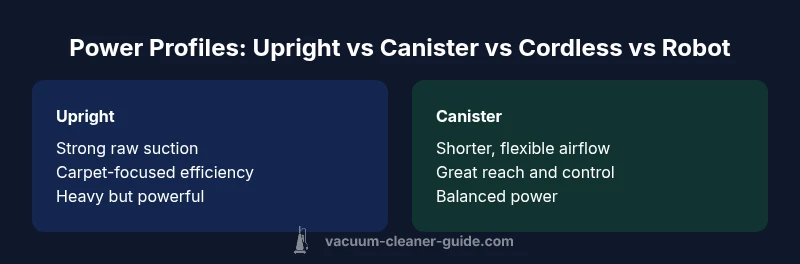
Each form factor tends to specialize in power delivery. Uprights usually combine strong suction with ergonomic handling and wide cleaning paths, making them top performers on carpets. Canisters offer flexible airflow and longer reach, useful for stairs and above-floor cleaning, while still delivering powerful suction in enclosed ducts. Cordless sticks trade some peak power for light weight and immediacy, ideal for quick spot-cleaning. Robot vacuums prioritize autonomy and efficiency, but their power is generally lower than traditional corded or cordless models when tackling dense debris.
Reading manufacturer specs without marketing fluff
To avoid overrating a product, translate marketing terms into practical tests. Look for statements about effective suction at the cleaning head, stable airflow, and sealed filtration. Compare how models perform when the dust cup is half full versus nearly full, and whether filters remain effective with hair-laden debris. If a spec sounds impressive but lacks real-world context, seek independent reviews or lab tests that measure surface-cleaning outcomes rather than a single metric. The better approach is to build a simple test yourself: run a vacuum on a standard carpet and a standard hard floor with a consistent debris load and observe the difference in pick-up and dust emission.
Real-world testing scenarios: pet hair and high-pile carpet
Pet owners frequently demand power that can manage hair without frequent clogs or tangles. This means evaluating how well a vacuum avoids hair wrap in the brush roll, how easily it maintains suction on high-pile carpet, and whether filters remain effective with hair-laden debris. A robust test uses a mix of hair strands and standard particles to simulate everyday messes. Also consider how the dust cup or bin capacity and the suction control affect performance over a longer cleaning session. In our experience at Vacuum Cleaner Guide, models with sealed filtration and easily accessible maintenance routines tend to stay powerful longer.
Maintenance and design choices that preserve peak power
Power begins to degrade when seals fail, filters clog, or brushes snag with hair. Regularly cleaning the brush roll, emptying the dust cup, and replacing filters as recommended preserve power. Check gaskets around the motor housing and the wand connection to minimize leaks that drop effective suction. A well-designed vacuum uses accessible filter compartments, clear indicators for maintenance, and durable motors that tolerate repeated heat cycles. For households with pets, maintaining seals and a high-quality filtration system is especially important for long-term performance.
How to choose: a decision framework for which vacuum cleaner is most powerful
Create a short list of your primary surfaces, debris types, and cleaning patterns. If carpet cleaning with heavy debris is the main job, prioritize models with strong nozzle suction, robust brush design, and sealed filtration. For hard floors and delicate materials, focus on airflow efficiency and dust-path integrity. If you want quick spot-cleaning for pet hair, cordless sticks with reliable battery life can be compelling. Finally, check independent reviews from trusted outlets and consider lab-tested AW figures and real-world performance to avoid vanity metrics. The aim is a balanced decision that aligns peak power with practical needs.
Authority sources and verification of claims
To verify claims about power and cleaning effectiveness, consult established sources such as Energy Star's vacuum pages, the U.S. Consumer Product Safety Commission guidance for consumer electronics safety, and independent testing from major publications. These references help confirm that higher numbers do not always translate to better everyday results and that power should be interpreted in the context of airflow, filtration, and usability. For readers who want to dig deeper, the following sources provide reliable benchmarks and policy context: Energy Star (energystar.gov), CPSC (cpsc.gov), and Consumer Reports testing on vacuum cleaners.
Feature Comparison
| Feature | Upright vacuum | Canister vacuum | Cordless (stick) vacuum | Robot vacuum |
|---|---|---|---|---|
| Suction Power (air watts) | very high | high | medium to high | low to medium |
| Filtration | sealed/HEPA-ready | sealed/HEPA-ready | HEPA-compatible | sealed/HEPA-like |
| Weight | heavy | average | light to moderate | light |
| Run-time / Autonomy | No | No | variable by battery, mid-range | No |
| Best For | Deep carpet cleaning and pet hair | Versatile reach and stairs | Quick cleans and portability | Autonomous cleaning and convenience |
Strengths
- Delivers the strongest, most consistent cleaning power for deep debris
- Excellent filtration and airflow in well-designed models
- Flexible form factors for multi-surface homes
- Long-term durability with quality components
- Clear performance signals when maintained properly
The Bad
- Can be heavy and bulky to maneuver and store
- Higher upfront cost for peak-power configurations
- Noise and ongoing maintenance requirements
- Cordless models trade peak power for runtime
Upright or canister vacuums win for raw power; cordless sticks are for portability with power trade-offs.
For maximum deep-cleaning power on carpets, uprights and canisters lead. Cordless sticks offer convenience but may not sustain peak suction for long sessions. Choose based on surface needs, maintenance tolerance, and desired convenience.
FAQ
What metric should I trust for power: air watts or watts?
Air watts is generally a better indicator of cleaning power because it combines airflow and pressure. Pure wattage ignores airflow and filtration. Look for models that maintain airflow through sealed paths and filters under load.
Air watts better predicts cleaning power than raw watts. Check airflow and seals to gauge real performance.
Are cordless vacuums as powerful as corded ones?
Corded vacuums often provide steadier and higher sustained suction. Cordless models have improved a lot, but power is limited by battery life and motor design. Choose based on whether you need quick spot-cleaning or long, uninterrupted clean sessions.
Corded vacuums typically have steadier suction. Cordless are great for quick cleans but run-time matters.
Is a HEPA filter necessary for a high-powered vacuum?
HEPA-sealed filtration reduces particle re-emission and is especially helpful for households with allergies or pets. Any powerful vacuum should offer a sealed filtration path or compatible HEPA filters to keep performance high and air clean.
HEPA filtration helps keep allergens in check and maintains air quality during powerful cleaning.
Do more expensive models always clean better?
Not always. Higher price often correlates with better build quality and filtration, but real-world performance depends on design, maintenance, and how well the machine fits your surfaces. Prioritize tested performance over sticker price.
Price isn’t everything—look for real-world performance data and fit for your surfaces.
How can I test a vacuum’s power at home?
Run a simple side-by-side test on the same carpet and hard floor setup with similar debris. Note how easily debris is picked up, how the suction holds as the dust cup fills, and whether the unit’s filtration remains effective. Use independent reviews for corroboration.
Test by comparing pickup on carpet and hard floor; watch for suction drop and filter performance.
The Essentials
- Define your surfaces and mess types before shopping
- Prioritize sealed filtration and sustained suction over peak watts
- Cordless models suit quick cleans but watch run-time
- Robot vacuums trade power for automation; don’t rely on them for deep cleaning
- Consult independent tests to verify real-world performance