Best Vacuum for Dry vs Wet: Which to Choose in 2026
A comprehensive buying guide comparing dry vacuums and wet-dry vacuums for homes with carpets, hard floors, occasional spills, and pets. Learn how to pick by airflow, filtration, maintenance, and budget in 2026.


Which vacuum cleaner is best for home dry or wet? For most homes, a dry vacuum with strong suction and sealed filtration handles daily dust, pet hair, and debris on carpets and hard floors. If you regularly deal with spills, damp messes, or occasional liquids, a dedicated wet-dry vacuum delivers safer, faster cleanup. This guide compares top options to help you decide.
Why this choice matters for homes with pets and mixed floors
For homeowners who juggle carpets, hardwood, and occasional spills, choosing between a dry vacuum and a wet-dry model is not a luxury—it affects daily ease, indoor air quality, and long-term maintenance. The Vacuum Cleaner Guide team emphasizes that your selection should reflect your real cleaning calendar: how often you vacuum, how much pet hair you collect, whether you deal with liquid messes, and how much space you have for storage. In practice, dry vacuums excel at routine dust and hair removal on most surfaces, while wet-dry vacuums are designed to handle damp messes, spills, and even light liquid cleanup without swapping machines. This distinction matters most for pet owners, families with kids, and homes with a mix of tile, laminate, and carpet. According to Vacuum Cleaner Guide Analysis, 2026, readers often underestimate the value of a model that can switch from dry to damp tasks without a second device. When you evaluate “which vacuum cleaner is best for home dry or wet,” consider your typical messes, surface types, and storage constraints.
In this piece, Vacuum Cleaner Guide uses evidence-based analysis to help you identify the minimal setup that covers your dry cleaning needs and, where appropriate, adds wet-dry capability without unnecessary complexity.
Dry vacuums vs. wet-dry vacuums: Core differences
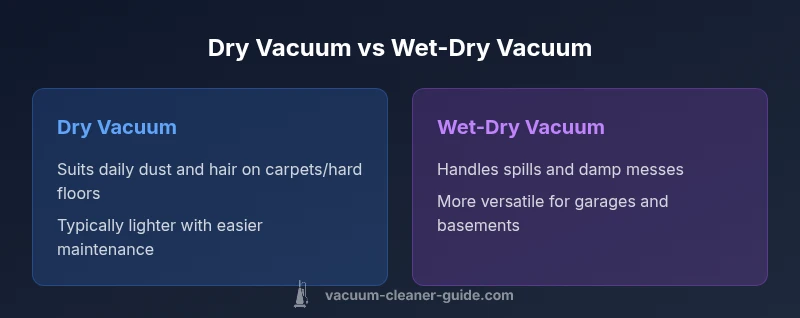
Dry vacuums are optimized for dry debris—dust, dirt, pet hair, and small particulate matter. They usually feature powerful suction, sealed filtration, and efficient brush tools to maximize carpet and hard-floor pickup. Wet-dry vacuums, by contrast, succeed at handling damp messes, spills, and even light liquids. They include a drain outlet, liquid-capable nozzles, and robust filtration that tolerates moisture without clogging. The key difference is not just what they pick up, but how they process what they pick up: dry vacuums prioritize airflow and dust filtration; wet-dry vacuums emphasize liquid containment and versatile nozzle options. When you are deciding between these two paths, assess how often liquids appear in your cleaning routine and how much you value one-device versatility over peak dry-cleaning performance.
How to match your needs to features
To choose intelligently, map your cleaning calendar against feature sets. Start with surface type: if your home has mostly hard floors with light to moderate carpet, a dry vacuum with strong suction and a high-quality HEPA or sealed filtration is usually sufficient. If you frequently deal with spills from kids, pets, or garage-adjacent spaces, a wet-dry model offers a safer, quicker way to remove liquids without swapping tools. Consider storage space: wet-dry vacuums tend to be bulkier, with larger tanks; if you live in a small apartment, a compact dry vacuum might be the better daily driver. Finally, factor maintenance: sealed filtration and easy brushroll cleaning reduce odor buildup and improve long-term performance. The goal is a practical balance between dry-cleaning efficiency and occasional wet cleanup capability that fits your home and budget.
Filtration & allergen control: why it matters
Filtration quality directly impacts indoor air quality, especially for pet owners and allergy sufferers. Dry vacuums with true HEPA filtration or sealed systems minimize dust leakage back into the room and improve capture of fine particles. Wet-dry vacuums often use moisture-tolerant filters and cyclone pre-filters to prevent moisture from saturating the main filter. If you have pets that shed heavily or family members with allergies, prioritize models with high-efficiency filtration and easy-to-clean replaceable parts. Regular maintenance—emptying the canister or tank, cleaning filters, and inspecting hoses—extends the life of the unit and preserves suction.
Suction power, airflow, and filtration ratings explained
Suction power is a useful shorthand, but it is not the whole story. Airflow (measured in cubic feet per minute) and filtration efficiency often determine real-world performance more accurately. A high suction number paired with poor filtration can move debris around or exhaust dust back into the room. Dry vacuums typically emphasize sustained airflow for deep-cleaning of carpets and dense piles, while wet-dry vacuums balance airflow with liquid-capable intake and robust filtration to prevent moisture from saturating the filter. When comparing models, look for: rated airflow, filter type (HEPA or sealed), ease of cleaning filters, and tank capacity.
Wet cleaning capabilities: when you need a wet-dry vacuum
Wet-dry vacuums shine in kitchens after spills, basements with damp messes, garages, and car interiors. They are designed to prevent mold and mildew by managing moisture effectively and often come with utility nozzles, squeegee tools, and a range of hoses that reach tight spaces. If your cleaning situations include spills or pet urine accidents, a wet-dry model may be the most efficient single-device solution. However, remember that not every wet-dry vacuum is equally capable of dry pickup on delicate surfaces, so evaluate both functions when you compare models.
Noise, size, and ergonomics: practical considerations
A vacuum’s noise level, weight, and handle design affect daily use. If you vacuum for long sessions, ergonomics—such as a swivel head, comfortable grip, and lightweight construction—reduces fatigue. Some models offer adjustable suction, programmable power modes, and quick-release dust canisters for easier emptying. Consider your living space: a compact, quiet model is better for apartments, while a heavier-duty unit with a bigger tank may be preferable in larger homes with pets. Longevity and warranty should also factor into the decision, especially for households where the unit is a frequent cleaning companion.
Budget ranges and value: price vs performance
Price is a practical guide to capabilities, but value comes from how well a vacuum matches your needs. Dry vacuums commonly sit at moderate price points with excellent durability and low maintenance. Wet-dry vacuums may command higher upfront costs but deliver versatility, reducing the need for separate tools or devices in many households. When evaluating price, consider long-term costs such as filter replacements, bag purchases, and repairability. A model that efficiently handles your most frequent messes will typically offer the best value, even if its upfront price is higher.
Brand and model landscape: what shoppers are asking
Across the market, homeowners ask for vacuums that balance power with reliability, especially models that excel at pet-hair pickup and carpet care while offering solid filtration. The best-worst questions frequently center on maintenance ease, filter availability, and how well a model handles liquid cleanup. In our reviews, we look for models with robust customer support, abundant replacement parts, and long-term reliability. Remember that a truly good purchase is not just about raw power—it’s about how well the machine integrates into your home routine and budget.
Cleaning scenarios: apartments, homes with pets, large households
Apartment dwellers typically benefit from compact, lightweight dry vacuums with maneuverable heads and quiet operation. Homes with pets require effective hair pickup and strong filtration to reduce dander. Large households benefit from higher tank capacity and more durable motors with easy maintenance schedules. If you expect multiple daily cleanups or plan to tackle garage spills, a wet-dry vacuum might reduce the number of devices you need to own. In short, tailor your choice to your space, your routines, and your tolerance for maintenance.
Safety and maintenance best practices
Always unplug before servicing any vacuum. For wet cleaning, ensure the unit is rated for moisture and never use the appliance to suction flammable liquids. Regularly inspect hoses and gaskets for wear, wash filters when recommended, and empty the tank before it reaches maximum capacity. Store the unit in a dry area and check the power cord for cracks. A well-maintained vacuum not only cleans more effectively but also lasts longer and stays safer to operate.
Common mistakes and how to avoid them
Avoid assuming a higher wattage means better cleaning; airflow is often more important. Don’t neglect filter maintenance; clogged filters reduce suction and can harbor odors. Resist the urge to use a wet-dry vacuum only for dry debris or vice versa—some models do not perform well in the opposite task. Read the manufacturer’s instructions, use appropriate tools and guards, and match the nozzle to the task. Finally, measure your storage space and pick a model that fits comfortably with your daily routine.
How to choose: a quick decision checklist
- List your typical cleaning tasks (dry dusting vs. spills vs. damp messes).- Check surface types (carpet, tile, hardwood) and whether you need a soft brush or stiff beater bar. - Prioritize filtration quality and ease of maintenance. - Assess tank capacity and portability. - Compare warranty and parts availability. - Set a realistic budget and weigh long-term value over upfront cost. A well-matched model will reduce time spent cleaning and provide better air quality for your family.
Making the final choice: a decision framework
Create a short scoring rubric: assign points for spill frequency, surface variety, and filtration needs. If spills are infrequent and surfaces are mostly dry, a dry vacuum with good filtration may score highest. If spills, damp messes, or garage cleanup are common, give additional weight to the wet-dry option. Finally, factor in storage space and budget, ensuring the final pick harmonizes with your household routine and long-term maintenance expectations.
Comparison
| Feature | Dry vacuum | Wet-dry vacuum |
|---|---|---|
| Suction power (dry debris) | Strong, optimized for dust and hair | Balanced for dry debris with liquid intake support |
| Liquid handling | Not designed for liquids; avoid liquids | Engineered for liquids and damp messes |
| Filtration | Sealed filtration, often HEPA-capable | Moisture-tolerant filtration; moisture management |
| Tank capacity | Moderate; focus on mobility | Higher capacity for longer cleanups |
| Weight & maneuverability | Typically lighter; easy to lift and carry | Bulker; requires more storage and space to maneuver |
| Best for | Daily dry cleaning on carpets/hard floors | Spills, damp messes, and multi-surface cleanup |
| Price range | Moderate upfront cost | Higher upfront cost for added capability |
Strengths
- One device can handle most dry cleaning tasks and some light maintenance
- Sealed filtration improves air quality and reduces allergens
- Wet-dry vacuums add versatility for spills and damp messes
- Long-term value when you need both dry and liquid cleanup
The Bad
- Dry vacuums are less capable with liquids and may require a separate tool for spills
- Wet-dry vacuums are heavier and bulkier, requiring more storage
- Maintenance can be more involved with filters and hoses
Dry vacuum is the default choice for everyday cleaning; wet-dry vacuum is best when spills are frequent.
Choose dry if you mainly clean dust and hair. Choose wet-dry if your home experiences spills or damp messes often. Consider filtration, maintenance, and space when deciding.
FAQ
What is the difference between a dry vacuum and a wet-dry vacuum?
A dry vacuum focuses on dry debris with strong suction and filtration, while a wet-dry vacuum is designed to pick up liquids and damp messes, typically with a more robust tank and moisture-tolerant filtration.
A dry vacuum cleans dry messes with great filtration; a wet-dry vacuum handles spills and damp messes, offering more versatility.
Can I use a dry vacuum to pick up wet spills?
No. Dry vacuums are not designed for liquids and attempting to vacuum spills can damage the motor and filtration system.
Avoid using a dry vacuum on wet spills; use a wet-dry unit or a dedicated liquid-cleaning tool.
Are HEPA filters worth it for pet owners?
HEPA filtration helps reduce airborne allergens and pet dander. If you or a family member has allergies, prioritize models with high-quality sealed filtration and easy maintenance.
Yes—HEPA filtration helps keep the air cleaner, especially for households with pets.
Do wet-dry vacuums work well on all floor types?
Most wet-dry vacuums handle multiple surfaces, but performance depends on nozzle choice and surface type. Check that the model includes attachments suitable for your floors.
They can clean many surfaces, but verify attachments fit your floors.
What should I look for when choosing a wet-dry vacuum?
Prioritize liquid pickup capability, tank size, filtration tolerance to moisture, nozzle options, and portability. Consider storage space and warranty as well.
Look for liquid pickup, tank size, moisture-friendly filtration, and good attachments.
Is price a good indicator of quality?
Price often reflects durability, filtration, and capacity, but a mid-range model with strong filtration and reliable parts can offer excellent value if it matches your needs.
Not always—the best value balances features, reliability, and maintenance cost for your home.
The Essentials
- Assess spill risk before shopping
- Prioritize filtration for pet owners and allergy sufferers
- Balance weight, storage, and budget against your cleaning needs
- A wet-dry vacuum adds versatility but may cost more and take space
- Regular maintenance extends lifespan and performance