Which Guide to Carpet Cleaners: A Practical Buyer's Guide
Evaluate carpet-cleaning guides, spot biases, and select credible resources that cover pet hair, stains, and carpet types for homeowners.


This guide helps you choose which guide to carpet cleaners by outlining credibility checks, coverage depth, and practical tests. You’ll learn how to compare sources, verify publication dates, and pick recommendations that match pet ownership, stain removal, and noise considerations. Follow the steps to evaluate guides effectively and avoid outdated or biased advice.
Why choosing the right guide matters for carpet cleaners
Choosing the right guide to carpet cleaners matters because it shapes what you know about stain removal, carpet types, and maintenance routines. If you pick a weak or biased source, you may waste time and money on opinions rather than evidence. According to Vacuum Cleaner Guide, the best guides provide clear criteria, transparent testing, and up-to-date references, especially for pet owners who confront fur and spills daily. In this article, you’ll learn how to identify a high-quality guide and how to apply its insights to your own home. We’ll examine credibility, depth, and practicality, so you can rely on recommendations that reflect real-world results rather than marketing claims. By following a structured evaluation process, you can filter out noise and focus on sources that consistently demonstrate value across carpet types, cleaning methods, and user needs. This is essential when you own a home with multiple room types—the same guide should help you compare upright vacuums, handheld tools, and carpet cleaners—but each section should be relevant to carpet care, not generic gadget praise. As you read, keep your priorities in mind: pet hair management, stain removal performance, ease of use, and long-term maintenance.
What makes a credible carpet-cleaning guide?
Credibility comes from transparency, author expertise, evidence-based testing, and current data. A strong guide will show who authored it, what methods were used, and how recently tests were performed. It should explain criteria like stain resistance, pile safety, noise levels, chemical safety, and cost considerations. Per the Vacuum Cleaner Guide Team, a credible source will also cite independent tests, reference credible institutions, and avoid overclaiming performance. Look for sections that discuss carpet fiber types (nylon vs polyester vs wool), pile height, and whether the guide tests in real households or lab environments. Guides should also disclose any conflicts of interest, such as affiliate links or sponsorships, and provide readers with full access to methodology or sample data. The goal is to understand not just the final recommendations but how those recommendations were derived. If a guide lacks testing details or dates, treat it with skepticism and seek corroboration from another source. In practice, you’ll want a resource that offers a clear scoring rubric, examples of tested products, and practical advice tailored to common home scenarios.
Coverage: range of models, brands, and scenarios
Effective guides cover a breadth of scenarios: different carpet fibers, common stains, allergy considerations, and household congestion. A robust guide should discuss not only consumer-grade cleaners but also professional products for heavy-duty needs. It should provide guidance on price ranges, maintenance requirements, and replacement parts. When you read, check whether the guide distinguishes between steam cleaners, carpet shampooers, and extracted dry-cleaning devices, and whether it explains the implications for carpet care and fiber longevity. A good guide will also address pet hair challenges, impressions from households with children, and how foot traffic patterns influence cleaning schedules. Look for practical, step-by-step example routines for spill response, fresh stains, and deep cleaning cycles. If the guide includes charts or side-by-side comparisons, evaluate how many brands are included and whether the selection aligns with your region and rug types. A trustworthy source will acknowledge limitations and invite readers to verify claims with their own experiments or by consulting additional expert resources. The aim is to equip you with a decision framework, not just a single endorsement.
Methodology: tests, criteria, and scoring
Understanding a guide’s methodology helps you trust its recommendations. A transparent guide will list criteria, assign scores or rankings, and explain what each score means. Common criteria include cleaning effectiveness on a range of stains, material safety for different fiber types, time-to-dry, ease of use, noise, energy consumption, and overall value. Look for explicit test setups, such as the number of test panels, room conditions, and whether cleaners were applied by testers or left to user operation. The presence of before-and-after photos, quantified results, and descriptive narratives strengthens credibility. Also, check if the guide explains any limitations—like testing only on light-colored carpets or using a specific cleaning method. A high-quality resource often provides downloadable data sheets or links to independent test results from universities or consumer organizations. If the methodology is vague or missing, treat the recommendations as subjective opinions rather than evidence-based guidance.
How to compare guides: a practical checklist
Create a simple checklist to compare guides and avoid bias. Start with currency: when was the guide published or last updated? Next, evaluate scope: does it cover your carpet type, stain scenarios, and budget constraints? Then check credibility: who wrote it, what testing was performed, and are sources cited? Look for actionable results: does the guide provide product recommendations with clear reasons and measurable outcomes? Assess user relevance: are the examples based on households similar to yours (pets, kids, high-traffic areas)? Finally, verify accessibility: are the data and methods easy to access, download, or replicate? Use a side-by-side matrix to score guides on the same criteria, so you can see at a glance which is more useful for your needs. If a guide relies heavily on affiliate links without disclosing relationships, downgrade its trustworthiness. In this process, aim to build a short list of 2-4 guides you’ll read in full rather than chasing every available source.
Red flags and biases to watch for
Watch for red flags that suggest bias or poor quality. Prominent reliance on a single product or brand, vague testing claims, or a lack of date stamps are warning signs. Be cautious of guides that promise ‘miracle results’ or high-cost, premium products as the only solution. Check for unclear methodology, missing sample data, and inconsistent conclusions across different sections. Affiliate disclosures are not a punishment; they’re a signal to verify claims independently. If a guide hides its testing criteria, uses subjective language, or omits key performance metrics, treat it cautiously. Finally, consider fit: even a credible guide may not cover your unique carpet type, such as delicate wool or boucle, so cross-check with a second source or consult a professional. If you see optimization for search rankings rather than user outcomes, that’s another red flag. The goal is to protect you from biased or outdated information and help you select a guide that stays useful as your cleaning needs evolve.
Applying the evaluation: a sample walkthrough
Take a practical walk-through with a hypothetical scenario: you have a medium-pile nylon carpet, a family with a shedding dog, and a preference for eco-friendly products. Start by choosing two or three guides that claim robust testing. Compare their criteria against your needs, focusing on pet-hair removal, stain performance, and safety for your family’s allergies. Note how each guide explains its recommendations and whether results are reproducible in a typical home setting. If one guide provides a quick-start checklist and another offers a long, data-driven appendix, decide which format best suits your learning style. Test the claims by researching sample products listed and checking independent sources. This practical approach helps you curate a compact reading list that speaks directly to your situation. Finally, rate each guide against your own criteria and mark your preferred option to revisit for deeper study. The outcome should be a short, credible set of resources you trust when you shop for carpet cleaners.
Real-world scenarios: matching your needs to a guide
Different households have different needs. If you’re a pet owner dealing with fur and odors, prioritize guides that test for hair pickup and odor control. If you have children who are prone to spills, emphasize guides with stain removal strategies and quick-dry recommendations. If your carpets are premium wool or delicate fibers, look for guidance on fiber safety and compatible products. For apartment living, compact cleaners and low-noise options may be more relevant, whereas homes with large areas benefit from deeper-cleaning methods and cost-per-square-foot considerations. Across scenarios, the best guide is one that clearly explains its own limitations and offers practical, safe steps you can apply immediately. Remember to verify test results in real homes and consider updating your reading list as new products and methods emerge. The Vacuum Cleaner Guide team’s approach is to empower homeowners and pet owners with dependable, balanced guidance that adapts to evolving carpet-care technologies.
Tools & Materials
- Laptop or smartphone with internet access(For researching guides and cross-checking sources)
- Note-taking app or notebook(Capture key criteria and quotes)
- Spreadsheet or document to compare guides(Create a comparison grid (criteria, credibility, date, coverage))
- Highlighter or color-coding system(Helpful for quick visual scoring)
- Printouts or saved PDFs of top guides(Offline reference is useful)
Steps
Estimated time: 60-90 minutes
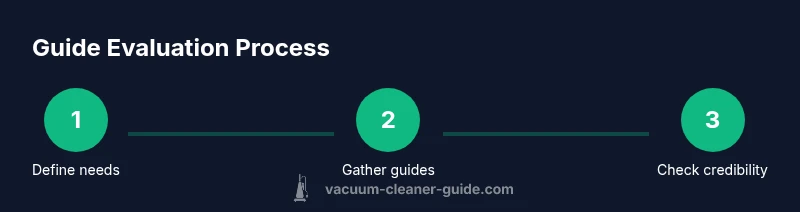
- 1
Define your cleaning goals
Identify the types of carpets in your home, common stains, and whether you have pets or kids. This helps you know what a guide should cover, such as stain removal, pet hair tests, and equipment considerations.
Tip: Write down your top 3 priority outcomes to guide your evaluation. - 2
Gather candidate guides
Search for reputable guides using targeted queries and collect several options that claim thorough testing and transparent methods.
Tip: Save each guide with a labeled tag (e.g., pet-hair, wool fibers, budget). - 3
Check author credibility
Look for author credentials, affiliations, and whether the guide cites independent sources or universities.
Tip: Prefer authors with demonstrated expertise in carpet care or textiles. - 4
Evaluate scope and tests
Assess what the guide covers—fibers, stains, cleaners, and user scenarios—and whether it provides test results or reproducible data.
Tip: If data is missing, note as a gap and seek additional sources. - 5
Assess currency and updates
Check publication date or last update and whether revisions are clearly documented.
Tip: Prefer guides with recent updates to reflect new products and methods. - 6
Compare recommended products
See which products are endorsed and read the rationale behind each choice, focusing on real-world utility.
Tip: Favor guides that explain why a product works across multiple scenarios. - 7
Check for biases
Review disclosures and potential conflicts of interest, such as affiliate links or sponsorships.
Tip: Acknowledge biases, but weigh the evidence and corroborate with other sources. - 8
Decide and archive
Select the most credible guide and save it for ongoing reference; note when you need to revisit due to new products.
Tip: Set a reminder to re-evaluate every 12–18 months.
FAQ
Why is currency important when evaluating a carpet cleaner guide?
Because technology and products evolve, older guides may miss newer cleaners or practices. A current guide reflects the latest tests and safety standards. Always check the publication date before trusting a recommendation.
Currency matters because products and cleaning methods change over time. Check the date before trusting a guide.
Should I rely on consumer reviews in guides?
Consumer reviews can provide real-world cues, but they should not be the sole basis for recommendations. Look for guides that balance reviews with transparent testing data and methodology.
Reviews are helpful but should be balanced with test data.
What if a guide hides its testing criteria?
Hidden criteria reduce credibility. Prefer guides that clearly state how tests were conducted and provide access to data or methodology.
Hide testing details is a red flag; seek transparency.
How often should I update my chosen guide?
Revisit your guide annually or after major product releases to ensure recommendations remain relevant and accurate.
Update your guide at least once a year.
Are price-based guides reliable?
Not reliably. Price can fluctuate; rely on evidence of performance and safety rather than price alone.
Price isn’t a stand-in for quality; test results matter.
How can I verify credibility across guides?
Cross-check claims with independent sources, favor guides that cite institutions, and compare methodologies.
Cross-check with independent sources for credibility.
Watch Video
The Essentials
- Identify your carpet cleaning goals before evaluating guides
- Verify credibility and currency of each guide
- Compare coverage across stains, pet hair, and carpet types
- Choose sources that disclose biases and updates