Corded vs Cordless Vacuum: A Comprehensive Buying Guide
Compare corded and cordless vacuum cleaners to choose the right type for homes with pets and hard floors. Learn power, runtime, weight, filtration, and maintenance in this analytical guide by Vacuum Cleaner Guide.


Corded vacuums deliver consistent peak suction and unlimited runtime, making them reliable for large spaces and deep-clean tasks. Cordless models offer unmatched maneuverability and quick cleanup, but they depend on battery life and charging time. The best choice hinges on your floor types, pet hair, cleaning habits, and tolerance for maintenance. In short, corded is power-focused supremacy, cordless is freedom with trade-offs.
The Core Trade-offs: Power, Runtime, and Usability
Choosing a vacuum cleaner with or without cord is not purely about convenience; it centers on how you clean and where you clean. According to Vacuum Cleaner Guide, homeowners should weigh three core axes when comparing corded and cordless models: sustained power and suction, runtime or battery life, and day-to-day usability. For many households, the phrase vacuum cleaner with or without cord anchors the decision. Corded vacuums provide consistent suction and essentially unlimited runtime, ideal for deep-clean sessions on carpets, dealing with pet hair, and large spaces because you won’t have to pause to recharge. They also typically support larger dust bins and more robust motors, delivering steady performance across rooms with minimal fatigue. Cordless vacuums, by contrast, excel in agility: lighter weight, no cord to manage, and the ability to clean stairs, cars, and tight spots without locating a power outlet. Yet battery chemistry means suction can wane as the charge depletes, and runtime depends on the model and battery size. The best choice balances power and convenience with your living space, cleaning schedule, and maintenance tolerance.
Key Differences at a Glance
- Corded: Continuous power, unlimited runtime, heavier build, higher potential suction over long sessions, typically lower upfront cost for similar performance.
- Cordless: Excellent maneuverability and quick cleanup, runtime limited by battery, lighter and easier to store, higher upfront cost for comparable suction, battery replacement is a potential long-term cost.
In homes with open floor plans and frequent deep-clean needs, corded vacuums tend to be the workhorse. In apartments or vehicles where reach and ease matter most, cordless vacuums shine. The decision is not binary—hybrid approaches or models with interchangeable batteries are increasingly common and worth considering for multi-use households.
Power and Suction: Do you need peak suction?
Power and suction are central to performance, especially on carpets and high-pile floors. Corded vacuums generally maintain strong, consistent suction as long as they are powered, which makes them dependable for heavy debris, pet hair, and dense fibers. When you read claims about suction, look for CFM and Pa specifications as a rough guide, but remember that real-world performance depends on attachments, nozzle design, and airflow management. Vacuum Cleaner Guide’s evaluation emphasizes that the best corded options remain surprisingly quiet for their class and deliver stable performance across multiple surface types. Cordless vacuums can match high-end corded suction in short bursts, but battery voltage and motor efficiency often cause a temporary dip in suction as the battery drains. For homes with mixed surfaces, a corded model can handle carpets with heavy soiling, while a cordless option handles rapid tidy-ups and stairs.
Runtime, Charging, and What It Means in Practice
Runtime is the defining constraint for cordless vacuums. Most models advertise 20–60 minutes of usable run time, but practical figures depend on power setting, motorized heads, and flooring type. In a typical scenario, a cordless vacuum handles quick pickups around the house, pet-related messes, and spot-cleaning without stopping, but you may need to recharge or swap batteries for larger cleaning tasks. Conversely, corded vacuums run uninterrupted, which makes them ideal for large rooms, whole-home cleans, or homes with multiple pets. If you opt for cordless, consider whether the charger is fast or whether you can buy an extra battery to extend runtime. Budget-conscious buyers should also factor in replacement batteries over the device’s lifetime. Vacuum Cleaner Guide notes that battery longevity and availability of spare parts influence long-term value just as much as the initial price.
Weight, Ergonomics, and Noise: Comfort matters for the long clean
Weight and balance matter for upper-body comfort, especially when cleaning stairs or overhead fixtures. Cordless vacuums are typically lighter, which reduces fatigue and enables easier maneuvering in tight corners. Corded models often feel heavier, but modern designs incorporate better balance and ergonomic handles. Noise is another factor; many modern units balance powerful suction with relatively low noise, but high-suction cordless models can be louder at peak, especially on high-pile carpet. In both cases, consider the handle ergonomics, wand length, and ease of changing attachments. If you have sensitive ears or children, look for models with sound-dampening features and adjustable power settings.
Filtration, Air Quality, and Maintenance: Keeping air clean
Filtration level matters for homes with pets, allergies, or small children. Both corded and cordless vacuums can feature true HEPA filtration or sealed systems that minimize particle leakage. When evaluating filtration, check the filter type, accessibility for cleaning, and whether the unit uses washable filters. Maintenance is a practical concern: corded vacuums have fewer moving parts that degrade over time, while cordless vacuums have battery packs that will eventually lose capacity and may require replacement. Regardless of type, regular maintenance—emptying the dustbin, cleaning filters, and inspecting brushes—extends performance and lifetime. Vacuum Cleaner Guide’s practical guidance stresses that longevity hinges on cleaning heads and seals and on replacing worn brushes promptly to sustain suction efficiency.
Use Case Scenarios: When to choose corded vs cordless
- Large homes with multiple rooms and thick carpets: a corded vacuum often provides steady power and continuous operation, reducing interruption and need for frequent emptying. Best for homes where you regularly deep-clean and have pets.
- Small to medium apartments, vehicles, and quick cleanups: a cordless model offers flexibility and fast response, especially for stairs and tight spaces. Look for models with strong brush design and quick-access attachments for upholstery and car interiors.
- Homes with a mix of floor types: consider a model with adaptive suction or two batteries to balance runtime and performance, or invest in a corded model for routine deep-clean sessions and a cordless for spot cleaning.
Budget, Value, and Long-Term Costs: Price considerations that matter
Initial price is only part of value. Corded vacuums typically have lower upfront costs for similar suction power and require less ongoing investment in batteries. Cordless vacuums command a premium for portability and convenience; battery replacement or upgrades can add to lifetime costs. When comparing models, factor in dustbin capacity, filter replacement frequency, and head/tloor attachment versatility. Vacuum Cleaner Guide’s cost guidance emphasizes not only sticker price but also the practical cost of ownership over 3–5 years, including parts and potential battery refresh cycles.
How to Extend the Life of Either Type: Practical maintenance tips
Regardless of cord or cordless design, routine maintenance extends lifespan. Regularly check seals and gaskets for leaks, clean filters on schedule, and remove hair from brush rolls to prevent clogging. For corded vacuums, inspect the power cord for wear and replace damaged sections. For cordless models, avoid deep discharges and store at moderate temperatures to preserve battery health. Periodically test suction and airflow to catch issues early, and schedule professional service if performance drops despite routine care.
Comparison
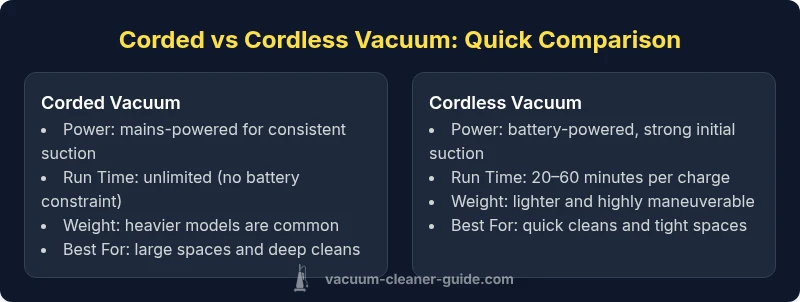
| Feature | Corded vacuum | Cordless vacuum |
|---|---|---|
| Power Source | Mains power with unlimited runtime | Rechargeable battery with finite runtime |
| Run Time | Essentially unlimited when plugged in | Typically 20–60 minutes per charge (model-dependent) |
| Suction Consistency | Stable, continuous suction during use | Strong suction initially, may drop as battery drains |
| Weight and Mobility | Heavier overall, more bulk in some designs | Lighter, easier to maneuver, especially on stairs |
| Maintenance | Fewer moving parts wear concerns; no battery replacement needed | Battery health, potential replacement, battery charging accessories |
| Best For | Large spaces, frequent deep cleaning, pet hair in bulk | Apartment living, quick cleans, vehicles, tight spaces |
| Price Range | $150–$500 (entry to mid-range corded models) | $150–$800 (varies with tech and battery capacity) |
Strengths
- Uninterrupted power for sustained cleaning
- Lower long-term maintenance costs without battery wear
- More durable motors and larger dustbins
- Stable performance across carpets and hard floors
The Bad
- Higher weight and less reach without a cord
- Limited accessibility to outlets may hinder certain layouts
- Less flexibility for vehicles or stairs without battery assistance
- Cord management can be cumbersome in cluttered spaces
Corded vacuums excel in power and endurance; cordless vacuums win on mobility and quick-clean convenience
Choose corded for large homes with deep-clean needs and fewer interruptions. Choose cordless for agility in tight spaces and rapid spot-cleaning. For multi-use households, a cordless model with a second battery or a hybrid approach can offer balanced performance.
FAQ
What is the main difference between corded and cordless vacuums?
The main difference lies in power source and runtime: corded vacuums draw continuous power for constant suction, while cordless vacuums rely on batteries, offering freedom of movement but with finite runtime. Your choice depends on space, cleaning frequency, and tolerance for charging.
The main difference is power source and runtime: corded vacuums run continuously, cordless depend on a battery, offering more freedom but less runtime.
Is a cordless vacuum suitable for whole-home cleaning?
Cordless vacuums can handle most everyday cleaning, but for large homes or heavy debris, you may need multiple batteries or regular recharging. If you have stairs and multiple rooms, a cordless model with strong suction and good attachments can be very effective.
Cordless works for everyday cleaning, but for large homes you might need extra batteries or frequent recharging.
Do corded vacuums work well on carpets?
Yes. Corded vacuums generally provide stable, strong suction that is well suited for carpeted surfaces, including high-pile varieties. Pair with a motorized brush head for optimal dirt and pet-hair removal.
Corded vacuums perform well on carpets, especially with a good motorized brush.
Which is cheaper to maintain, corded or cordless?
Corded vacuums usually have lower ongoing maintenance costs because there is no battery to replace over time. Cordless models may require battery replacements or upgrades and can incur higher long-term maintenance as warranties expire.
Corded is typically cheaper to maintain; cordless may need battery replacements later.
How should I choose between models for mixed surfaces?
Assess surface types, room size, and cleaning frequency. Look for models with adaptable suction, anti-tangle brushes, and easy-to-clean filters. If surfaces vary, consider a cordless option with effective floor heads and a corded backup for deep cleans.
For mixed surfaces, pick a model with adaptable suction and good attachments, or have both cordless and corded options.
Do cordless vacuums have HEPA filtration?
Many cordless vacuums offer HEPA-level filtration or sealed systems, but it varies by model. Check the specification and consider a unit with washable or replaceable HEPA filters if you have allergies or pets.
Some cordless vacuums have HEPA filtration; verify the model’s filtration specs before buying.
The Essentials
- Prioritize runtime and power for frequent deep-clean sessions
- Choose cordless for stairs, cars, and quick cleanups
- Consider an extra battery or a hybrid setup for mixed-use homes
- Factor maintenance costs beyond sticker price