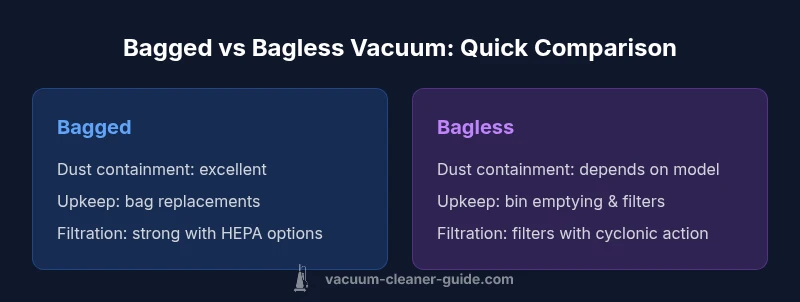
Bagged vs Bagless Vacuum: A Comprehensive 2026 Buying Guide
Compare bagged vs bagless vacuum cleaners for pets, allergies, and floors. Vacuum Cleaner Guide analyzes performance, maintenance, and cost in 2026 for smarter buying.


For many homeowners and pet owners, the choice between a vacuum cleaner with or without bag hinges on dust containment, maintenance, and running costs. In this comparison, bagged models excel at dust containment and allergen control, while bagless options offer lower upfront cost and easier disposal. Vacuum Cleaner Guide analyzes these trade-offs to help you decide which setup fits your home best.
Why the Bagged vs Bagless Debate Matters
When evaluating a vacuum cleaner with or without bag, the decision shapes how you manage dust, how often you perform maintenance, and how your cleaning routine feels day to day. For homeowners and especially pet owners, small differences in containment and disposal can translate into noticeable improvements in air quality and convenience. The Vacuum Cleaner Guide team has found that the bagged vs bagless choice is not about a single 'best' model, but about aligning the design with your home’s realities. If you live with frequent shedding, household allergies, or shared living spaces, bagged models often provide more predictable containment. If you prize simplicity and upfront price, bagless units can shine. This section sets up the core trade-offs, including how each system handles dust, how it impacts filtration, and what maintenance work looks like in practical terms. Remember: the best decision depends on your home, your routines, and your tolerance for handling bags or bins.
How Bagged Vacuum Cleaners Work
Bagged vacuum cleaners use replaceable bags to collect dust and debris. The bag acts as the primary containment chamber, often paired with a sealed filtration system that minimizes leakage when you empty or replace the bag. Because the bag seals dust inside, many users notice less exposure during disposal compared with bin-emptying in bagless designs. Bagged models come in various capacities and filter combinations, including options that feature HEPA-grade filtration for households with allergies or sensitive occupants. Maintenance typically involves checking the bag’s fullness and replacing it before performance drops, after which a quick replacement restores suction and airflow. A well-maintained bagged unit can feel simple and predictable, with fewer parts to monitor beyond the bag, belt, and a few filters.
How Bagless Vacuum Cleaners Work
Bagless vacuum cleaners operate by capturing dust in a bin or canister, then relying on filters to separate dust from the airflow. The advantage is clear: you don’t need to buy replacement bags, and disposal can be quicker and neater in many households. The trade-off is that emptying the bin can release dust back into the air if you don’t use the right technique or controls. Bagless designs often feature multiple filtration stages, including cyclonic action and HEPA options, but the performance depends on how well you maintain the filters and clear the bin. Modern bagless vacuums emphasize easy disassembly for cleaning, but you should be prepared to wipe down the interior and wash filters periodically to maintain peak suction.
Cost of Ownership and Running Costs
The long-term cost of ownership for a vacuum cleaner with or without bag depends on several factors beyond sticker price. Bagged vacuums incur ongoing bag replacements, which add to monthly expenses but can be predictable. Bagless models avoid bag costs, but you may pay for tune-ups, filters, and occasional bin replacements. Energy efficiency is another consideration: some bagless models emphasize energy-saving motors and advanced filtration to balance performance with power use. When evaluating total cost of ownership, consider your cleaning frequency, whether you have pets, and how often you expect to replace filters or parts. A well-chosen model can minimize both upfront and ongoing costs while supporting your cleaning routine.
Filtration and Allergens: What to Expect
Filtration quality is central to the bagged vs bagless decision, especially for allergy sufferers and pet owners. Bagged systems often pair with sealed bags and optional HEPA filters, enabling a high level of containment of fine particles. Bagless configurations rely on filters and a bin that must be emptied, which can expose occupants if not managed carefully. Vacuum Cleaner Guide analysis shows that for homes with persistent allergens, sealed systems and genuinely high-grade filters in either design tend to deliver the best results. When selecting a model, look for certifications such as HEPA or equivalent and confirm that the system remains sealed during routine use. Energy Star-rated vacuums can also help minimize power costs without sacrificing performance.
Maintenance and Cleaning: Bag Changes vs Bin Emptying
Maintenance habits differ between bagged and bagless designs. Bagged models require monitoring bag fullness and timely replacement, which is a straightforward task and often less messy. Some users find bag replacement to be a pleasant ritual of upkeep, as it minimizes dust circulation. Bagless models require regular bin emptying and filter cleaning or replacement. The bin can accumulate fine dust and fibers, especially in households with pets or heavy debris. It’s essential to practice good technique when emptying a bagless bin—turn off the machine, use the vacuum’s release mechanism, and empty over a trash can rather than the sink. Regardless of the design, periodic filter maintenance is key to sustaining suction and prolonging motor life.
Pet Hair and Car Settings
Pet hair presents a unique challenge for most vacuums. Bagged units with strong filtration and well-sealed bags tend to trap hair effectively, reducing the amount of hair that becomes airborne during disposal. Bagless vacuums can also perform well if equipped with powerful suction, motorized brush rolls designed for hair, and easy-clean filters. In vehicles and tight spaces, compact bagged or bagless models with flat-nozzle attachments can be especially handy. For homes with frequent shedding, consider models with a dedicated pet-hair mode, strong suction, and robust brush design to minimize hair wrap and maximize cleaning efficiency.
Floor Types and Suction Performance
Different floor types benefit from different suction strategies. Bagged vacuums with sealed filtration are often reliable across a range of surfaces, offering consistent suction and less dust leakage on hard floors and carpets alike. Bagless models can be just as capable when they include adjustable suction, a good beater brush, and a sealed filtration path. When dealing with mixed floors—hard surfaces plus area rugs or short-pile carpets—look for a vacuum with variable suction and an easily switchable brush roll. If you have thick carpets or high-pile rugs, a bagged system with strong containment may help keep debris from re-entering the room during disposal while preserving suction on dense fibers.
Noise, Ergonomics, and Design Trends
Noise levels and ergonomics play a practical role in daily use. Bagged vacuums sometimes feel quieter on average because of sealed containment and fewer turbulent air paths within the canister. Bagless designs can be equally ergonomic if they use efficient air routing and lightweight components. Design trends now emphasize lighter, more maneuverable bodies and intuitive controls—especially for homes with stair access or multi-room cleaning. For pet owners and allergy sufferers, ergonomics can also include easy-to-clean filters and tool storage that reduces the time spent searching for attachments. In summary, prioritize a model that feels stable in your hand, with a comfortable wand length and a well-behaved brush that minimizes hair tangling.
Real-World Buying Scenarios: How to Decide
Your decision should reflect daily life realities. If you primarily clean hard floors in a small space and prefer quick disposal, a bagless unit with a reliable filter might fit best. If you have shedding pets, a sealed bag system with HEPA filtration could offer superior dust containment and air quality. For allergy-prone households, consider a bagged vacuum with a truly sealed system and HEPA-grade filtration. Finally, factor noise, ongoing bag or filter costs, and the time you’re willing to dedicate to maintenance. In many cases, a hybrid approach—choosing a bagged model for main living areas and a compact bagless unit for car interiors—can deliver the best balance of convenience and performance, without locking you into one design forever.
Authoritative Sources and Practical Takeaways
If you want to dive deeper, several respected sources discuss dust containment, filtration, and best practices for vacuum maintenance. Energy Star’s guidance on vacuum efficiency provides a useful baseline for comparing power usage and filtration options. Consumer Reports offers practical buying guidance based on real-world testing and user feedback. The CDC’s resources on indoor air quality highlight why filtration and containment matter for health. Vacuum Cleaner Guide’s recommendations synthesize these perspectives to help you make an informed choice.
main topic query within the body blocks used for Wikidata lookup: bagged vacuum
Comparison
| Feature | Bagged Vacuum Cleaner | Bagless Vacuum Cleaner |
|---|---|---|
| Dust Containment | Excellent containment with bags | Bin-based containment; risk of dust release during emptying |
| Filtration Options | Sealed bag systems + optional HEPA | Filters and bin may require more frequent cleaning |
| Upfront Cost | Typically mid-range | Typically lower upfront |
| Running Costs | Bag replacements add ongoing cost | Lower ongoing costs, higher upfront price for some models |
| Maintenance Time | Bag replacement occurs less often; disposal is quick | Bin emptying and filter maintenance can be messier |
| Best For | Allergy-prone homes; precise dust control | Cost-conscious buyers; easy disposal |
Strengths
- Predictable dust containment when emptying
- Adaptable filtration options with sealed bags
- Simple maintenance routine for many bagged models
- Reliable performance with fewer moving parts on older designs
The Bad
- Ongoing cost for replacement bags
- Bag changes can be dusty and messy
- Not as convenient for quick pickups as some bagless models
- Limited design variety in older bagged models
Bagged vacuums are better for dust containment and filtration reliability; bagless vacuums win for upfront cost and disposal convenience.
If allergy control and consistent filtration matter most, choose a bagged model. For lower upfront cost and easier disposal, a bagless option can be ideal. Balance these factors with your floor types and cleaning frequency.
FAQ
What is the main difference between bagged and bagless vacuum cleaners?
Bagged vacuums trap dust in replaceable bags, often delivering better containment and filtration. Bagless vacuums use a bin and filters, with disposal requiring emptying and shaking out dust. The choice depends on containment needs and maintenance preferences.
Bagged vacuums trap dust in bags, which helps keep dust contained during disposal. Bagless vacuums dump dust into the trash, which can stir up dust if not handled carefully.
Are bagged vacuums better for pets?
Bagged vacuums with sealed systems and HEPA options are typically preferred for homes with pets due to stronger dust containment and filtration.
For homes with pets, bagged vacuums usually reduce pet dander exposure because the dust stays inside the bag until disposal.
Do bagless vacuums handle pet hair as well as bagged?
Performance varies by model. Some bagless vacuums with strong suction and efficient brushes can handle pet hair well, but bags tend to minimize dust exposure during emptying.
Some bagless models clean pet hair effectively, but bagged units often keep hair contained better during disposal.
Is bag replacement more expensive than buying bags?
Bag replacements add ongoing costs, which can add up over time. Bagless models avoid bag costs but may have higher upfront prices and regular filter maintenance.
Yes, bags cost money over time, but bagless may require more frequent filter care and sometimes a pricier upfront purchase.
What about allergens and filtration?
Sealed systems with HEPA filtration in either design help minimize allergen exposure. Bagged models often offer stronger containment, which benefits allergy-prone households.
HEPA or similar filtration helps with allergies in both designs, with bagged systems offering stronger containment overall.
Which is more convenient for a small apartment?
Bagless vacuums can be more convenient in small spaces due to no bag changes, but bin emptying may be frequent in high-traffic areas. Choose based on how often you clean and your tolerance for dust during disposal.
For small spaces, bagless can be easier to handle, but you might deal with more frequent emptying.
The Essentials
- Assess allergy risk to decide containment needs
- Weigh ongoing bag costs against upfront price
- Consider floor types and pet hair levels when choosing
- Check for sealed systems and HEPA filtration
- Plan for disposal and maintenance routines in daily life