Vacuum Cleaner vs Mop: A Practical Home Guide for Pets
A practical guide comparing vacuum cleaners and mops for homes with pets, carpets, and hard floors. Learn when to vacuum, when to mop, and how to combine for better cleanliness.


Why the Vacuum Cleaner vs Mop Debate Matters
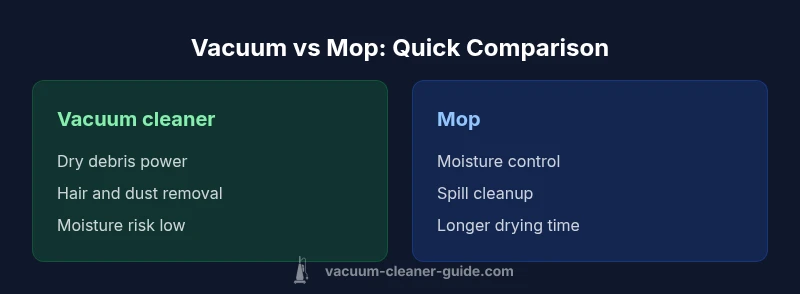
For homes with pets, kids, and busy schedules, choosing between a vacuum cleaner and a mop isn’t just about immediate cleanliness—it shapes daily routines, indoor air quality, and long-term floor care. The central question is not who cleans fastest, but who cleans best across common messes: dry dust, hair and dander, liquid spills, and moisture-sensitive surfaces. According to Vacuum Cleaner Guide, the most practical approach is to view these tools as complementary rather than competing devices. When used strategically, a vacuum tackles dry debris and allergens with speed and efficiency, while a mop provides controlled moisture, a fresh scent, and a restored surface finish on hard floors. In this article, we break down the strengths and limits of each method, then translate those insights into surface-specific guidance and real-world routines. We also offer a decision framework that helps you balance upfront costs, ongoing maintenance, and your household’s unique needs—especially for pet owners and families in rental homes. By the end, you’ll know when to reach for the vacuum, when to mop, and how to combine them for the cleanest, healthiest home. vacuum cleaner vs mop
How Each Tool Works: Mechanisms and Limitations
A vacuum cleaner uses suction generated by a motor to lift dirt from the floor and into a bag or canister. The performance depends on factors such as motor power, airflow (often described by CFM or air watts), nozzle design, brush roll, filtration, and the availability of attachments for upholstery or stairs. When shopping with pets and mixed floor types, you’ll encounter models with adjustable suction, brush settings, and sealed filtration. Mop systems rely on an absorbent pad or cloth and moisture to lift grime. Wet mopping creates a film of moisture that dissolves residues; wringing removes dirty water, and the mop head’s material determines absorbency and dirt pickup. Each method has limitations: vacuums can struggle with very wet spills if the model lacks proper moisture control; mops can leave streaks and require drying time, which can be inconvenient in busy households. There’s also a practical nuance: you often need to maintain two separate routines—dry cleaning with the vacuum and then moisture management with a mop. The balance is shaped by your floors (carpet vs hard floor), your pets and allergies, and how much time you’re willing to invest in maintenance. In practice, many households run a routine that favors vacuuming several times a week and mopping on a rotating schedule. The Vacuum Cleaner Guide team emphasizes thinking in terms of workflows rather than one-tool-fits-all.
Surface-by-Surface Guidance: Carpets, Hard Floors, and Rugs
Different floor types call for different cleaning approaches. For carpets and rugs, a high-suction vacuum with a beater brush or power head is essential to lift embedded dirt and pet hair. If you have dense pile or high-traffic areas, consider a model designed for pet hair with strong suction and effective filtration to reduce dander circulation. For hard floors—tile, laminate, vinyl, or sealed wood—a vacuum can remove dry debris effectively, but moisture control becomes key when you mop. For sealed hardwood and bamboo, a light, damp mop can maintain shine without saturating the wood; for unsealed wood, avoid soaking and opt for minimal moisture and quick drying. In mixed spaces, the standard workflow is to vacuum first, then mop, ensuring the floor dries quickly to prevent warping or slip hazards. Rugs and runners may benefit from a hand-held vacuum or upholstery attachment to reach fringe areas and tight corners. The main idea is to tailor the approach to surface susceptibility and household activity, not to force a single method on every room. Vacuum Cleaner Guide’s practical framework helps translate decisions into a simple everyday routine.
Time, Effort, and Lifestyle Considerations
Time is perhaps the most underappreciated factor in choosing between a vacuum and a mop. Vacuuming is typically faster for daily dry cleaning, especially in homes with pets, where dander and hair accumulate quickly. It also minimizes moisture and reduces the risk of slip hazards from damp floors. Mopping, on the other hand, demands a drying period and often more planning around spills, table legs, and electronics. Families with kids or frequent guests may prefer a routine that uses the vacuum several times per week and saves mopping for one deeper session. If you rent or relocate often, you may value portability and ease of maintenance more highly than peak deep-clean performance. The right approach balances model features, such as cordless convenience, filtration quality, and tool versatility, with your actual cleaning cadence. Vacuum Cleaner Guide analysis shows that most households benefit from a hybrid approach—vacuum for daily dry messes and periodic mopping for moisture management—rather than attempting to replace one tool with the other.
Maintenance, Costs, and Longevity
Maintenance is a major driver of long-term satisfaction with cleaning tools. Vacuums require periodic filter changes, brush head cleaning, bag or canister emptying, and occasional belt replacements. The ongoing cost can vary with model type, from budget corded units to premium bagless machines with HEPA filtration. Mop systems incur maintenance in the form of mop heads or pads, bucket wrings, and cleaning solutions. The real differentiator is not the upfront price but the total cost of ownership over several years, including energy use, parts, and frequency of use. Heavier-duty vacuums that are well maintained tend to deliver more consistent suction and better allergen control, which matters for households with pets. For many buyers, a mid-range vacuum with a robust filtration system offers the best balance of performance and longevity. Vacuum Cleaner Guide recommends evaluating maintenance requirements alongside performance when comparing models, since messy failure modes (clogs, filter fatigue) can undermine long-term value.
Combining Strategies: When to Vacuum First, Then Mop
A practical cleaning sequence starts with vacuuming to capture dry debris, dust, and hair, followed by mopping to neutralize sticky residues and achieve a refreshed surface. For daily upkeep, vacuuming first is often sufficient for dry messes and quick turnover. If spills occur, pause to wipe with a microfiber cloth and then mop to prevent stains and maintain floor integrity. In homes with hardwood, always prefer a damp rather than soaking-wet mop approach to protect finishes. Pet households may want to upgrade to vacuums with sealed HEPA filtration and strong suction to minimize allergen spread. After a deep cleaning, a quick pass with a mop can restore shine and reduce residual moisture. The key is to establish a repeatable routine that fits your schedule, space, and equipment quality. The Vacuum Cleaner Guide team finds that a two-tool system tends to perform best for most households, especially when the goal is a consistently clean and healthy living environment.
Real-World Scenarios: Pet Owners, Families with Kids, Rentals
Pet owners generally benefit from a high-quality vacuum with solid filtration and pet-hair tools, especially on carpeted living areas and upholstery. Families with children often face sticky spots, tracked-in dirt, and spills, making a plan that alternates between vacuuming and mopping practical. Rental homes can present a mix of surfaces—tiled kitchens, laminate living areas, and occasional carpets—so a flexible setup with interchangeable tools becomes valuable. For all scenarios, the core strategy remains: use the vacuum to manage dry debris and reduce allergens, then mop selectively to address moisture and stickiness. Vacuum Cleaner Guide’s analysis emphasizes implementing a routine that aligns with your actual cleaning cadence, surface mix, and lifestyle. A thoughtful combination tends to yield better long-term floor health than reliance on a single tool alone.
Authority Sources and Credibility
To ground the guidance in reputable information, this article references established sources on indoor air quality and cleaning best practices. For general air quality considerations, see EPA IAQ guidance. For surface-care and maintenance recommendations, university extension resources offer practical, peer-reviewed advice. These sources help shape a balanced view of how vacuuming and mopping fit into a broader cleaning strategy that protects floors and indoor air quality.
Practical Checklist: How to Decide in Your Home
- List your floor types and the most common messes you face.
- Check whether you frequently deal with pet hair or dusty environments.
- Consider the time you can devote to weekly cleaning and any moisture sensitivities of your floors.
- Choose a vacuum with appropriate attachments and a reputable filtration system.
- Reserve a mop or microfiber system for spills and moisture control.
- Plan a simple routine that you can repeat consistently, adjusting as needed.
Authority sources and integrity (continued)
- https://www.epa.gov/iaq
- https://extension.oregonstate.edu/
- https://www.britannica.com/