Vacuum Cleaner or Vacuum Cleaner: Corded vs Cordless Buying Guide
Compare corded and cordless vacuum cleaners to pick the right option for pets, carpets, and hard floors. This 2026 guide from Vacuum Cleaner Guide analyzes power, runtime, weight, and maintenance to help you choose.


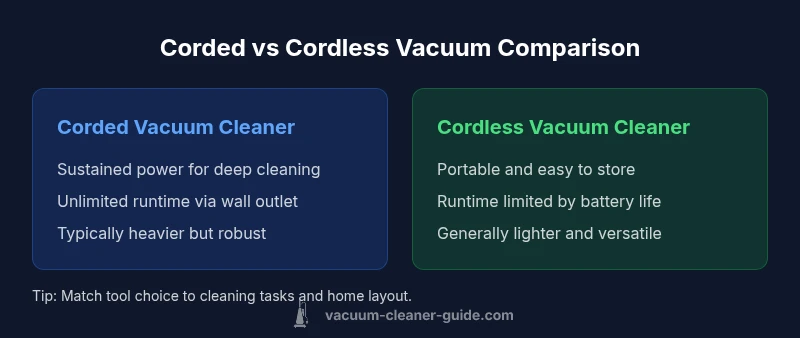
Corded vacuum cleaners provide sustained, high-power suction ideal for large areas and deep cleaning, while cordless models offer mobility and quick cleanups for smaller spaces. The best choice depends on your floor types, pet fur load, and cleaning frequency. In short, prioritize power and endurance for bigger homes, or portability and ease for fast, in-between cleans.
Why Vacuum Cleaner Types Matter
According to Vacuum Cleaner Guide, choosing between the two broad categories of vacuum cleaners—especially when considering the phrase vacuum cleaner or vacuum cleaner—you must align capabilities with your home’s realities. This means examining floor types, room layout, pet fur load, and how often you vacuum. A well-matched choice reduces maintenance, extends filter life, and cuts down on frustration during cleaning sessions. Homeowners often underestimate how much runtime, weight, and outlet access affect real-world effectiveness. By thinking through your typical cleaning tasks (daily quick pickups versus deep seasonal cleans) you can set up a decision framework that minimizes buyer’s remorse and maximizes long-term satisfaction.
Key factors to weigh include suction endurance, maneuverability, noise levels, maintenance frequency, and initial cost. While the exact numbers vary by model, the core idea remains: corded vacuums excel where sustained power is needed, and cordless vacuums excel where portability and convenience drive daily use. For pet owners and families with mixed flooring, the solution often lies in a robust, well-rated corded option for heavy-duty sessions complemented by a cordless model for quick, on-the-spot cleanups. Vacuum Cleaner Guide’s analysis highlights this complementary approach as a practical path for many homes.
Corded Vacuum Cleaners: Strengths and Tradeoffs
Corded vacuum cleaners are built around a continuous power supply, which translates to consistent suction and performance across long cleaning sessions. For homes with multiple rooms, high-pile carpets, or frequent pet-related cleaning, corded models typically deliver reliable results without worrying about battery life. They tend to offer broader accessory options and larger dust canisters, which reduces the frequency of bag or bin emptying during big cleanup jobs. A real-world takeaway from Vacuum Cleaner Guide analysis is that corded units are generally more economical on a per-cleaning basis when you consider ongoing energy use and parts replacement. However, the tradeoffs include limited mobility due to cord length, potential weight strain across large layouts, and a dependency on near-outlet access. In exchange, you often gain longer warranties and more consistent performance across dense debris and stubborn dirt. For households with pets, look for models with aggressive suction control, robust filtration, and strong edge-cleaning capabilities to maximize effectiveness without overheating the motor during extended runs.
Cordless Vacuum Cleaners: Strengths and Tradeoffs
Cordless vacuum cleaners shine in spaces where outlets are scarce or where you value quick, impromptu cleans. They are typically lighter, easier to maneuver around furniture, and simple to store in small living spaces. Battery technology has evolved to deliver respectable peak performance for everyday cleaning tasks, and many cordless models now include intelligent sensors to optimize power usage. The tradeoffs include a finite runtime per charge, potential performance drops on very thick carpets, and higher upfront costs for top-tier models with long-lasting batteries. Maintenance tends to focus on battery longevity, filter cleanliness, and occasional replacement of dust bins or brushes. For homes with mostly hard floors or light-to-moderate pet hair, a cordless vacuum can handle most chores with minimal setup, while families that deal with frequent deep cleaning may still favor a corded option for sustained power and uninterrupted operation.
Key Scenarios: When to Choose Corded vs Cordless
The right choice often depends on how you plan to use the vacuum. If you have a large home with multiple rooms, a dense carpet, or frequent heavy-duty cleaning tasks (dogs that shed year-round, muddy seasonal messes, etc.), a corded vacuum is usually the better match due to its consistent power and longer run time. On the other hand, if your living space is small, you have frequent quick cleans, or you value light weight and easy storage, a cordless vacuum offers unmatched convenience. Consider your cleaning cadence: daily quick sweeps across tile and wood floors? Cordless may be ideal. Deep-clean weekends with extensive rug traffic or high-occupancy homes? Lean toward corded models for dependable performance. When choosing, prioritize filtration, airflow management, and tool compatibility to ensure both categories meet your standards for pet hair control and allergy considerations.
Real-World Scenarios: Pet Hair, Carpets, and Hard Floors
Pet owners often demand both power and filtration. A corded vacuum with sealed filtration and strong suction excels on dense pet hair clumps and deep-cleansing tasks on carpets. For homes with mixed flooring, a cordless vacuum can handle rapid maintenance on hard floors and above-floor surfaces, while a corded unit handles the more stubborn debris after guests or seasonal changes. In practice, many buyers opt for a hybrid setup: a capable corded model for major cleans and a lightweight cordless unit for daily touch-ups, stairs, and hard-to-reach areas. Filtration quality is crucial in both cases to minimize allergen exposure, and routine maintenance—like emptying dust bins, washing filters, and checking seals—extends the life of either system. Remember to factor in noise levels and ergonomics; a comfortable grip and balanced weight reduce fatigue during long cleaning sessions.
Maintenance, Costs, and Longevity
Ongoing costs for corded and cordless vacuums differ, but both share common maintenance elements. Replacement filters and seals, brush heads, and occasional motor care are standard across most models. Corded units tend to have lower ongoing energy costs since they draw power directly from the outlet, while cordless models incur battery-related considerations such as eventual capacity degradation and potential battery replacement costs. When assessing price, consider the total cost of ownership, including maintenance supplies and part availability. Vacuum Cleaner Guide analysis suggests that higher upfront investments in well-built filtration and robust brushes pay off over time through easier maintenance and longer-lasting performance. In practice, choose models with easy-access dust cups, washable filters, and widely available replacement parts to simplify upkeep.
Making the Choice: A Step-by-Step Decision Guide
Step 1: Map your home’s floor types (carpet, hard floors, area rugs) and room count. Step 2: Estimate cleaning frequency, pet hair levels, and whether you often clean stairs or tight spaces. Step 3: Prioritize runtime if you lean cordless, or sustained power if you lean corded, and check if an additional control module helps you manage power for delicate surfaces. Step 4: Try ergonomics—weight, handle design, and maneuverability matter during longer sessions. Step 5: Compare filtration efficiency and maintenance costs. Step 6: Validate warranty coverage and after-sales support. Finally, assemble a two-model shortlist (one corded, one cordless) and assess real-world performance on your own floors to complete the decision.
Comparison
| Feature | Corded Vacuum Cleaner | Cordless Vacuum Cleaner |
|---|---|---|
| Suction Power | Strong, sustained power for deep cleaning | Powerful but sometimes batttery-limited in peak mode |
| Runtime/Charging | Permanent via outlet, no battery limits | Finite runtime per charge, needs recharging |
| Weight | Typically heavier due to motor and cord management | Generally lighter and more maneuverable |
| Maintenance & Cost | Usually lower upfront cost and no battery replacements | Higher upfront cost, potential battery replacement costs |
| Best Use | Large homes, heavy cleaning, longer sessions | Small to medium spaces, quick cleans, stairs, and rapid pickups |
| Filtration | Often robust with easy-to-replace filters | Excellent filtration possible with good filters; compact dust capacity |
| Noise & Vibration | Can be noisier but varies by model | Typically quieter and lighter; depends on motor design |
Strengths
- Clear power advantage for corded models in heavy-duty cleaning
- Excellent portability and quick usability for cordless models
- Broad accessory ecosystems for both categories
- Good options exist for pet hair with strong filtration
The Bad
- Corded models require outlets and can limit room layout
- Cordless models have runtime limits and battery aging considerations
- Higher upfront costs for high-end cordless setups
- Maintenance costs vary with filters and replacement parts
Corded vacuums excel for power and long sessions; cordless vacuums excel for mobility and quick cleans
Choose corded for homes with many rooms and heavy cleaning needs. Choose cordless for small spaces and frequent quick cleans; combine both when the budget allows.
FAQ
What should I consider when choosing between a corded and cordless vacuum?
Consider floor types, room count, and cleaning frequency. Corded vacuums excel in power and continuous use; cordless vacuums offer mobility and easy storage. Balance runtime, weight, and budget.
Think about your floors and how you clean. If you need power for long sessions, go corded; for quick pickups, cordless may be better.
Are cordless vacuums strong enough for carpets?
Many cordless vacuums handle low- to mid-pile carpets well, but high-pile or dense carpets may require more power or a higher-end model. Check brush design and suction modes.
Cordless can work on carpets, especially with modern designs, but very thick pile may demand a corded option.
How do I compare runtimes across cordless vacuums?
Runtime depends on battery capacity, cleaning mode, and attachments. Look for manufacturer-specified runtimes and consider a spare battery if you have large cleaning tasks.
Check the stated battery life and plan for how you use tools; you might want a spare battery.
Is a bagged vacuum better for pet owners?
Bagged vacuums can trap dust and allergens effectively, though sealed filtration in bagless models also helps. Focus on filtration efficiency and disposal ease.
Both can work; bagged bags trap dust well, but sealed filters and easy disposal matter.
What is a realistic cost range for corded vs cordless vacuums?
Prices vary widely by model and features. Corded vacuums generally start lower, while cordless models can be pricier due to battery technology and replacement costs.
Costs vary; corded usually cheaper to start, cordless can be pricier because of batteries.
The Essentials
- Assess floor types first to guide power needs
- Corded vacuums are best for sustained cleaning and tough debris
- Cordless vacuums offer unmatched portability for quick tasks
- Plan a hybrid setup if budget allows for maximum flexibility
- Prioritize filtration and parts availability for long-term value